23. Sept. 26102 min read
Published by Vaapad Capital
Published: 23. Sept. 26. Author, if named: in the article. Research does not establish contemporaneous trade rationale.
Published by Vaapad Capital
Published: 23. Sept. 26. Author, if named: in the article. Research does not establish contemporaneous trade rationale.
How gold-backed money could carry a civilisation to abundance – and why it may lose its monetary role for basic provision along the way
Today, we almost automatically see economic growth as a world of rising numbers. Gross domestic product should grow; wages and company revenues should rise. Many property owners regard higher property prices as a sign of their success. The money supply and the volume of credit expand, and in many currency areas monetary policy aims for a moderate increase in the general price level. In this environment, it is difficult to imagine progress without larger nominal amounts.
Yet nominal growth is not the same as real progress. A society becomes more prosperous when it can produce more and better goods with less effort, treat diseases more effectively, supply energy more reliably and open up more opportunities for people. None of these achievements logically requires an increase in the number of its units of account.
Perhaps progress could therefore look quite different under another monetary order: wages stay the same, prices fall, purchasing power rises. This is not a forecast for every occupation or every good. It is the starting point of a thought experiment: what would happen if immediately available money were fully backed by gold, while investments were financed through capital explicitly committed for that purpose and openly shared risk?
The order of causes matters here. Technology is the engine of abundance; gold is the bridge to it. Machines, energy and knowledge produce the additional goods, not the monetary metal. The monetary order, however, decides whether that engine gets fuel: whether savings keep their purchasing power and can therefore flow into real capital formation, whether investments are measured against an honest alternative, whether debt stays limited and whether the same monetary rules apply to everyone. This Fieldnote argues that full gold backing meets these four conditions better than a fiat order – and that it therefore carries the path to abundance better.
Such an order could connect several feedback mechanisms. Productivity increases the purchasing power of savings. Greater gold purchasing power encourages additional mining. New production slows further appreciation. Technology improves both the production of goods and access to the monetary metal. These relationships could perform some of the coordination that discretionary monetary policy provides today.
The thesis of this Fieldnote is not that money abolishes itself. It is this: gold loses its monetary role for basic provision because its scarcity is coupled to the technical capabilities of civilisation. The same processes that make food, energy and housing cheaper also open up deeper deposits and poorer ores. As the world grows richer, the metal can gradually withdraw from everyday life. For the scarcities that remain – land in desirable places, unique goods, attention, lifetime – money persists.
The Fieldnote distinguishes three levels: historical experience with currencies tied to gold; economic relationships that hold under specified assumptions; and a long-term scenario in which automation and better energy provision greatly reduce material scarcity. The reservations that attach to every link of this chain are collected in a chapter of their own, so that the argument can run undivided in the remaining chapters.
Gold would not be an object of eternal reverence here. Its task would be to coordinate a world in which resources, goods and time remain scarce.
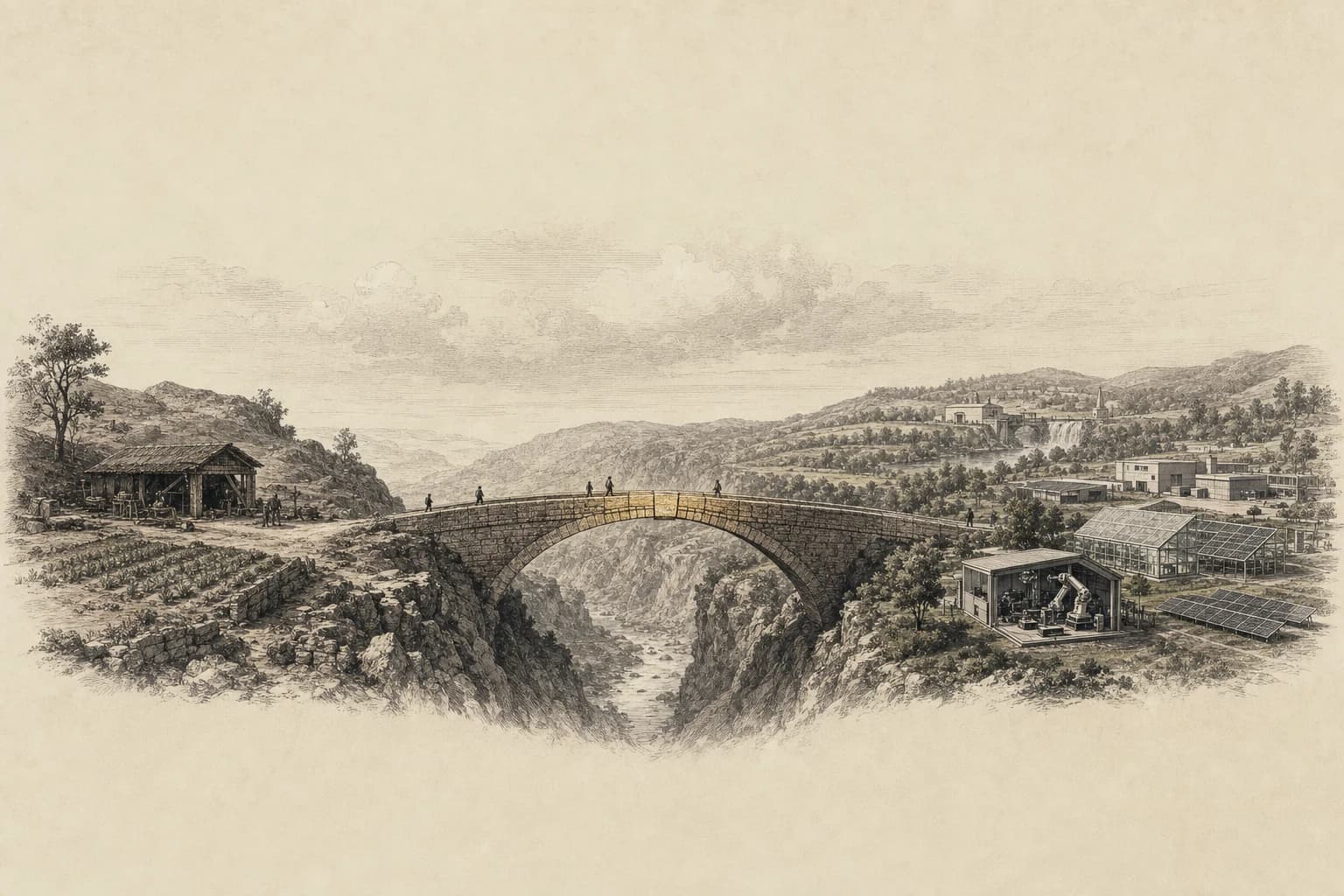
Gold would be the technological bridge between scarcity and abundance.
Such a bridge would succeed if it helped people lead better lives. Its value would be measured by what it enables—even a world in which money is needed for fewer and fewer things.
Money is not a law of nature. It is a human technology through which we organise exchange and express claims on scarce resources. Food, tools, raw materials, housing and human working time are not available in unlimited quantities. A generally accepted medium of exchange makes their allocation easier: someone who wants to buy bread does not have to offer the baker exactly what the baker happens to need. Money separates one's own sale from a later purchase.
Gold offers an unusual combination of physical properties for this purpose. It is scarce, durable, divisible, portable and interchangeable at the same fineness. Its authenticity can be tested; producing it requires effort. Above all, nobody can bring additional gold into existence by decree. Whatever enters circulation as money must first be found, extracted and processed.
In its simplest form, this money needs no issuer: a gold coin is not a promise of gold. It is the gold. Anyone who directly owns genuine metal holds no claim against a debtor. Payment by handing it over can therefore be completed without a promise of later repayment. Storage, theft and authentication remain practical concerns. The counterparty risk of a promise to pay arises again only when ownership of the metal itself is replaced by a claim on someone else's custody of it.
The classical international gold standard, which became established in the late 19th century and broke down in 1914, was not a universal system of one hundred per cent reserves. Currencies were redeemable in gold at fixed parities. Yet banknotes, bank deposits and an extensive credit system existed on top of this. Claims payable on demand could exceed the available gold reserves. A link to gold therefore did not mean that everyone could withdraw all their money at the same time.
One concrete example is the original Federal Reserve Act of 1913. It required gold reserves of at least 40 per cent against Federal Reserve Notes, and reserves of at least 35 per cent in gold or lawful money against deposits at the Reserve Banks. These rules applied to specific central bank liabilities, not to one hundred per cent backing of all bank deposits. Federal Reserve Act, § 16
The thought experiment in this Fieldnote begins with a stricter requirement: all claims issued as immediately available money must be fully backed by specifically allocated physical gold and redeemable for it. A payment provider would not be allowed to promise the same ounce to several customers simultaneously as a balance available at any time. Merely backing the central bank's monetary base with gold would be insufficient if commercial banks could then create additional unbacked means of payment payable on demand.
Credit would remain possible. Anyone lending gold for an agreed period exchanges its present availability for a claim to future repayment. That claim carries credit risk; it is not a gold balance redeemable at any time. Full reserves therefore do not mean securing every debt with gold, but clearly separating payment custody from financing.
A modern global industrial economy with this consistent architecture has not yet existed. The subject is an alternative system and an examination of its mechanisms, not a return to an ideal once realised in history.
Consider a highly simplified economy with 100 monetary units and annual production of 100 identical units of goods. Each monetary unit is spent once during the period under consideration. The average price is then one monetary unit per good. Better machinery, science, energy and organisation subsequently double production to 200 units of goods. The money supply remains at 100.
If the frequency of spending and the other assumptions remain unchanged, the average price can halve. One monetary unit now buys two goods. Real production has grown by 100 per cent even though no additional money has been created. Economic growth appears as rising purchasing power.
The relationship can be expressed as M × V = P × Y: money supply multiplied by velocity of circulation equals the price level multiplied by real output. This equation describes a relationship; it guarantees neither a constant velocity of circulation nor a smooth adjustment of prices. People may hold larger cash balances, payment practices change and prices respond at different speeds.
The fundamental point remains: more real goods do not necessarily require more nominal monetary units. Prosperity arises from greater and better production. Money makes that progress measurable in accounts; it does not create it.
When consumer prices rise persistently, a wage that remains unchanged for twenty years loses purchasing power. We therefore associate material progress almost automatically with a higher number on the payslip. In an economy with prices falling over the long term, the same progress could become visible in a different way.
An employee might, for example, earn 10 grams of gold per month for twenty years. If available real production per person doubles during that period, the money supply grows significantly more slowly and the gains are reflected accordingly in that person's basket of goods, those 10 grams could eventually buy twice as many goods. The nominal wage would have remained the same; the real standard of living would have improved substantially.
Nevertheless, the example shifts the measure of progress: how much of a standard of living can a person buy with one hour of work? That question measures economic progress more accurately than the mere size of nominal income.
Suppose a new agricultural technology halves the production cost of a food product. Some of the benefit can reach the buyer directly through a lower price. The buyer need neither own shares in the producer nor first negotiate a wage increase. The route from progress to living standards can be much shorter than the chain of higher corporate profits, rising share prices and subsequent income gains.
The same principle applies to energy, transport, machinery, housing construction, medicine, communications and manufacturing. Wherever more can be achieved with less real effort, scope for lower prices opens up. Whether that scope is used depends substantially on competition. Monopolies, scarce land, closed markets or other bottlenecks can leave cost advantages with producers or owners.
Under effective competition, rising purchasing power could be understood as a monetary productivity dividend: even someone who simply holds money can buy more with that balance. It reaches money holders according to their balances and consumption, however, rather than as an equal amount for every person.
Gold does not create this dividend. Machinery, knowledge and work create the additional goods. In this model, the monetary order would make that progress visible through their falling prices.
When the price level rises, money that earns no interest loses purchasing power. This gives savers a recurring task: earn, set aside, invest and generate a sufficient return to preserve the value of what they have earned. Someone with financial knowledge, access to capital markets, existing assets or cheap credit can often handle this task more easily than someone whose room for manoeuvre is limited to a small bank balance.
In the system examined here, simple saving would once again be a viable long-term strategy. If real production grows by two per cent while the quantity of gold available for monetary use grows more slowly, an unchanged velocity of circulation leaves room for falling prices. The relationship between money supply, money demand and the production of goods determines how much of that reaches the saver.
An employee would then not necessarily have to take capital market risks to preserve purchasing power already earned. They could invest because they see a business opportunity or want to support a project. Simply holding money would be a serious alternative.
The aim is fundamental: saving should have a dependable place in planning one's life, without requiring a perpetual race against the loss of purchasing power.
Money works because people expect others to continue accepting it. Its usefulness therefore rests on a combination of experience, social acceptance, payment infrastructure and reliable rules. Purchasing power that is preserved or increases over the long term could strengthen this combination.
Users would learn from experience: if I store part of my work in this money, the economy's progress can increase its purchasing power. This could encourage people to save, enter into longer-term contracts in the same unit and continue accepting it when selling goods or services. Productivity, purchasing power, confidence and adoption could thus support one another.
This is a monetary network effect. The more people use the money, the more useful it becomes to each individual; the more reliably it proves itself, the more likely its use is to persist. Its ability to hold value would perform some of the work that otherwise has to be done through institutional credibility.
If money can buy more tomorrow, why spend any today? The objection identifies a real incentive: expected price declines make waiting more attractive. Some purchases would happen later; some less compelling offers would find no buyer. To the extent that this reduces unnecessary consumption and makes decisions more considered, it serves the model's intention.
People save, however, so that they can eventually obtain real things. Eating cannot be postponed for twenty years. Housing, energy, medicine and tools are needed today. A journey, an encounter or a concert also has a value tied to its timing. We buy computers even though we expect to get more computing power for the same amount later. The benefit of using something now can outweigh the gain from waiting.
A possible countervailing incentive also comes into play: the more strongly the purchasing power of existing savings rises, the easier it becomes to afford a desired purchase. A lower price level can make spending more attractive again. This does not, however, establish a definite point at which consumption will revive by itself. Anyone expecting further price declines, unemployment or uncertainty may remain cautious.
The model must therefore distinguish between patient saving and an abrupt fall in demand. The fact that people have needs refutes the idea of consumption stopping altogether. It does not, by itself, rule out a temporary economic crisis.
Gold is scarce, but the quantity economically available is not fixed. Annual mining today amounts to roughly one and a half to two per cent of the above-ground stock. That ratio is often treated as a constant of nature. It is not. It is the result of today's prices: at today's purchasing power per ounce, mining pays only above certain ore grades, only in certain places and only with a certain amount of capital. World Gold Council: above-ground gold stocks
If the production of goods grows faster than the monetary gold supply, the metal's purchasing power rises and every producer's calculation changes. The same ounce now pays for more machinery, energy and labour. A purchasing power per ounce sufficient to back today's means of payment in full – for illustration, something like 100,000 dollars per ounce in today's money – would shift the boundary of what is worth mining dramatically. Ore with a fraction of today's minimum grade would become a deposit. Waste dumps, tailings and closed mines would become economical again. Capital, skilled workers and machinery would flow into the industry. The scarcity of the monetary metal creates the incentive to increase its supply – and the scarcer it becomes, the stronger that incentive.
History shows how strong this response can be. After the discoveries in California in 1848 and Australia in 1851, average annual world production rose from roughly 0.67 million ounces in the 1830s to roughly 6.35 million ounces in 1851–1855 – ninefold within a decade and a half, and three and a half times the average of the 1840s. California alone produced an average of 76 tonnes a year from 1848 to 1857, more in a single year than the United States had mined in the 55 years before. Encyclopædia Britannica 1911: Gold, Table I · EH.net: California Gold Rush An annual inflow of ten per cent of the stock or more is therefore not far-fetched at the prices of full gold backing. The limit of the feedback lies not in quantity but in speed: exploration, technical studies, permitting, financing and construction take years. World Gold Council: Gold Mining
The elasticity of supply therefore works differently on three time scales. Over the secular horizon it is potentially very strong: across decades, mining can follow any rise in purchasing power. Over the cycle it is too slow: no mine answers a sudden rush for gold within a year. In the short run, the price level therefore carries the adjustment – gold's purchasing power rises until mining catches up. Precisely this division of labour between price and quantity allows a response to rising monetary demand without a central authority having to set the desired money supply.
The economics also work in the opposite direction. New discoveries or better extraction methods can increase the inflow of gold. If this causes the monetary stock to grow faster than the demand for it and the production of goods, gold's purchasing power can fall. A mine's revenues then buy fewer real production inputs.
Under these conditions, the most expensive projects come under pressure first. Exploration and investment are scaled back, expansions are postponed and some mines close. Declining profitability limits the further inflow. Scarcity encourages additional production; oversupply weakens the incentive for it.
The distinction between stock and inflow is crucial. Closing a mine does not destroy the gold already mined. It merely slows the growth of that stock in the future. A further mechanism is often overlooked: the flow rate falls by itself as the stock grows. Every mining surge enlarges the stock against which the next year's production is measured. An inflow that amounts to ten per cent today amounts to only five per cent once the stock has doubled, even if the mines keep working unchanged.
The realistic picture is therefore not a plateau but a surge that exhausts itself: high purchasing power triggers a surge, the surge enlarges the stock, the larger stock reduces the relative weight of every further ounce, and falling purchasing power finally slows mining down. The negative feedback is a market brake on supply growth – effective over years, not months.
The geological quantity of gold in existence and the economically accessible quantity are two different things. An early society could mainly collect metal close to the surface or work simple deposits. Its technological limit was narrower than the limit of the natural resource.
Underground mining, pumps, explosives, steam engines and electricity extended that reach. Geophysics, modern drilling technology and processes such as cyanide leaching opened up further deposits. Today, automation, sensors, three-dimensional deposit models and AI-assisted analysis can improve exploration, planning and processing. Material that could not be used economically with earlier methods can thereby become ore.
Technological progress can therefore expand both the production of goods and access to the monetary metal at the same time. This is crucial to the thesis: technological development acts on both sides of the monetary relationship.
As economic capacity grows, there are more goods, more trade, greater specialisation and longer production chains. Demand for reliable settlement grows. At the same time, that same society has better machinery, more powerful energy sources, more precise geological knowledge and better processing technology. It can therefore develop a larger share of the natural gold resource.
An evolutionary argument for gold lies in this relationship: the capabilities that make a more complex economy possible can also expand its material monetary base. Monetary metal and the world of goods are not entirely separate spheres. Both are made accessible through human knowledge and technological effort.
A wealthier civilisation does not automatically need more tonnes of gold for this purpose. Greater purchasing power, smaller units of account, more frequent use and more efficient payment processing can enable more transactions with a given stock. The argument concerns the possible expansion of supply, not a fixed quantity of metal required per unit of gross domestic product.
There is no mathematical link between economic output and gold production. The relationship is more open: a more capable society can access more resources while also making better use of the resources it already has. Precisely this adaptability is part of the model.
The mechanisms discussed so far form an interconnected structure. If real production rises faster than the monetary gold supply, prices can fall and gold's purchasing power can rise. That purchasing power can make new mining profitable, increasing subsequent supply growth.
If the stock of gold grows too quickly, on the other hand, its purchasing power can fall. Lower mining margins then curb exploration and investment in new mines. A strong preference for holding money can initially depress prices, while also increasing the real purchasing power of existing savings and making certain purchases affordable again. Finally, technological progress expands both the production of goods and access to previously uneconomical gold resources.
The thesis rests on several interlocking feedback mechanisms, not on a single perfect control. Adjustment would emerge from the decisions of consumers, savers, entrepreneurs and producers.
In this design, gold is more than a commodity that a monetary order happens to use. It is that order's monetary technology. Its properties perform some of the functions of constraint and confidence that would otherwise have to be established institutionally.
Its scarcity and the effort required to extract it make arbitrary expansion difficult. Its durability allows storage across generations. Divisibility, standardisation and interchangeability facilitate trade. The economics of mining allow supply to respond to changes in purchasing power, while technological progress shifts the limits of what is accessible.
In this limited sense, gold can be understood as a physical algorithm for coordinating scarcity. The expression is a metaphor: the metal calculates neither an optimal price level nor a socially fair distribution plan. It establishes material conditions within which people make decisions.
Such an order could operate without central fine-tuning of the money supply. Reliable institutions would still be needed to secure ownership, custody, contract enforcement and the actual backing of payment claims. The physical constraint does not replace every rule. It gives those rules a verifiable anchor.
Money whose purchasing power rises over the long term changes the way people handle fixed debts. Someone who borrows 100 grams of gold today and must repay it in thirty years still owes 100 grams. By then, those grams may represent considerably more goods. The creditor still bears a risk of default, but the debtor cannot count on automatic relief through monetary depreciation.
This makes long-term leverage more demanding. People, companies and states would have to examine more carefully which obligations they could sustain over decades. In the model, this hurdle is expressly intended: less debt can reduce dependence on refinancing and lower the risk that a default will be passed through many interconnected balance sheets. It could therefore also reduce the need for monetary rescues.
A distinction must be made between the real debt burden and the ongoing ability to pay. If an income remains at 10 grams per month, rising purchasing power alone does not increase the ratio of a fixed gold instalment to that income. If nominal wages or company revenues fall while the instalment remains unchanged, however, servicing it becomes harder. Precisely this situation can trigger a downward spiral of forced sales, defaults and further declines in spending.
The strength of lower indebtedness therefore lies above all in a financial structure designed for it in advance. Abruptly shifting an existing, heavily indebted economy into falling prices would be a different matter. The transition would have to take existing contracts and their sustainability into account; the intended discipline must not be confused with a costless change of system.
Making fixed debt less attractive does not mean that companies would have to go without capital. Savings can still flow into productive ventures. Clearly defined term loans also remain possible when the provider of capital gives up access to it for the duration of the loan. Alongside these, forms of equity participation could become relatively more important.
With equity, investors and entrepreneurs share both commercial success and the risk of loss. Profit-sharing arrangements tie remuneration to results actually achieved. Partnerships can bring capital and labour together; cooperatives allow people to jointly finance facilities or businesses that benefit them. Crowdfunding spreads support across many participants.
Foundations and patronage complement this range where a socially valuable undertaking does not promise a sufficient financial return. Family and community capital can build on trust and long-term relationships. These forms also require clear agreements and protection against abuse. Personal closeness alone makes financing neither successful nor fair.
The fundamental difference is this: providing capital does not always have to create a fixed claim to repayment. Risks can be shared more widely. This brings the strongest objection to the model into view: if simply holding money already promises real gains in purchasing power, the hurdle for every investment rises. The next chapter addresses it on its own.
The objection runs as follows. If money gains purchasing power by itself, every investment must beat that gain. If productivity grows by two per cent, simply holding money yields two per cent in real terms, and a project has to deliver more. This hits long-term, risky ventures hardest – fusion reactors, robotics, basic research – which are precisely the ones meant to create abundance. Would a gold system leave the engine it wants to drive idling?
First, the order of magnitude. The hurdle is the economy's growth rate, nothing more. An investment must outperform the average development of productivity to be worthwhile. That is not a distortion but the definition of a sensible use of capital: a project that creates less than the average should not be financed. The same hurdle exists in a fiat order, only hidden: investors demand a nominal return above inflation and interest, and the central bank moves that threshold at will. Under gold it is visible, stable and the same for everyone.
Second, the size of the returns. The ventures in question do not promise three per cent but multiples. A technology that cuts the cost of energy or manufacturing by ninety per cent generates a real return against which a two per cent hurdle is immaterial. What the hurdle filters out are projects that survive only on zero interest rates and a flood of credit: reshufflings of existing assets, leveraged trades, marginal expansions. Risky ventures are in any case financed not one by one but in portfolios whose few successes carry the many failures; a two per cent hurdle changes nothing in that calculation. Projects with real usefulness become easier to finance precisely as purchasing power rises, because their returns accrue in money that buys more, and because machinery, energy and inputs grow cheaper over their lifetime. The longer a project runs, the cheaper its later capital expenditure becomes.
Third, the form of financing. With equity there is no fixed coupon that would have to clear the hurdle; the investor receives a share of what is actually created. Their calculation concerns the expected real return and the risk, not a nominal target yield. Profit-sharing and partnerships tie capital and labour to the same result. Cooperatives finance what their members themselves need – an energy grid, a workshop, a clinic; their hurdle is use value, not a return above the market rate.
Fourth, patronage. Precisely as purchasing power rises, it becomes cheaper to support research that promises no financial return. An endowment that preserves its purchasing power by itself does not have to chase yield to serve its purpose for decades. Research with thirty-year horizons is easier to finance for such sponsors than for a fund that has to beat inflation every year. The monetary order thus lowers the cost of patience – and patience is what fusion and basic research need above all.
The investment hurdle is therefore not a design flaw but the model's filter criterion. It lets through projects that create real possibilities and holds back projects that merely shift nominal claims. That this criterion bites harder in a world of visible costs than in a world of hidden subsidies is intended.
A monetary order cannot make people moral. But it can change which behaviours are particularly attractive economically. In an environment of rapidly expanding credit and rising asset prices, easy access to finance and high leverage can confer considerable advantages. Those who lack these means participate in developments on different terms.
An order that limits the creation of unbacked means of payment and provides less encouragement for long-term debt could reduce this advantage. Joint investments, voluntary support and equity participation would consequently gain relative importance. Providers of capital would more often have to ask about a project's actual usefulness and sustainable returns.
Cooperation would therefore not be a compulsory moral programme. It could become an economically sensible response to a different set of incentives. People could bear risks together or use part of their secure savings for purposes whose value cannot be fully expressed as a financial return.
In this model, fairness does not mean that everyone must own the same amount. Abilities, interests, decisions and paths through life differ. Someone who solves an important problem, builds a successful company or takes a substantial risk may become very wealthy as a result. A hard-money order does not preclude that outcome.
Its aim concerns the rules: no one should be able, through privileged access, to create additional unbacked payment claims and thereby claim the purchasing power of others. The backing requirement should apply to everyone. Savers should be able to preserve their purchasing power, investors should openly bear their risks and entrepreneurs should earn by offering something for which there is demand.
This aim also has a material dimension. Gold must verifiably exist; custodians must not merely assert that claims can be redeemed. Legal protection and access to payment infrastructure must work. Otherwise, privilege simply shifts from money creation to control over vaults or payment channels.
Equal monetary rules also do not eliminate inheritances, monopolies or unequal starting wealth. Falling prices benefit money holders in proportion to their balances. The concept of fairness is therefore clearly bounded: the monetary order should not enable additional privileged creation of claims. Other questions of distribution remain separate tasks for society.
If there is less scope for unbacked money creation and highly leveraged finance, some routes to great wealth change. Gains from credit-driven asset price inflation, extreme leverage, particularly cheap refinancing or preferential access to new credit could become less important. This shift is precisely part of the design's intention.
Great fortunes would remain possible. They could still arise from innovation, higher productivity, entrepreneurial risk and voluntary exchange. A company that supplies cheaper energy, develops better medicines or builds more housing with less effort creates a real benefit. A monetary order in which consumers experience cost savings as greater purchasing power would by no means prevent such success.
The aim is to change the balance: economic success should depend more heavily on a compelling offering and consciously borne risk. Inequality can persist without the monetary order itself establishing different rules for the creation of payment claims.
The chapters so far have described four contributions a monetary order can make to the path into abundance. They can now be gathered and compared with today's order. Technology is the engine; the question is which monetary order supplies the engine better.
Capital discipline. Under gold, holding money is a real alternative. Capital flows only where a venture promises more than the economy's average. Under fiat, money held loses purchasing power by design; savers are pushed into risk, and capital seeks asset prices rather than production. The hurdle exists there too, but it is set and moved by monetary policy instead of following from the economy's productivity.
Time preference. Money that preserves purchasing power lengthens the horizon: saving for decades is possible without being a financial expert. Money that is devalued by design shortens it: whoever waits, loses. Fusion, infrastructure and basic research take decades. An order that punishes waiting punishes the financing of exactly these ventures.
Limits on debt. A gold loan remains owed in grams; no inflation relieves the debtor. Leverage is more expensive, chain reactions become shorter, rescues rarer – and with them the expectation of rescue. Under fiat, the prospect of nominal devaluation and central-bank liquidity makes borrowing cheaper and turns leverage into the preferred route to wealth. Capital flows into control of existing assets, not into the creation of new ones.
Equal monetary rules. Under full gold backing, nobody can create unbacked claims. The productivity dividend reaches every money holder directly through falling prices. Under fiat, the state, banks and asset owners receive new money first; the cost reductions of progress arrive as margins, asset prices and government financing before they reach the consumer – if at all – as lower prices. A two per cent inflation target means in practice that productivity gains which would lower the price level are absorbed monetarily.
Fiat can finance progress; the past fifty years show that. But it finances it through credit, asset prices and the expectation of public backstops – and it severs the last link of the chain, in which progress reaches people as purchasing power. Gold is the better bridge because its incentives point in the same direction as the engine: savings become real capital, real capital becomes productivity, productivity becomes falling prices, falling prices become new savings. An order that supports each of these links carries the path to abundance better than one that severs the last link by design.
If such a monetary system could encourage a long-term outlook, why has it not established itself permanently? Part of the answer lies in political power. Tying a currency to gold limits the scope for financing additional government expenditure through money creation. This limit becomes particularly clear when a state wants, within a short time, to equip millions of soldiers, manufacture weapons and ammunition, build factories and ships, and procure energy, food and raw materials.
In our hypothetical fully gold-backed system, it would primarily have to raise taxes, borrow savings or requisition resources directly. These routes make substantial parts of the burden immediately visible. Additional money creation, by contrast, offers the possibility of providing nominal purchasing power before the corresponding tax revenues arrive. When productive capacity is fully utilised, the burden can subsequently appear in rising prices and declining purchasing power.
The First World War therefore also damaged the monetary order. Many European belligerents suspended gold convertibility or restricted it in practice. This did not happen in the same way everywhere; in particular, the US dollar remained tied to gold. Moreover, the historical gold standards were not comprehensive full-reserve systems. Federal Reserve History
The fundamental tension remains: a credible link to gold also limits a state's financial room for manoeuvre. It does not, however, prevent war or the mobilisation of vast resources through taxation, debt and coercion.
Money creation itself produces neither tanks nor oil nor wheat. Nor does it build a factory. It changes the nominal claims through which people and institutions compete for real resources. When the state buys steel with additional money, it can draw resources to itself that are then unavailable for other uses. How strongly this raises prices depends, among other things, on whether steelworks are already operating at full capacity or can still expand production.
This distinction is essential. Where capacity is unused, additional demand can also enable more real production. Where workers, raw materials or machinery are already fully employed, it mainly shifts their use. The real costs of a government decision disappear in neither case; their distribution and timing can, however, change.
Hard money could make the direct relationship between expenditure, taxation and borrowing more visible. “Honesty about real economic costs” would be the aim: anyone claiming resources should disclose their costs.
After the First World War, several states tried to return to the old monetary order. But the starting conditions had changed: debts had grown substantially, price levels had shifted, and trade relationships and capital flows followed different patterns. In some cases, earlier gold parities were restored even though they could fit the new circumstances only through substantial adjustments.
Defending an overvalued parity could force restrictive monetary policy, falling prices and rising unemployment. At the same time, deflation increased the real burden of debts fixed in nominal terms. Distress sales, credit losses and bank failures could reinforce one another. This mechanism, described by Irving Fisher, explains why falling prices in a highly indebted economy can have a different effect from cost reductions achieved through better machinery. Irving Fisher, 1933
The gold standard was an important transmission mechanism in this process, not a complete explanation of the Great Depression. Countries that left it earlier generally recovered earlier. Ben Bernanke, 2004
Our theoretical fully gold-backed system differs from this: gold would itself be the unit of account, with no state-defended parity for a separate paper currency. This would remove one particular exchange-rate problem. Debt crises, liquidity shortages and economic adjustment costs would nevertheless remain possible. The choice of a unit of account is no substitute for sound institutions.
The Bretton Woods arrangements agreed in 1944 did not simply restore the classical gold standard. In simplified terms, the system connected three levels: gold anchored the US dollar, while other currencies maintained fixed, but in principle adjustable, exchange rates against the dollar. Official conversion took place at a price of 35 dollars per troy ounce of fine gold.
The crucial question was who could exercise this right. US citizens could not freely exchange their banknotes for gold at the central bank. The relevant international convertibility applied to foreign official monetary institutions, particularly central banks. The international payment arrangements envisaged by the system were also restored only gradually after the war. International Monetary Fund
Gold thus remained the ultimate means of settlement between monetary authorities. At the same time, dollar holdings and credit claims could grow beyond it. Not every dollar was a gold certificate that its current holder could redeem directly. Nevertheless, confidence in the system depended on the United States being able to continue honoring valid claims for conversion. This combination of elastic credit and a fixed promise of gold contained the system's central tension.
Several developments converged in the 1960s. The United States financed the Vietnam War and major government programs, while its economy and international credit markets expanded. Inflation accelerated, particularly in the second half of the decade. Meanwhile, growing dollar balances accumulated abroad, while the official gold parity remained at 35 dollars per troy ounce of fine gold. Federal Reserve History: The Great Inflation
The tension did not arise simply because a growing economy used more money. The difficulty lay in the relationship between dollar claims held abroad, confidence in their purchasing power, and the gold reserves backing the United States' international promise of conversion. Foreign central banks could respond to declining confidence by exchanging dollars for gold. Doing so depleted the very reserves on which the promise rested.
A dilemma emerged: international payments required dollar liquidity, yet growing dollar balances could intensify doubts about their convertibility into gold. War spending and government programs were part of this development. Reducing the entire crisis to those factors, however, would overlook the balance of payments, international capital movements, and the design of the monetary system. Federal Reserve History: The Dollar and Gold Convertibility
A monetary system can face considerable economic strains long before its rules are officially changed. Investors do not have to wait for a government announcement to consider such a change possible. Gold mining shares are interesting in this context: their valuations could reflect expectations about future gold prices, extraction costs, and profits while the official gold price initially remained fixed.
This does not mean, however, that every movement in a gold miner's share price proved that an abandonment of the gold standard was approaching. Production volumes, new deposits, costs, taxes, and political risks also affect these companies. Anticipating a possible change in monetary regime is a plausible valuation mechanism; explaining specific share returns would require separate data.
Nor did the gold market itself remain uniformly fixed until 1971. Following the collapse of the London Gold Pool in March 1968, a two-tier system emerged: the official parity remained in place between monetary authorities, while the private market price could fluctuate more freely. The break therefore unfolded in stages. The political decision of 1971 ended a link that was already visibly under economic pressure. Federal Reserve History: The Gold Pool and the Two-Tier Gold Market
On 15 August 1971, President Richard Nixon closed the so-called gold window. The United States suspended the official conversion of dollars into gold. This removed the central international redemption promise of Bretton Woods. After further attempts to preserve fixed exchange rates, the major currencies largely moved to floating rates in 1973. The freeing of the private gold price in 1968, the end of official convertibility in 1971, and the broad transition to floating exchange rates in 1973 must therefore be distinguished. Federal Reserve History
For the major currencies, this marked the beginning of an order without a fixed right of redemption in a monetary metal. Their value rested on the economy's productive capacity, government and legal institutions, demand for the currency, and confidence in its monetary policy.
Gold money, too, had always required institutions: property rights, coinage standards, banks, and reliable contracts. What was new, therefore, was not the institutional foundation of money itself. It was the global reach of an order whose major currencies had relinquished their earlier metallic anchor of convertibility.
Gold and silver served different monetary functions over thousands of years. They circulated as coins, settled larger payments, or underpinned promises of redemption. Alongside them existed credit money, bank deposits, partially backed notes, and, at times, nonconvertible paper money. Monetary history was never exclusively the history of precious metals.
Nevertheless, the present worldwide prevalence of major currencies that remain permanently nonconvertible into gold is comparatively recent. A little more than half a century has passed since the decisive breaks of the early 1970s. In this limited sense, the global fiat system can be described as a young historical experiment.
The label does not determine its success. An old system is not superior merely because of its age, and a new order need not inevitably fail. Likewise, a hypothetical fully gold-backed system should acknowledge its own novelty: it would not simply restore a practice that had remained unchanged for millennia. Historical comparison opens our eyes to alternatives; it does not replace their examination.
A fair comparison must explain why an elastic monetary system is attractive. In a crisis, central banks can provide additional liquidity, support payments, and help prevent temporary funding shortages from turning into a chain of collapses. Monetary and fiscal policy can also respond to a sharp fall in demand. A binding commitment to gold convertibility leaves less room for such action.
When many participants need means of payment at the same time, a central bank can create them in its own currency. That is a considerable advantage. It does not mean, however, that it can create real resources at will or restore every insolvent business to economic health. Liquidity can address a payment shortfall; insufficient assets or persistently unviable business models are different problems.
Such a system also makes it easier to finance government deficits. Growth in nominal income can make existing debt more manageable, provided interest rates and contractual adjustments do not offset that effect. The additional capacity to act is real. Yet it also creates incentives that a monetary order must take into account.
When banks, investors, or governments expect to be supported in an emergency, their willingness to take risks can change. Banks might use more debt financing, investors might accept greater risks, and governments might borrow more. Their decisions would then rest partly on the expectation of an institution capable of providing large amounts of nominal liquidity.
This can produce a reinforcing feedback loop: greater rescue capacity encourages higher risks, those risks increase the potential need for rescue, and subsequent interventions can in turn strengthen expectations of further support. Successfully stabilizing the present can thus create the conditions for new difficulties.
Capital requirements, credible loss sharing, and the resolution of failed businesses can limit this feedback loop. The relevant question is who bears the risks and who absorbs the losses. Our alternative model seeks to bring those responsibilities into closer alignment.
Business failures, misguided investments, crop failures, natural disasters, and speculative bubbles would also be possible in a fully gold-backed system. People do not possess complete knowledge; they can misjudge expectations and take similar risks at the same time. Scarce money does not eliminate these causes of economic crises.
Greater reliance on equity financing could, however, weaken certain chain reactions. When a business fails, its owners suffer losses. The fewer debt connections it has, the fewer creditors are directly dragged down with it. This could shorten the chain from business failure through a weakened bank to further payment difficulties and government support.
That requires a clear separation between payments and risky financing. Fully reserved payment balances would remain reliably available, while investors knowingly bear risks through separate lending and equity agreements. The aim would be to distribute the consequences of crises differently, not to abolish them.
Many central banks today understand price stability as a low, predictable increase in the general price level over the medium term. The European Central Bank, for example, aims for 2 percent inflation over the medium term. Among other things, this is intended to provide a buffer against persistent deflation. It is a target for a price index, not a promise that every individual price will rise slowly. ECB: The Two Percent Inflation Target
Our alternative model places the emphasis elsewhere: the monetary unit should remain scarce, while productivity gains are allowed to appear more clearly in falling goods prices. If the supply of real goods and services increases by 2 % while total nominal spending remains unchanged, the average price level could mathematically fall by approximately 2 %. Such a change need not represent a loss of prosperity.
The central idea: an economy need not demonstrate its stability by making its goods more expensive every year.
Prices can fall because demand and credit collapse. But they can also decline because businesses produce the same goods with fewer inputs. Both developments change the price level, yet their economic significance differs considerably.
If a machine becomes substantially more capable and reduces a product's manufacturing costs by 30 %, the initial result is a real efficiency gain. Whether the selling price falls accordingly depends on competition, demand, and other costs. The gain can also flow into higher wages, additional investment, or larger business margins. Cheaper production creates the possibility of greater prosperity; it does not yet determine how that gain will be distributed.
Our model would explicitly allow price declines driven by productivity. At the same time, it would have to recognize that even such changes can put individual borrowers under pressure when their revenues fall while their payment obligations remain unchanged. A broad historical BIS study finds no general correspondence between goods price deflation and economic collapse; asset price crashes combined with indebtedness were often particularly problematic. BIS: The costs of deflations
The cause of a price decline and the financing structure therefore need to be considered together.
The decisive question would be less how quickly a nominal sum of money grows than how many real goods and services an hour of work can buy. Today's economic statistics already distinguish between nominal and real growth. Nevertheless, rising wages, revenues, and asset values often dominate everyday discussion and political debate as visible measures of success.
Imagine someone continuing to earn ten grams of gold over the same period. Meanwhile, food costs half as much, energy becomes 70 % cheaper, and transport 80 % cheaper; machines become 90 % more productive. To the extent that these advances reach that person, their real purchasing power rises substantially even though their wage measured in gold remains unchanged.
What counts as a social objective is what people can actually achieve with their time and income: better provision for their needs, more opportunities to act, and more freely available time in their lives.
If money preserves or increases its purchasing power over the long term, this could change the incentive to bring a purchase forward. A product would have to make a stronger case that its usefulness today exceeds the value of deferred consumption. Durability, repairability, and quality could consequently carry more weight. A device that works reliably for many years would be better placed to compete with a short-lived purchase.
Environmental protection does not follow from this by itself; cheaper production can encourage additional consumption, and gold mining itself uses resources. The monetary order's contribution is narrower and therefore more robust: a reliable means of transferring purchasing power into the future supports longer planning horizons. What a society does with that horizon is decided by the pricing of environmental damage, technical standards and its priorities.
In an economy where goods prices frequently fall, businesses would have even less reason to take rising nominal revenues for granted. To maintain their economic position, they would have to produce more, improve quality, reduce costs, or create something new. A lower price would not necessarily indicate failure. It could be the result of a successful improvement.
Even today, inflation guarantees neither revenue growth nor profits. The difference in our model would be that technological advances would be allowed to become more visible through falling prices. Businesses would have to adapt their financing accordingly, for example by using more equity, keeping costs flexible, and setting fixed payment obligations cautiously.
This could encourage a demanding competitive order in which lasting usefulness counts for more than nominal expansion.
From here, we can follow the thought experiment further into the future. Technology improves mining, agriculture, manufacturing, energy supply, transport, and information processing. Autonomous systems increasingly take over entire stages of production: robots manufacture goods, AI assists in designing new machines, and machines diagnose or repair faults in other machines. Autonomous mines could extract raw materials, while improved recycling processes recover more materials.
In such a scenario, the marginal costs of many goods could fall sharply. Producing an additional unit would require less and less human working time and fewer other scarce inputs. This would be a significant step toward material abundance.
Marginal costs, however, are not total costs. Research, factories, computing facilities, maintenance, and renewal of the capital stock would still need to be financed. Near-complete recovery is also more conceivable for some material cycles than for others; dispersed substances and process losses impose limits. The vision does not require a perfect machine. It requires a far-reaching, sustained reduction in the effort needed to provide for real needs.
Almost all physical production requires energy. Mining and metallurgy, agriculture and desalination, transport and recycling depend on usable energy being available in the right place at the right time. A civilization with very cheap, abundant, low-emission energy could therefore also reduce the economic scarcity of many other resources.
Lower-grade deposits could become usable. Seawater could be treated on a larger scale. Complex separation and recycling processes could become more worthwhile, and the energy component of transport costs could decline. Energy abundance would thus be a powerful means of increasing material availability.
Physical and ecological limits remain: facilities, grids, storage and land are needed, desalination produces waste streams, and mining affects ecosystems. The defensible core is therefore this: cheap energy can ease many scarcities. Whether it produces sustainable abundance depends on how that energy is generated and used.
Technological progress could eventually change the monetary anchor itself. Beyond deposits near the surface, it opens up deeper mines and ores with very low gold content. Some sources that are uneconomic today could become usable in the future. Even extraction from seawater can be considered as a distant thought experiment, without presuming its technical or economic viability.
The possibility of extraterrestrial resources extends the idea further still. Metal-rich asteroids might one day be mined. Whether they would yield large quantities of affordable gold, however, depends on the actual deposits, extraction methods, and costs of processing and transport. An abundance of metals alone does not establish the presence of an economically viable gold deposit.
The relationship between new production and the existing stock would be decisive. A surge in mining changes that stock gradually at first, and with every surge the weight of the next ounce declines. If the available quantity nevertheless grew very rapidly for a sustained period, gold would lose a substantial part of its scarcity. The supply-side feedback of the model would thus challenge its own monetary foundation – this is the coupling that distinguishes gold from absolutely scarce money, and at the same time the core of the monetary paradox in Stage XIV.
If technology made gold so readily available that much of its previous scarcity disappeared, it could become less suitable as a reliable store of value. For people holding gold balances, this would initially pose a risk to their wealth. Contracts and prices would have to adjust; such a change would not be smooth merely because technological progress lay behind it.
Our evolutionary model nevertheless allows an optimistic interpretation. Perhaps improved gold extraction would be part of a broader advance that also made energy, raw materials, production, and transport very cheap. The declining scarcity of the monetary metal would then accompany a society in which many material needs could be met more easily.
Success would lie not in the end of gold scarcity itself, but in a broader ability to provide for people's needs. In this development, money would be the means of coordination, not the cause of abundance.
Among other things, money answers the question of who can access scarce resources. If ten people want something of which only one is available, society needs rules of allocation. Prices are one such mechanism; others include waiting lists, shared use, lotteries, or public provision. Money also serves other functions: it enables payments, makes values comparable, and transfers purchasing power through time.
If a good can be reproduced in almost any quantity, its price can fall sharply. An additional copy of a digital file already shows how low the direct costs of another unit can be. Yet the original content, software, and infrastructure first had to be created.
Almost costless reproduction therefore makes free use possible, but not inevitable. Copyright, access controls, or market power can sustain prices; ongoing maintenance brings further costs. The economic question shifts: how can development and provision be financed when additional use itself requires hardly any resources?
Imagine solar energy, or eventually fusion energy, becoming available at very low cost. Autonomous agriculture could produce plentiful food, robots could construct buildings, and vehicles could handle large parts of transport. AI could make knowledge and education more accessible, while automated procedures support medicine. Other machines would extract and recycle raw materials.
In this scenario, more and more basic services could be available without every individual use requiring a payment. Community facilities, public provision, or other forms of financing could cover the remaining costs. Money would then become less important for some aspects of everyday access, without being prohibited or entirely abolished.
Technical capability alone is not enough. Housing requires suitable land and infrastructure; healthcare continues to depend on reliable quality and, in part, human care. Decisions must also be made about who owns the automated facilities and who may use their services. Affordable production becomes social abundance only when sufficient capacity and broad access come together.
Even a largely automated society would retain certain scarcities. Land in a desirable location cannot be reproduced at will. An original work of art remains unique. Human attention and lifetimes are limited, as is access to sensitive natural areas or special experiences.
Rules would still be needed for such goods. Perhaps prices and money would remain; perhaps other forms of allocation would become more important. A world with very inexpensive basic provision would not necessarily also be a world without property, exchange, or conflicts of interest.
The decisive threshold in our model would lie elsewhere: food, basic housing, energy, healthcare, transport, and the production of many everyday goods would be reliably accessible at costs that did not threaten people's livelihoods. This does not mean that every wish could be fulfilled immediately in every place. It means that a lack of current income would no longer automatically have to endanger the material foundations of life. Money could continue to coordinate particular claims while its role in securing daily subsistence diminished.
Such a society would not be literally infinitely rich. Here, “post-scarcity” would mean that core material needs could be met with a comparatively small share of available labor and resources, and that this provision was broadly accessible. Scarcity would remain, but it would lose some of its power over everyday life.
People might then have to spend less of their lives earning an income solely to secure their subsistence. Work could shift more toward research, art and discovery, social activity, creativity, philosophy, and voluntary projects. Care work and personal relationships could also receive more attention without their value depending on a market price.
The purpose of economic activity could shift: from constantly warding off material hardship toward shaping possibilities. The measure would be how much freedom a productive society actually opened up for its members.
Where everyone can produce or obtain another unit of an item with little effort, hoarding large quantities loses its purpose. Ten thousand copies confer little advantage if another is just as readily available. Exclusive ownership of everyday goods could consequently lose some of its previous economic importance.
The prerequisites of production are a different matter. Those who control energy facilities, factories, computing capacity, land, or crucial knowledge could restrict access even when manufacturing costs were very low. Material plenty therefore does not eliminate questions of ownership; it shifts their focus from individual products to infrastructure, rights of use, and decision-making power.
Where scarcity persists, ownership and other reliable rules of access remain relevant. Where it diminishes, shared use and generous provision become easier. How far prices and exclusive claims would still need to coordinate life would then no longer be a purely technical question. It would be a social decision about whether productive capabilities also translated into opportunities in life that people could share.
In a world of extreme scarcity, generosity entails a tangible sacrifice. Someone who has just enough food for their own family can help others only by reducing what their family consumes. As productivity increases, this relationship can change: the easier it becomes to produce an additional good, the lower the material cost of sharing it.
An autonomous farm could provide additional meals at very low cost. Plentiful, inexpensive energy would make it easier to supply others with electricity and heat. An AI could teach large numbers of people simultaneously without requiring an additional teacher for every new learner. At the furthest reaches of the thought experiment, sufficiently extensive infrastructure could even reach a billion learners. Infrastructure and human support would still be necessary, but the additional effort could fall sharply.
This creates a possible feedback loop: technological progress lowers marginal costs, expands the available supply, and makes sharing less costly. Where people take advantage of this opportunity, voluntary provision increases and individual monetary transactions become less important. Altruism would not have to be imposed; it would become economically easier. The earlier transition from debt to shared ownership could thus be extended: shared ownership could encourage greater cooperation, cooperation could lead to more voluntary provision, and this in turn could make abundance more widely accessible.
The starting point is a narrowly defined conception of monetary fairness: no one should be able to increase their own purchasing power through privileged money creation at the expense of others. This is a statement about rules, not yet about equal starting conditions. Even a fully backed system can begin with highly concentrated gold ownership and perpetuate substantial differences in wealth.
The next level concerns financing. Capital providers and entrepreneurs should share more of the actual risk of their decisions, rather than privatizing profits and imposing losses on others. Another level emerges when productivity gains reach as many people as possible through lower prices. This requires competition, access, and sufficient incomes.
In an economy largely characterized by material abundance, the question would shift again: basic prosperity would increasingly cease to be allocated according to the ability to pay. Food, energy, or knowledge would be so plentiful that access would no longer be obstructed by a high financial barrier. Fairness would thus evolve from reliable rules for dealing with scarcity toward reducing the scarcities that make people dependent on one another in the first place.
From this perspective, social fairness is not exhausted by continually redistributing a given stock of resources. Its long-term ambition would be to give more people access to the things they actually need. One central task is therefore to reduce scarcity itself.
If homes can be built much more cheaply, providing adequate housing requires fewer resources. Inexpensive energy can reduce the need for continuing support with energy bills. Plentiful food production makes provision easier, while automated diagnosis and certain treatments could broaden the availability of medical services. In each case, technology expands the real possibilities within which distribution policy operates.
Production and access nevertheless remain different tasks. Cheap construction does not create more land in a desirable city center; plentiful food reaches those in need only through functioning logistics and appropriate rights. Reducing scarcity therefore does not replace every decision about distribution. It can, however, make those decisions less painful. The normative standard would be to ask not only how to divide shortages as fairly as possible, but how fewer and fewer people might have to live with those shortages at all.
In this model, gold would not be civilization's ultimate destination, but a bridging technology. As long as important resources are scarce, people need ways to store value, coordinate exchange, compare economic decisions, and allocate available resources among competing uses. Gold could contribute through its durability, divisibility, and limited scope for expansion.
Custody, verification, redemption, and reliable property rights would have to ensure that this physical constraint also becomes a credible monetary rule.
The proposed task is this: gold helps organize scarcity while technology reduces the scarcity of many goods. Its rarity would not be something society had to preserve for its own sake. It would be a useful property at a particular stage of development. As the economic problem changes, the tool people use to address it should be allowed to change as well.
An unusual standard for good money would therefore be its contribution to making people less dependent on money over the long term. The guiding question would no longer be solely how a currency can endure for as long as possible. It would also be which monetary order helps society meet its basic needs with ever fewer material inputs.
A system that makes saving reliable, favors productive investment, limits poor investment decisions, and restrains excessive debt could facilitate long-term capital formation. If competition passes on the resulting productivity gains through lower prices, more purchasing power would reach people. This would be the hoped-for connection between monetary discipline and a growing capacity to meet real needs.
Such a monetary system's greatest success might lie in reducing its own importance for basic provision. That does not mean the disappearance of money: for the scarcities that remain, it stays necessary. Much would already have been achieved if fewer and fewer essential decisions depended on a person's bank balance. The ideal would be a monetary technology whose success becomes apparent as more areas of life become accessible without it.
The hypothesis can be presented in sixteen stages. The later stages depend on institutional decisions, technological progress, and access to that progress.
People possess scarce real goods. Direct barter can be difficult because wants, timing, and available quantities rarely align precisely. Alongside other forms of social coordination, different kinds of commodity money emerge. A generally accepted good makes it easier to provide something of value today and use the proceeds for something else later.
Gold and silver have physical properties that make them suitable as durable stores of value and media of exchange. They can be divided, transported, and tested. Money itself consists of a scarce material good that can also be used outside its monetary function. Its acceptance combines these properties with expectations about its future usefulness.
When gold becomes the common unit of account, it makes different goods and services comparable. Its natural limitations and the cost of mining it make arbitrary expansion of supply difficult. At the same time, mining responds to economic incentives. Supply can therefore neither be expanded at political will nor be regarded as completely rigid; it has an elasticity constrained by geology, technology, and costs.
In the proposed system, monetary claims redeemable on demand are matched by corresponding gold holdings. No unbacked payment claims redeemable at any time are built on top of the gold stock; financing would have to remain recognizable as a separate activity involving risk. Productivity growth would then require no equivalent monetary expansion. Under otherwise suitable conditions, it could be expressed more strongly through falling prices and rising purchasing power.
If the quantity of goods grows faster than the available money and lower costs are passed on to buyers, savings gain real purchasing power. Even an unchanged nominal wage could provide access to more goods and services. Holding money would therefore allow participation in productivity gains without every saver having to select individual companies.
If money can preserve or increase its purchasing power, an investment must promise a compelling additional benefit. It must justify the return, the risk, and the loss of immediate access to funds. Capital providers would assess projects more closely against this alternative. The hope is that fewer weak ventures would receive financing, while productive companies could continue to earn high real returns and attract the capital needed to do so.
Long-term fixed debt represents more real goods as money gains purchasing power. If borrowers' nominal revenues also fall, that debt can become harder to service. This could limit its appeal and increase demand for equity, profit-sharing, partnerships, cooperatives, and voluntary financing. Less debt financing would weaken some of the mechanisms that amplify losses. Risks would not disappear; more of them would be borne by those who also share in potential gains.
Equal backing and redemption rules are intended to prevent privileged access to newly created unbacked money from systematically favoring certain participants. Savers would be protected from this form of dilution. Wealth could nevertheless remain very unequally distributed, especially if gold ownership were concentrated at the outset. The claim therefore concerns equal monetary rules first and foremost. It asserts neither equal wealth nor the end of all differences in economic power.
Several countervailing forces could interact. Rising productivity can increase gold's purchasing power and make additional mining profitable. Rapid growth in gold supply could in turn depress its purchasing power and make marginal mines unprofitable. Hoarding, too, could prompt a countervailing response: as goods become more attractive when priced in gold, the incentive to spend increases.
Better processes could make deeper mines, lower-grade deposits, higher recovery rates, and previously inaccessible deposits economically viable. The amount of gold that can be accessed would grow with civilization's capabilities, although not automatically at the same pace as other production. Permits, environmental effects, and long investment timelines would remain relevant.
AI, robotics, and autonomous production could reduce the human labor required for many goods and services. Where this lowers total costs and suppliers pass on the savings, these goods and services would also become cheaper in gold terms. Real purchasing power could rise.
Very inexpensive, plentiful energy could reduce the cost of mining, recycling, transport, desalination, and industrial production. Many processes that are expensive today would become more economically attractive. Additional sources of water and raw materials could then be used, while the cost of many everyday goods could fall. Energy abundance would be a powerful accelerator.
Low-grade deposits and effective recycling could expand the available stock of raw materials. Deep-sea resources and, over the long term, extraterrestrial deposits might contribute, provided their use were technically, environmentally, and economically viable. In a far-reaching scenario, even gold would become more accessible. Its economic scarcity could decline despite a finite total physical quantity.
The technological progress that the monetary order is intended to accompany could eventually change its material foundation. If gold became much more readily available, its limited supply would become less significant as a monetary anchor. Other material goods could simultaneously become more plentiful. The hoped-for parallel would be that gold becomes less necessary just as it becomes less suitable. This coincidence in timing is not guaranteed, however; a new monetary solution could also become necessary.
Food, energy, information, transport, basic housing, and many production goods could be provided to additional users at very low cost. Low marginal costs would not mean that building and maintaining the infrastructure was free. If these prerequisites were funded collectively or on a financially sustainable long-term basis, however, increasingly large parts of everyday life could function without separate monetary barriers to access.
At the end of the hypothesis lies a substantial decoupling of basic material existence from the ability to pay. Food, housing, energy, medical care, and knowledge would be widely accessible. Money might remain for unique goods and residual scarcities, such as desirable locations, human attention, or time. What matters is that it would less often determine whether someone could live safely and with dignity at all.
The hypothesis focuses on a process of development, rather than the eternal preservation of a particular form of money. It begins with scarcity and the task of coordinating it among people in more predictable and fairer ways. Gold would be the tool initially chosen. If the accompanying rules foster productive investment and long-term capital formation, they could support growing technological capabilities.
Better processes could produce a more abundant supply of goods. Where that supply becomes genuinely accessible, price becomes less important as an instrument of allocation. And where less needs to be allocated through prices, the need for money also declines. The proposed endpoint is therefore a society that requires its original monetary tool for fewer and fewer tasks. “End” here refers to the diminishing scope of a function, not a fixed date or an inevitable, complete abandonment of money.
Gold has no metaphysical status in this theory. It is interesting because certain properties of the material suit an economic problem. Its suitability must therefore be assessed by its results: reliability, costs, access, stability, and the scope for productive cooperation.
If another tool could perform these tasks better, there would be no substantive reason to retain gold merely out of loyalty to tradition. The same applies if the tasks themselves diminish. A society would not have to preserve an artificial dependence on gold merely to maintain the historical importance of its money.
Gold is meant to facilitate human activity. Its success matters in relation to that purpose.
The desired endpoint would not be for everyone to hold as much gold as possible. That would leave the measure of success focused on the quantity of a medium of exchange. The goal would instead be for people to need less and less money or gold to live well because the essential things were reliably available.
Material prosperity is reflected in sufficient food, secure housing, energy, mobility, medical care, and access to knowledge. Billions of monetary units are not an adequate measure of it. Freedom from scarcity means that people can increasingly make decisions about their lives according to their needs and abilities, without being obstructed by avoidable material barriers to access.
Money makes economic claims comparable; prices coordinate decisions under scarcity while also reflecting demand and market power. Money thus helps people deal with limited possibilities, while technological prosperity expands those possibilities.
From this perspective, a successful economy would be judged by how many useful things it makes available with fewer inputs. Larger nominal money supplies can accompany that success, but they are no substitute for it. What matters is whether people can more easily obtain the things that improve their lives.
The ambition would be to provide more and more goods so inexpensively and abundantly that paying for them becomes less important in everyday life. Money would retain its usefulness in areas where scarcity remains. Its reduced importance for meeting basic needs would itself, however, be an expression of growing prosperity.
Rising house prices, stock prices, revenues, wages and nominal economic output are taken as signs of success. Despite the technical distinction between real and nominal growth, larger sums of money are confused with greater prosperity. Rising asset prices benefit owners while making access harder for others.
The more important question is how much human labour a house, a meal, a kilowatt-hour or a medical treatment costs. If a technology reduces the price of a service relative to the working time needed to pay for it by ninety per cent, it creates a substantial gain in prosperity – even if the industry's nominal revenue falls. The strength of the system would be to make such progress visible in purchasing power. Larger numbers would matter only if they corresponded to a real improvement.
In a balanced order, nominal growth would not be an end in itself. Neither the money supply nor wages, prices, debts or revenues would have to rise every year for the system to function. The economy could be stationary in monetary terms and dynamic in technological terms: a business makes better products with the same inputs, and a family buys more with the same income. A limited monetary base does not mean a standstill in real possibilities.
High debt forces businesses, households and governments to keep raising their nominal revenues, because higher incomes make existing obligations sustainable. If growth fails to arrive, past financing decisions become a burden on the present. If financing relied more on equity and variable participation, payments could fluctuate with actual results. Fewer fixed obligations remove the pressure for growth that arises from debts already incurred; a period of weak productivity then triggers a chain of defaults less often.
Innovation would remain desirable because it improves living standards – not because it has to make past promises viable after the fact. Growth would again be assessed as the result of genuine improvement: greater quality, more available time and more possibilities from the same inputs.
This could be the most fundamental stabilising mechanism of all. An architecture whose resilience does not depend on continued nominal expansion combines a limited monetary base, sustainable obligations, little debt financing and the possibility of falling prices as productivity rises. Stable nominal wages would be compatible with rising real purchasing power. Businesses could succeed without every efficiency gain having to result in higher revenue. Technological progress would be free to generate growth, but it would not be required to support an ever-growing burden of fixed payment promises. Crop failures, failed technologies and mistakes would remain possible; they would simply no longer be amplified by a vulnerable financing structure.
The starting point was a gold coin: a physical object that facilitates cooperation when resources are scarce and personal trust is insufficient. From it a chain has emerged. Limits on expansion protect purchasing power and make saving easier. A reliable savings option raises the standard required of investments. Less fixed debt reduces leverage, equity models connect risk with the chance of profit, and equal monetary rules close one source of privileged enrichment. Productive investment yields better technology; falling prices pass the gains on; rising gold purchasing power encourages mining and expands the monetary base. Automation reduces labour requirements, inexpensive energy facilitates raw-material extraction, and growing abundance reduces the need for monetary allocation.
The choice between “gold or fiat” therefore captures only part of the question. The question is which monetary architecture best carries a civilisation from severe material scarcity to widespread provision. Gold combines physical limits with economic elasticity – not multipliable by decree, but not immutable either.
The normative ambition for this order remains clear. Workers should be able to afford more with their labour. Savers should be able to preserve purchasing power without having to become financial experts. Investors may earn high profits, but should bear risks and create benefits in return. Entrepreneurial success should rest on performance, not on the ability to insure private leverage through public guarantees against losses. Government use of resources should be financed transparently. Technological progress should improve lives without making continued nominal expansion a condition for any stability at all.
The goal would be less scarcity. Money would become less important wherever there was less and less to allocate. The strongest expression of this ideal is this: perfect money would not be money that endures forever at any cost. It would be money that helps a civilisation eventually need as little money as possible – and none at all for the foundations of a life with dignity.
A possible transition would not have to begin with shared idealism. It could initially be driven by fear, the need for security, and the pursuit of profit. If confidence in a fiat currency were damaged by high inflation, excessive debt, or a severe currency crisis, people might try to protect their purchasing power by acquiring scarce assets. Gold would be one possible choice because others might also value it in the future.
Rising demand could increase its purchasing power, attract further buyers, and broaden its acceptance as a store of wealth or a means of payment. Individual decisions to protect wealth could thus create a larger monetary network.
Moreover, a rise in the gold price does not yet create a fair monetary order. It initially benefits existing holders. Only transparent, generally applicable rules could connect the transition with the claim to fairness described here. The paradox would be that self-interested behavior could produce an order that later rewards certain forms of privileged enrichment less generously.
A viable economic order should not depend on all participants acting altruistically. The miner wants to earn a profit, the saver wants to preserve purchasing power, and the entrepreneur wants the venture to succeed. Consumers seek suitable products at affordable prices; investors avoid poor projects because they do not want to lose their wealth.
Under appropriate rules, such motives could produce countervailing responses. Higher gold purchasing power makes additional mining more attractive. Falling purchasing power limits the profitability of new mining; initially it reduces the growth of the gold stock, not automatically the existing stock itself. Higher productivity can lower prices and thus spread purchasing power more widely. Unconvincing investments can lose access to capital because holding money remains an available alternative.
Competition, liability, and effective limits on fraud and the shifting of harm onto others remain necessary. The ambition is to place ordinary human motives within a framework in which personal benefit more often coincides with productive performance and the resilience of the system as a whole.
Gold would not morally transform people through any power of its own. A persistently different incentive structure could, however, influence which behaviors pay off and, over time, gain social recognition.
Where non-interest-bearing money persistently loses purchasing power, consuming earlier, borrowing, or acquiring real assets may appear more attractive. The strength of this effect depends on interest rates, risks, and personal circumstances. In the proposed order, retaining liquid funds could instead be more compatible with long-term goals. Saving, patience, manageable debt, lasting quality, and carefully selected investments could gain economic importance.
Over generations, such experiences could shape habits and norms. A development originating in the desire for security or greed for gold could foster long-term thinking culturally.
Reliable purchasing power can make it easier to forgo something in the present in favor of future possibilities. Someone who can trust that savings will still be useful in the future has more scope for long-term plans. The question of what can be achieved immediately might therefore more often be accompanied by the question of what will still be valuable in twenty years.
Businesses could place greater emphasis on durable products, families could save over longer horizons, and investors could provide more patient capital. Infrastructure could be evaluated over longer useful lives. Less wasteful use of resources could also become more attractive if durability and future returns were given appropriate weight.
People who barely have enough to live on often cannot defer consumption. Security, income, health, and expectations about the future remain crucial. A more reliable material foundation could make patience possible, while economic rules rewarded it further.
The pursuit of profit and the desire for wealth would persist under a gold-based order. What could change is which paths to those goals are particularly attractive. In a heavily indebted system, high returns on equity can sometimes be achieved by controlling large assets with little money of one's own. If debt financing were more limited and responsibility for losses more credible, this strategy would lose some of its appeal.
Exceptional success would then have to arise more strongly from discoveries, inventions, more efficient production, and the solution of important problems. Someone who offers others something they willingly wish to buy could still become very wealthy. Productive achievements should pay precisely because they create real possibilities.
Monopolies, scarce land, or political privileges could nevertheless continue to generate high profits. Gold alone does not eliminate these sources of economic power. The ambition is to organize incentives overall so that personal striving more often translates into useful production, rather than primarily shifting existing claims through leverage and privilege.
Material accumulation is particularly useful when essential goods are scarce and their availability uncertain. With reliable abundance, this usefulness could decline. There would be little point in hoarding billions of identical copies of a freely reproducible file. If more and more physical goods became similarly easy to access, accumulating large stocks of those goods would also lose part of its purpose.
The possible trajectory would therefore be this: a loss of confidence or a voluntary change in direction leads to demand for gold; monetary acceptance enables different rules; more reliable saving extends the time horizon; less debt and more demanding investment standards support productive capital formation. Technological progress then increases productivity, falling prices spread purchasing power more widely, and automation can unlock further abundance.
This development would not dissolve every desire for ownership. Land in desirable locations, attention, influence, and human time remain scarce. Competition for status can persist as well. Yet for plentiful everyday goods, the additional benefit of hoarding could fall sharply. A development that begins with the desire for more gold could thus end with gold ownership mattering less and less to basic quality of life.
The starting point is the human being with existing motives: fear, self-interest, competitiveness, and the desire for security. A better order would not have to wait for these qualities to disappear. It would have to establish rules under which the same motives more often produce results that benefit others as well.
The hoped-for connection leads from self-interest to demand for reliable money, and from there to monetary discipline and changed incentives. Incentives can influence behavior, repeated behavior can shape institutions, and resilient institutions can facilitate long-term capital formation. Better technologies could emerge, reducing the effort required to meet people's needs and diminishing material scarcity. Less deprivation could ease certain conflicts over distribution. Social peace does not follow automatically: power, recognition, identity, and residual scarcities retain their potential for conflict.
The normative core nevertheless remains ambitious. People should not have to become perfect before their cooperation can produce better results. The rules should be designed so that prudence, initiative, and personal ambition are more often compatible with more plentiful provision for everyone.
Greed could bring gold back. Gold could underpin different monetary rules. Those rules could encourage patience, capital formation, and technological development. Technology could overcome more and more scarcity. And abundance could ultimately make less significant the very material accumulation with which the development began.
From fiat money to greed for gold, from greed for gold to discipline, from discipline to productivity, and from productivity to abundance: the measure of this journey would be the freedom to make fewer and fewer possibilities in life dependent on money. Its highest ambition would be a society in which no one needs to own money in order to live with dignity.
The preceding chapters developed the thesis with conviction. Their reservations are collected here. They do not weaken the argument; they name where it could fail.
There is no historical proof. A modern industrial economy with consistent full gold backing has never existed. The historical gold standards were fractional-reserve systems with state-defended parities. Their history establishes neither that the model works nor that it fails.
The feedback mechanisms are slow and uneven. Mines respond to the prices of the day before yesterday, incomes and debts adjust more slowly than goods prices, and technology acts on the goods side and the money side at neither the same speed nor the same strength. A collection of countervailing forces does not yet prove stability; what matters is their strength, delay and interaction, especially at transitions and in crises.
Patient saving and a collapse in demand are two different things. That people have needs refutes a complete halt in consumption, not a temporary crisis. Anyone expecting further price declines, unemployment or uncertainty may remain cautious, and growing demand for money can temporarily slow the flow of payments.
The transition is the most dangerous part. Moving a heavily indebted economy abruptly into falling prices produces Fisher's spiral of distress sales, defaults and falling spending. The strength of low indebtedness lies in a financial structure designed for it; existing contracts and their sustainability would have to govern the transition.
Equal rules are not equal outcomes. Falling prices benefit money holders in proportion to their balances. A fully backed system can begin with concentrated gold ownership; land, monopoly rents and inheritances persist even when measured in gold. The monetary order removes one source of privileged enrichment, not all of them.
Passing on prices requires competition. Cost reductions become lower prices only under effective competition. Monopolies, closed markets and scarce land can keep them with producers and owners; market access and the distribution of power have a say.
Gold, too, needs institutions. Weight verification, custody, redemption, property rights and contract enforcement must work. Otherwise privilege shifts from money creation to control over vaults and payment channels.
Production is not access. Cheap manufacturing becomes abundance only when capacity and broad access come together. Those who control energy facilities, factories, computing capacity and land can restrict access even at low cost. Housing needs places, medicine needs care. How the transition is managed for those whose work disappears decides the social gain from automation.
Physics and ecology set limits. Facilities, land, materials and heat dissipation remain necessary; dispersed substances and process losses limit material cycles; mining affects ecosystems. Energy abundance eases scarcities; it does not abolish them.
The timing is not guaranteed. Gold could lose its scarcity before food, housing and health are plentiful – or after. That the metal becomes dispensable exactly when it becomes unsuitable is the hoped-for parallel, not a necessity. For holders, the loss of the scarcity premium would be a real effect on wealth, and a new monetary solution could become necessary.
Money shapes behaviour, but not alone. People save under inflation and waste under gold. Time preference depends on income, security, health and norms; those who barely have enough to live on cannot wait. The monetary order is one influence among several, and it promises no new kind of human being.
The order must survive politically. A credible link to gold limits the state's financial room for manoeuvre. That is exactly why states have abandoned hard money in wartime. A model that holds only in peacetime does not hold.
None of these points refutes the thesis. Each names a condition under which it holds. The model describes a plausible coordinating mechanism whose resilience would have to be tested at precisely these points.
The argument need not end with a single metal. If its strength lies in decentralized adjustment and verifiable scarcity, the choice of money is also an open question. Silver could play a complementary role, giving the system a second material anchor that responds differently.
In this conception, gold is particularly suitable as a long-term store of value, a reserve, and a means of final settlement for large payments. It is durable, and a large proportion of all the metal ever mined still exists. Annual mining therefore adds to a stock accumulated over a long period. This relationship between the stock and the new flow distinguishes its supply dynamics from those of many commodities that are consumed. It nevertheless does not guarantee a stable gold price. World Gold Council: above-ground gold stocks
Silver is more closely connected to industrial applications. It is used in electronics, photovoltaics, vehicles, and electrical infrastructure, among other areas. Monetary and industrial demand thus draw on the same raw material. Industrial use does not destroy silver atoms, but it can disperse or bind the metal so finely that recovery becomes technically difficult or economically unattractive. Silver Institute: industrial silver demand
This creates an additional feedback channel. A period of rapid electrification or other silver-intensive development could increase industrial demand and the price of silver. Higher prices would create incentives for recycling, new mining, more economical use of materials, and substitutes. Better mining and processing technology could in turn open up previously uneconomic deposits and change supply pressures. The response would depend on available deposits, project timelines, and technological alternatives; it would not constitute immediate automatic stabilization.
In such a model, gold would more strongly reflect long-term monetary scarcity, while silver would also reflect changes in its industrial uses. Gold could serve large reserves and final settlement. Silver could be practical for smaller physical payments or certain regional markets. No mandatory division of roles follows from this: gold, too, can be transferred in very small, fully backed digital units. Costs, reliability, and actual acceptance would be decisive.
A freely floating exchange ratio would be essential to this design. A government-guaranteed parity, such as 15 ounces of silver for one ounce of gold, would create a second obligation: the legally prescribed exchange would have to remain compatible with the changing scarcity of both metals.
A simple example illustrates the problem. Suppose an ounce of gold is worth 20 ounces of silver on the free market, while one ounce of gold and 15 ounces of silver are treated as equivalent when settling a particular debt. The debtor would have an incentive to pay with 15 ounces of silver and retain the more highly valued gold or exchange it elsewhere for 20 ounces of silver. If an institution also offered conversion at the fixed rate, taking advantage of that offer would draw on its gold reserve. The conflict arises from the different valuations and their legally binding equivalence, not from some mysterious misbehavior by users.
With a freely floating ratio, prices can reflect changes in scarcity. If monetary demand for gold rises particularly strongly, silver could become more attractive for certain payments. If industrial demand makes silver scarce, gold could assume relatively more monetary functions. New gold mining would operate on one side, and silver mining and recycling on the other. Users could choose among different properties and costs.
The goods side would also remain relevant for both metals: if higher productivity allows the supply of goods and services to grow faster than their monetary supply, with other conditions behaving accordingly, the purchasing power of both gold and silver could rise. The two different supply responses would then interact with a common advance in the real economy.
Two metals could thus provide alternatives and redundancy. They could also create additional exchange-rate risks, accounting costs, and liquidity problems. Common demand shocks could affect both at once. More feedback loops therefore mean more possible paths of adjustment, not automatically greater stability.
Silver is not a logical prerequisite for the full gold-backing model. It does, however, extend its central idea: people should be able to assess which money serves their needs. Gold, silver, or other suitable assets could compete, while claims on them remained transparent and genuinely redeemable. Scarcity alone does not make an asset good money; tradability, divisibility, security, and broad acceptance must also be present.
In this consistent formulation, the selection of money itself becomes an evolutionary process. Gold would have to sustain its role through its properties. Silver could be used where its advantages prevailed. Other solutions would be free to offer better properties. Equilibrium would not be a predetermined endpoint, but the provisional result of many decisions – and would have to evolve alongside technological possibilities.
If verifiable scarcity is what makes money strong, an objection suggests itself: Bitcoin is scarcer than gold. Its maximum supply of 21 million units is fixed in the protocol, its issuance schedule is public, and its authenticity can be verified without a vault or an assay laboratory. Why not Bitcoin as the monetary bridge?
The answer is not that Bitcoin is insufficiently scarce. It is that its scarcity is completely decoupled from the development of civilisation. Gold can abolish itself over centuries. Bitcoin cannot. It becomes a prison.
The scarcity of gold is tied to the technical capabilities of humanity. The same machines, energy sources and processes that make food, housing and tools cheaper also open up deeper deposits and lower ore grades. If gold's purchasing power rises strongly, additional mining pays. Progress on the goods side and progress on the money side remain connected. This scarcity is physically coupled.
In Bitcoin, this connection is deliberately severed. If chips become more efficient or energy cheaper, no additional coins result. Roughly every two weeks, the protocol adjusts the difficulty of mining so that new blocks appear at the same rate regardless of how much computing power is deployed. Every technical gain evaporates in the competition among miners. The quantity issued follows the halving schedule alone until the cap is reached. Progress never changes the quantity. This scarcity is absolute.
Precisely here lies the difference that matters for this thought experiment. Gold has a valve: as the world grows richer, its scarcity can diminish with it, and the metal can gradually withdraw from the exchange of goods. Bitcoin has no valve. Its scarcity persists however far civilisation advances.
In a world of moderate growth, a fixed money supply may be bearable. The model of this Fieldnote, however, aims at the opposite: at automation, energy abundance and a production of goods that grows faster than ever before. With a fixed money supply and strongly growing production, the price level falls at roughly the rate of that growth.
At two per cent, that is the productivity deflation this Fieldnote defends. At twenty or thirty per cent, it becomes a brake. Simply holding then yields the growth rate in real terms, and every investment must clear that hurdle. Even sensible ventures go unfunded because waiting is safer than building. Debts, rents and wages would have to fall continuously in nominal terms, and it is precisely there that prices adjust most slowly. The more successful the technology, the harder the fixed quantity throttles the economy.
Gold would respond differently in the same situation. An extreme rise in purchasing power would make deposits, dumps and tailings profitable that count as waste today. Mining would rise with a delay but strongly, and relieve the pressure. Bitcoin cannot do that.
Then there is the question of power. With gold, new mining continually distributes part of the scarcity rent to new miners, workers and participants. Whoever holds gold early sees their share of the total stock diluted over time. With Bitcoin, the initial distribution is final. Whoever holds the early units participates in all future progress without new issuance ever reducing their share.
The real sharpness, however, arises only within the abundance scenario itself. When food, energy and many everyday goods cost hardly any money, money increasingly buys only what remains scarce: land in desirable places, unique goods, influence, human attention. The entire purchasing power of an absolutely scarce money is then directed at these residual scarcities. The claim of the fixed holders on what remains grows with every step of abundance.
Gold withdraws as the world grows rich. Bitcoin concentrates on what is left.
One might reply that Bitcoin, too, would lose importance if abundance reduced the need for money overall. That is true, but it changes nothing about its scarcity. A less-used Bitcoin remains an absolutely scarce Bitcoin. The distribution remains frozen; it merely governs less of everyday life and all the more of the remaining scarcities.
One might equally object that the community could raise the cap by changing the protocol. But that would be exactly the discretionary decision about the money supply that Bitcoin set out to overcome. An exit that leads only through politics is not a mechanism of self-regulation. It confirms that the system itself has no exit.
Bitcoin is a remarkable technology for verifiable, censorship-resistant transfer. As the monetary anchor of a civilisation on its way to abundance, however, it carries a design flaw that follows precisely from its greatest strength. Its scarcity is protected against every change, including the progress that is supposed to make scarcity obsolete.
Coupled scarcity can pass away with progress; absolute scarcity cannot. Gold is a bridge a civilisation can leave behind. Bitcoin is a prison whose walls grow with prosperity.
The central idea of this thought experiment reaches beyond the question of which metal should back a currency. It concerns which monetary order helps a society build real possibilities, bear risks openly, and make progress tangible in everyday life.
The path of development is a chain. Physical scarcity limits the issuance of backed payment claims. Rising purchasing power rewards saving and raises the standard required of investments. Less debt reduces systemic leverage, more equity shares risks, equal rules prevent the privileged creation of claims. Under competition, productivity gains reach people as lower prices. On the supply side, rising gold purchasing power encourages mining, technology opens up more goods and more monetary metal, and energy and automation lower the cost of provision. Where this produces goods that are genuinely accessible, material scarcity declines – and with it the need to ration access through prices:
Scarcity → gold-backed money → saving and productive capital → technology → greater material availability → less scarcity → less necessary use of money.
Gold would be a physical technology through which a civilisation shaped by scarcity coordinates claims and exchange. Its distinctive feature is that its scarcity grows and shrinks with that civilisation. The same technology that makes goods cheaper opens up deeper deposits and poorer ores. In the most far-reaching scenario, it could make gold so plentiful that part of its monetary scarcity disappears. For holders that would be an effect on wealth; for society, a success: the capabilities for which the metal organised exchange would have grown beyond their earlier limits. A monetary system deserves no guarantee of survival at the expense of the progress it is supposed to carry.
That is the precise form of the thesis. Money does not abolish itself. Gold loses its monetary role for basic provision because its scarcity is coupled to the technical capabilities of civilisation. For what remains scarce – places, unique goods, attention, time – money persists. In more and more areas of life, the guiding question shifts:
From “Who can afford this scarce good?” to “What do we want to create?”
Real wealth would then consist of more possibilities per unit of human labour. Prosperity would increasingly mean the freedom to need money for fewer and fewer things at all. Fairness would still concern access and distribution, but it could develop on a stronger material foundation because there would be fewer shortages to distribute in important areas.
The right money would be the money that carries a society through its phase of material scarcity and helps gradually diminish its own tasks. Its test would lie in people's lives, not in the eternity of its purchasing power.
Gold would not be the goal. Gold would be the monetary technology – the bridge from scarcity to abundance.
The following sources support the historical and institutional statements, along with certain material characteristics of precious-metal supply. The broader connection developed between full gold backing, incentives, technology, and abundance is the conceptual model of this fieldnote. It is not a result that the cited sources establish as a whole.
The following historical market view accompanies the thought experiment. It shows a BGMI reconstruction, the US 10-year government bond yield and the BGMI market phases derived from the reconstruction. The figure does not establish the effects of full gold backing or a causal relationship between yields and mining valuations.
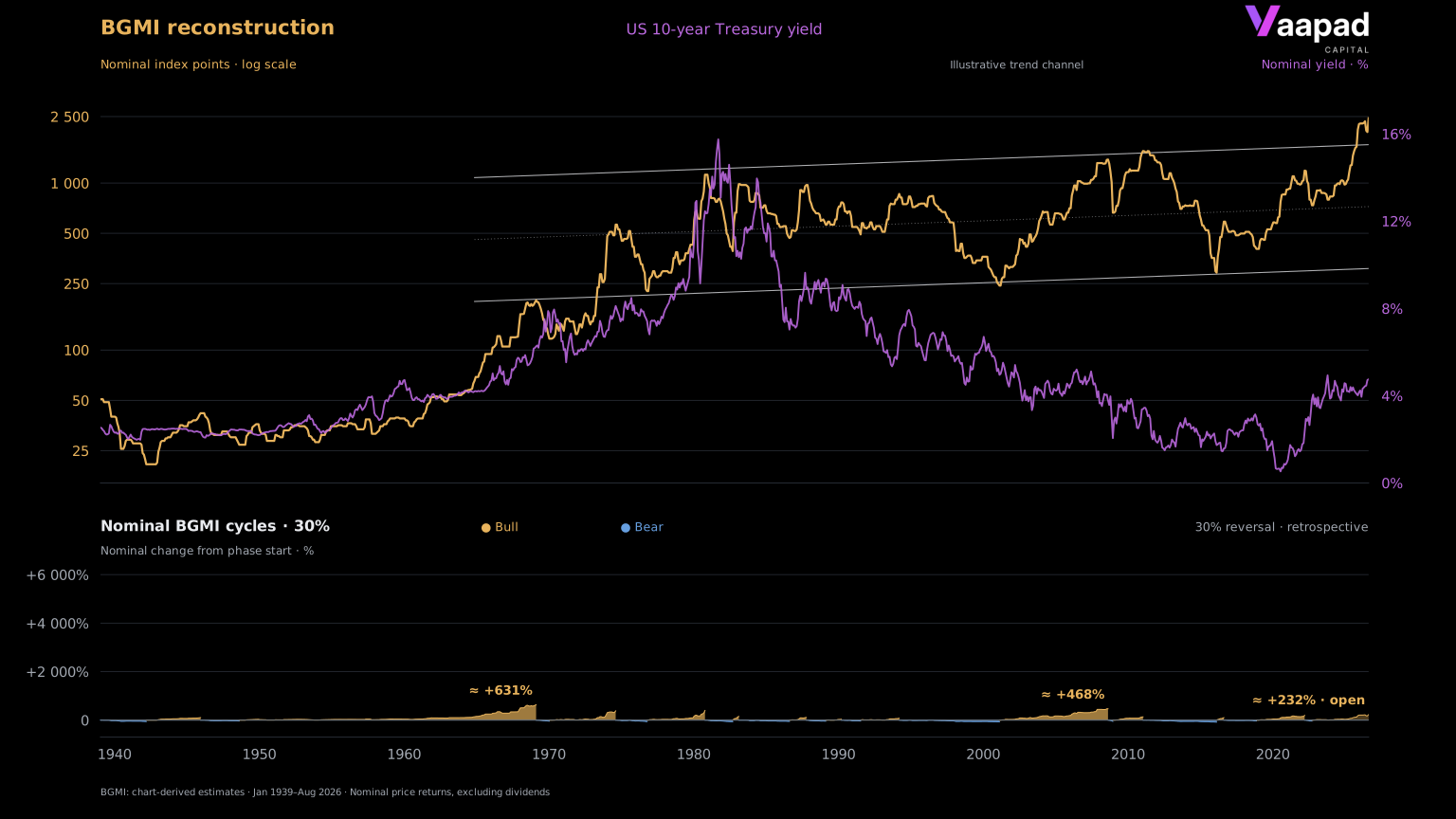
The second figure shows the same BGMI reconstruction in August 2026 purchasing power. Only the gold index line is adjusted for inflation. The purple US yield curve and the cycle percentages in the lower panel remain nominal, as in the TradingView reference.
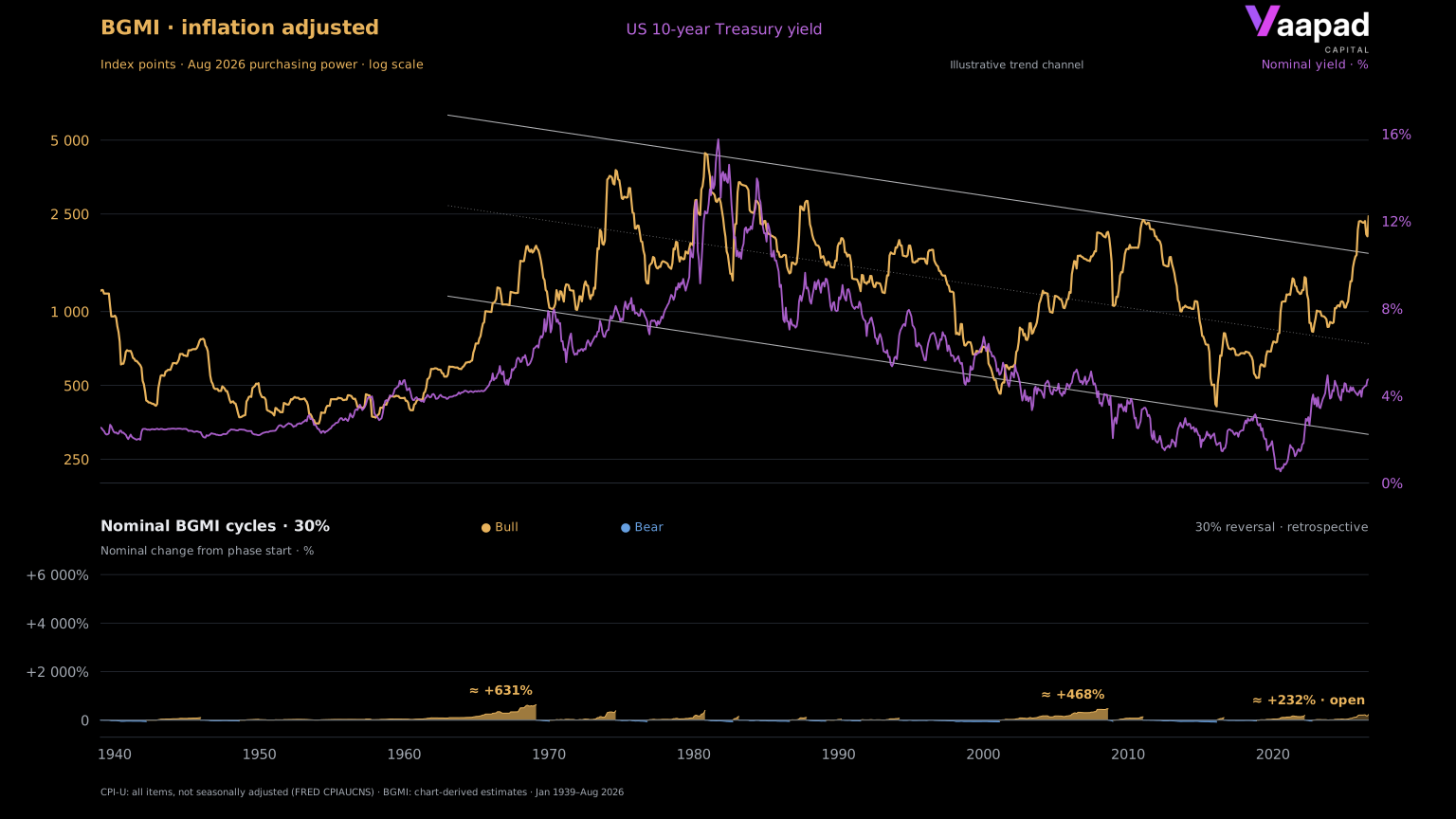
Open full-size figure (SVG) · Download PNG
Calculation: real BGMI in month t = nominal BGMI in month t × August 2026 CPI-U / CPI-U in month t. The series is the US Consumer Price Index for All Urban Consumers, all items, not seasonally adjusted, FRED CPIAUCNS (source: BLS), with an August 2026 base value of 334.980. This follows the BLS method for converting to constant purchasing power. For the missing October 2025 CPI observation, September's value of 324.800 is carried forward, as in the reference. All 1,052 exported monthly BGMI values match this calculation.
Reference and interpretation: Inflation-adjusted TradingView layout, exported on 24 September 2026. The channel was reproduced from its saved coordinates and clipped at the August 2026 data endpoint; it is a manual illustration, not a statistically estimated model. The reference's future arrow and early auxiliary lines are not part of this historical comparison. The GDX extension from September 2026 is excluded. The two upper axes remain independent. The nominal phase comparisons below and the limitations of the original BGMI reconstruction remain unchanged.
The following four figures show the same prices and yields with two broader phase definitions. A reversal of at least 40% or 50%, respectively, confirms the next turning point. Smaller counter-moves remain within the same phase. Boundaries are still assigned retrospectively to the preceding extreme. All views use the same previously documented yield series.
This reconstruction contains 18 phases at 40% and 14 at 50%. In both cases, the still-open advance begins in February 2016 and reaches approximately +741% nominally by August 2026. All six figures use the same linear percentage scale in the lower panel. The three nominal views have identical upper axes and trend channels; the same applies within the three inflation-adjusted views. Time axis, yield axis, dimensions, typography and colours are identical across all six figures. Only the phase segmentation and its labels change between 30%, 40% and 50%.
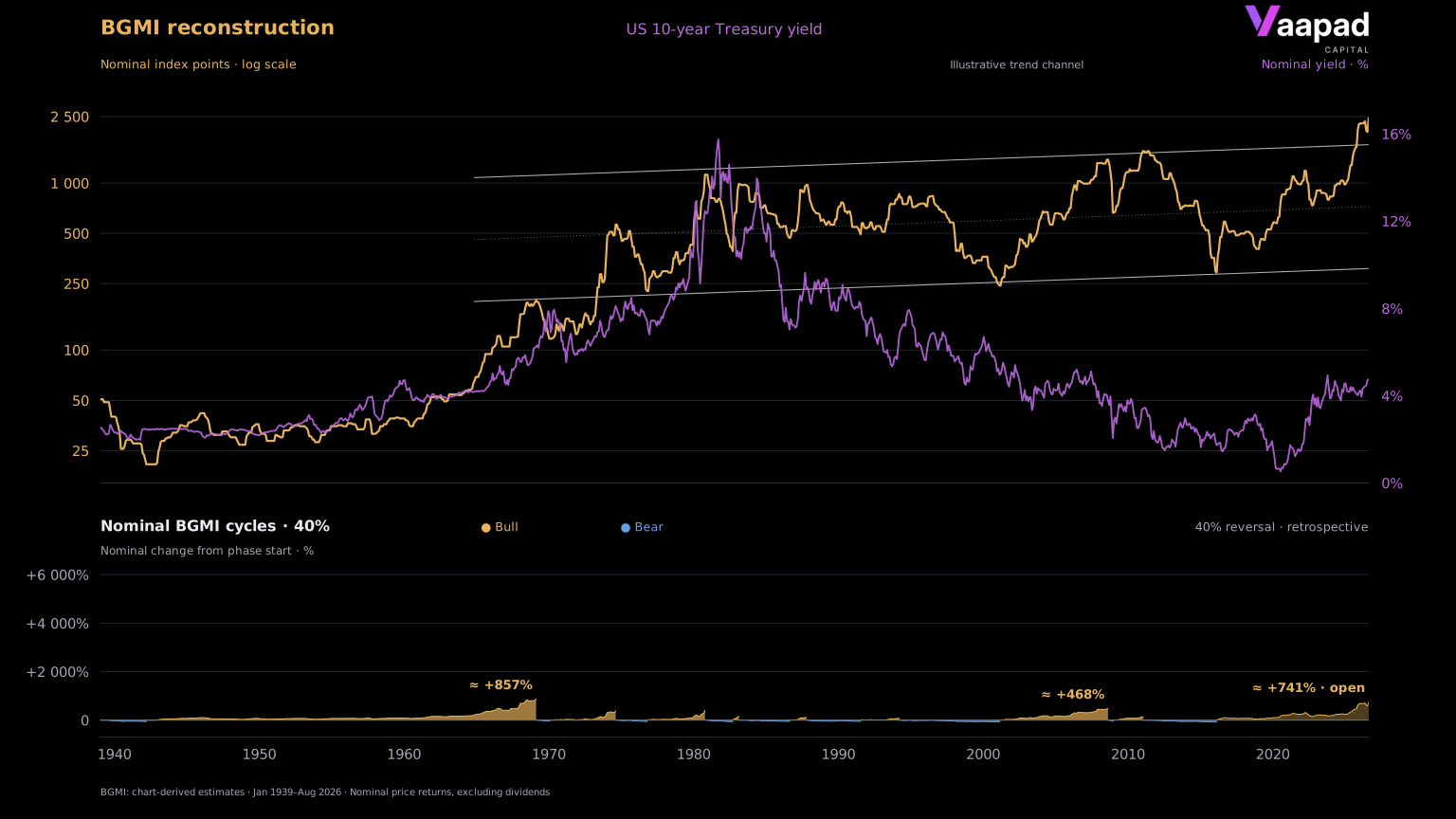
Open full-size figure (SVG) · Download PNG
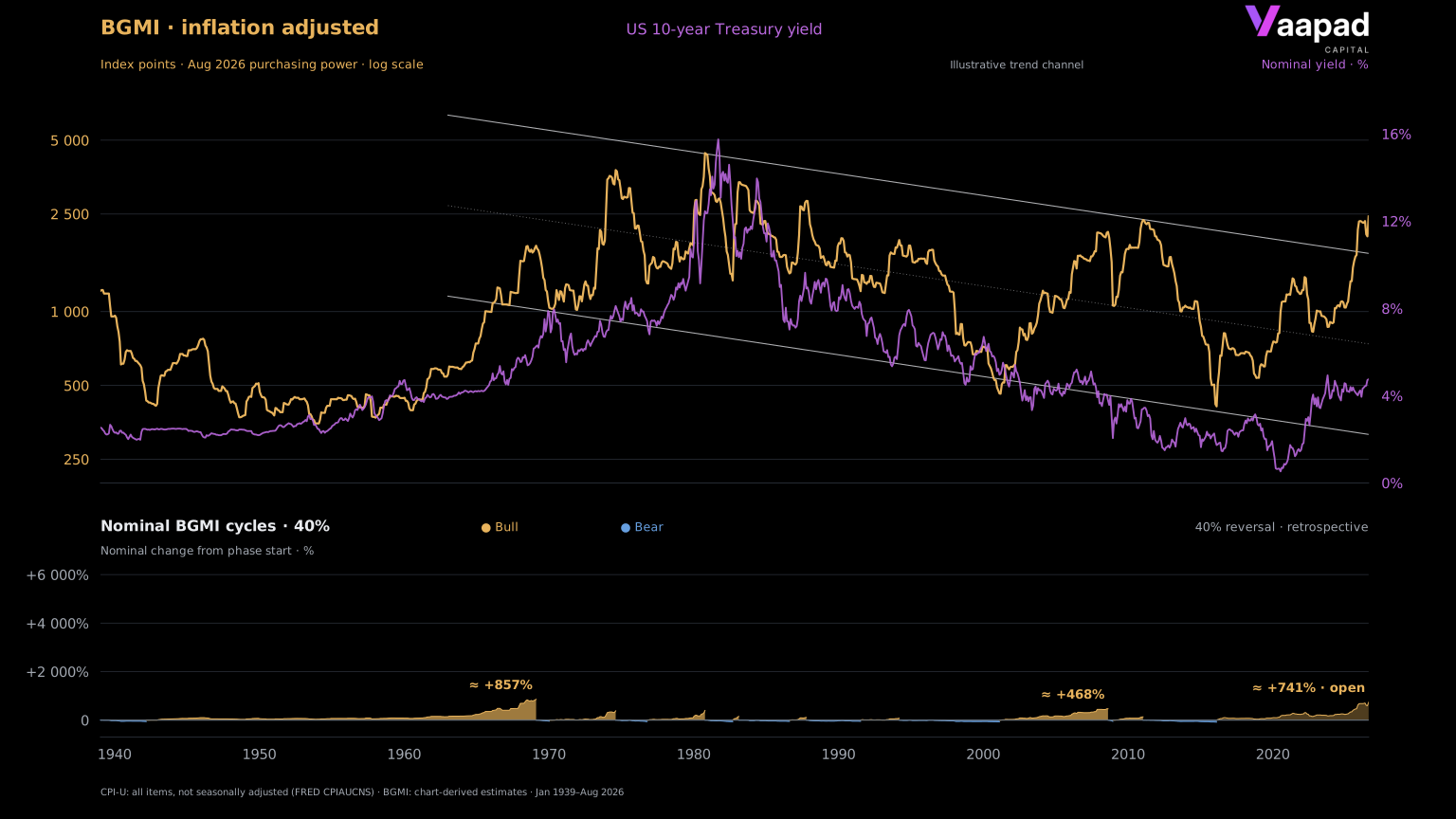
Open full-size figure (SVG) · Download PNG
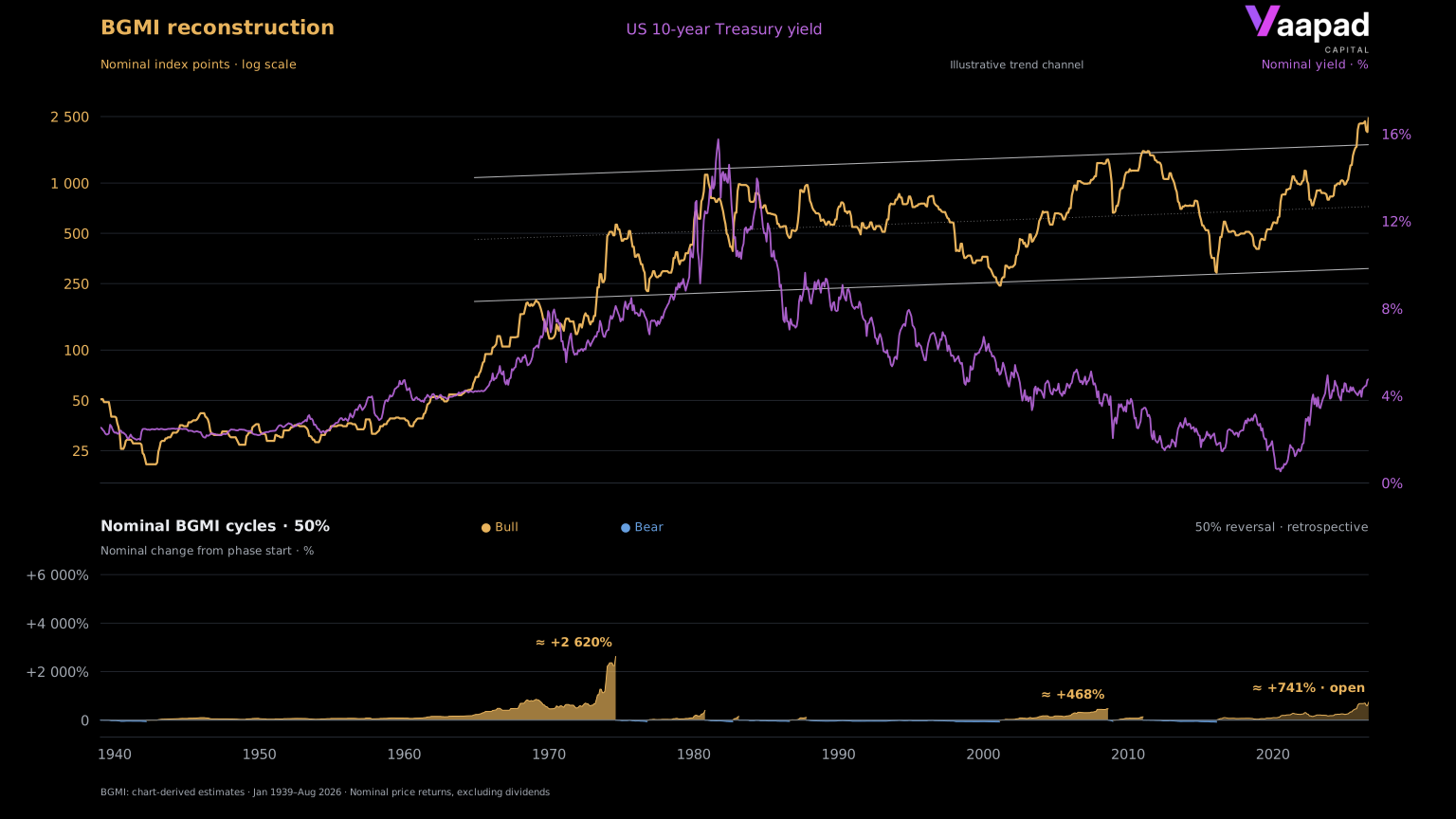
Open full-size figure (SVG) · Download PNG
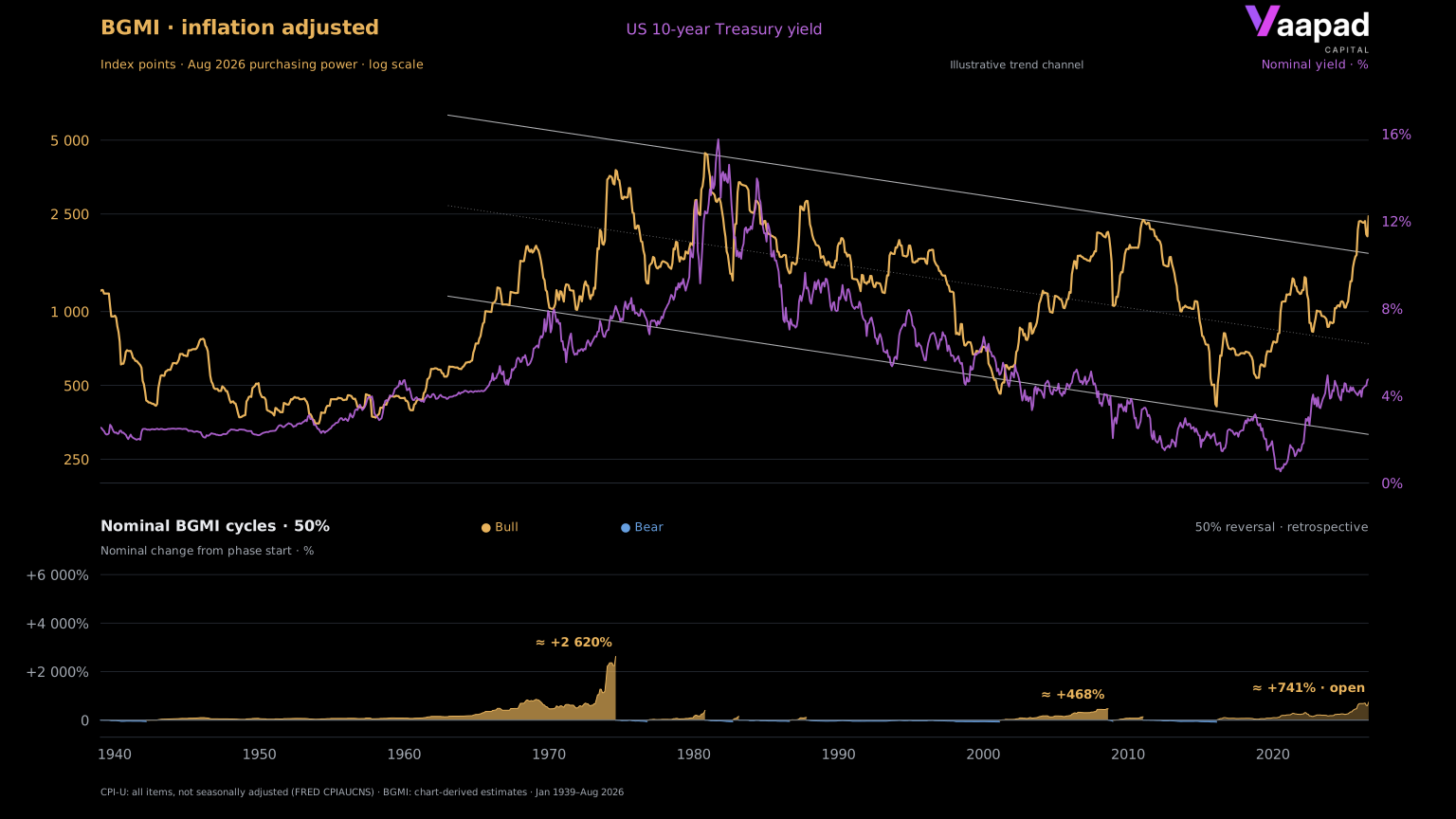
Open full-size figure (SVG) · Download PNG
The inflation-adjusted curves use the same CPI-U calculation and purchasing-power base as the second figure above; yields, phase boundaries and cycle percentages remain nominal. The manually drawn channels were checked against the saved coordinates in all four references and clipped at the data endpoint. Future arrows, early auxiliary lines and the GDX extension from September 2026 are excluded. The higher thresholds change the retrospective segmentation, not the underlying prices or their reconstruction limitations.
TradingView references, exported on 24 September 2026: 40% nominal · 40% adjusted for inflation · 50% nominal · 50% adjusted for inflation.
The following six cards bring the comparison to twelve views in total: 30%, 40%, 50%, 60%, 65% and 70%, each nominal and adjusted for inflation. All twelve share the same time axis, yield axis, linear cycle scale, dimensions, typography, colours and Vaapad logo. The six nominal views have identical upper charts and trend channels; the same applies within the six inflation-adjusted views. Only the phase segmentation and its labels change with the threshold.
The new phases are calculated with the same reversal rule from the existing 1,052 monthly BGMI values from January 1939 to August 2026. Higher thresholds keep larger counter-moves within the same phase. Phase boundaries and percentage gains still use nominal BGMI values, including in the inflation-adjusted views.
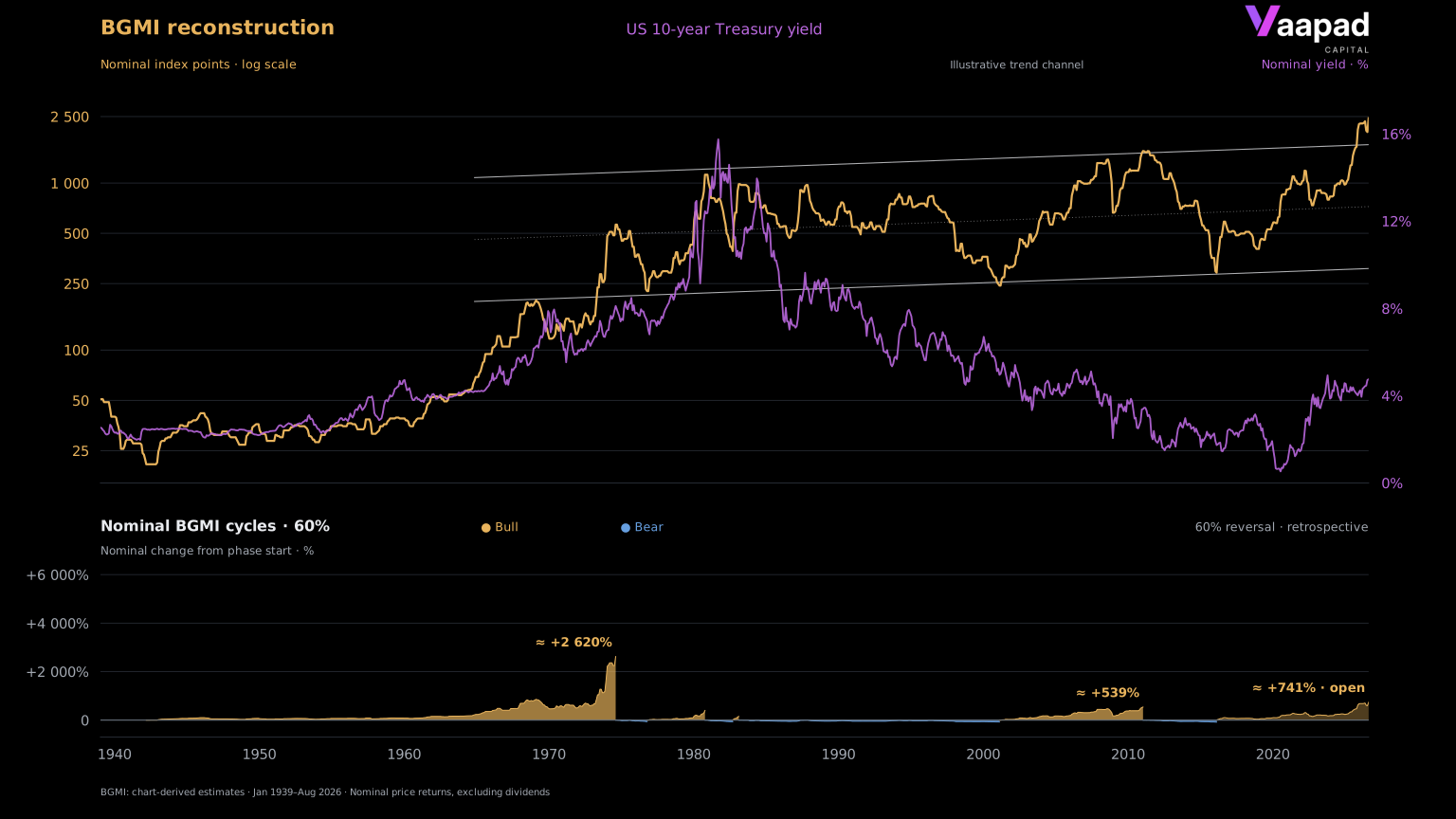
Open full-size figure (SVG) · Download PNG
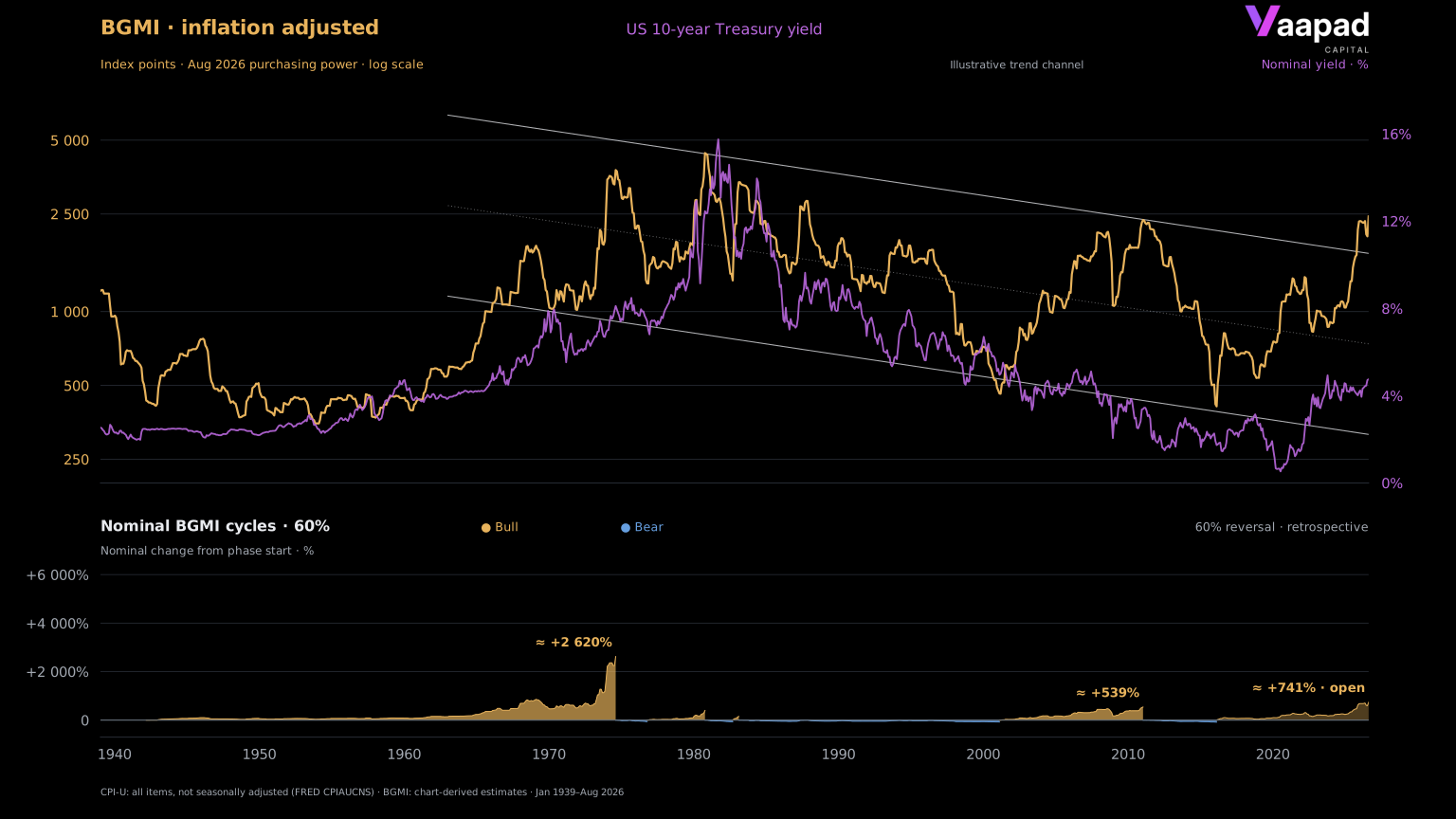
Open full-size figure (SVG) · Download PNG
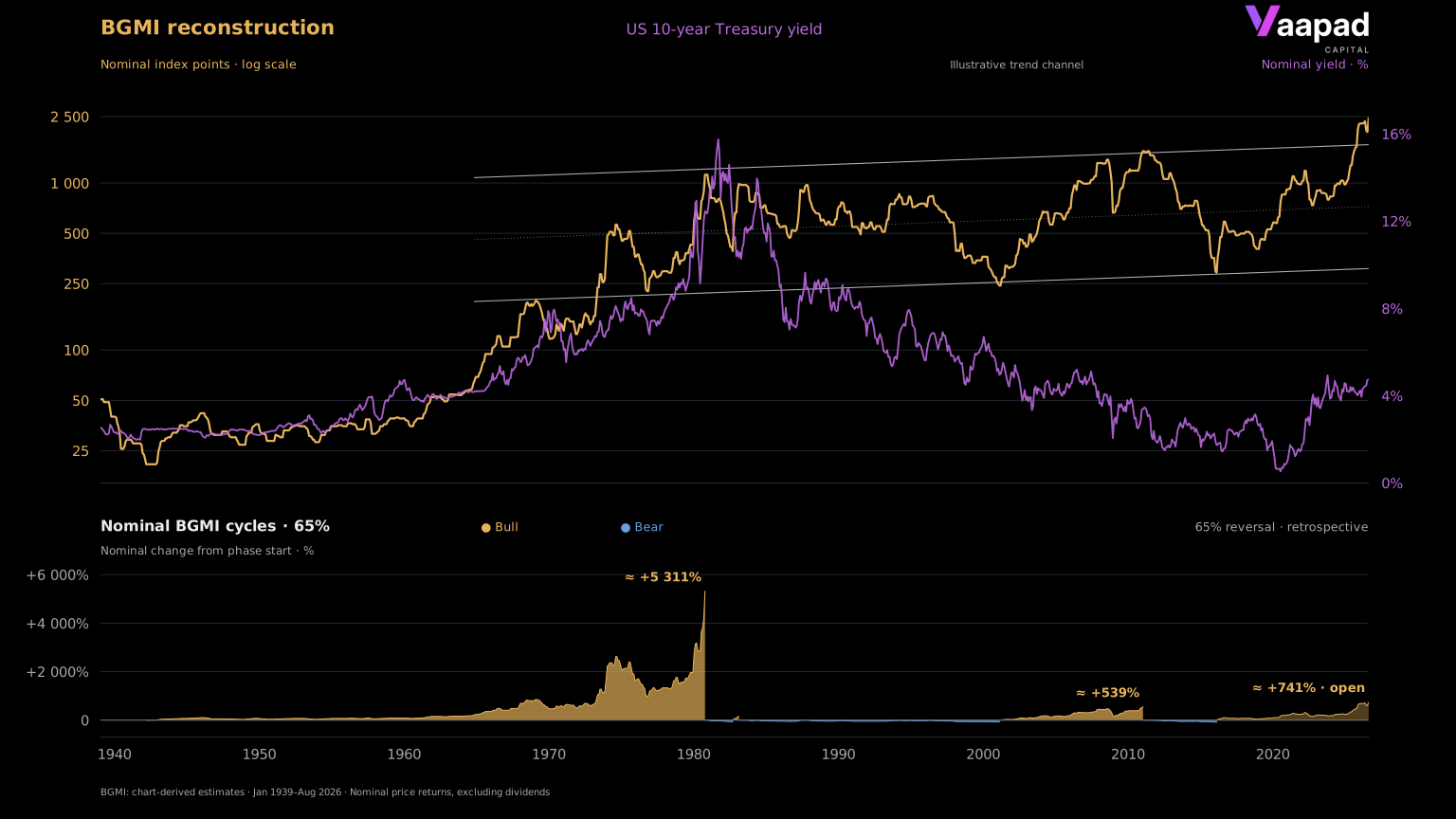
Open full-size figure (SVG) · Download PNG
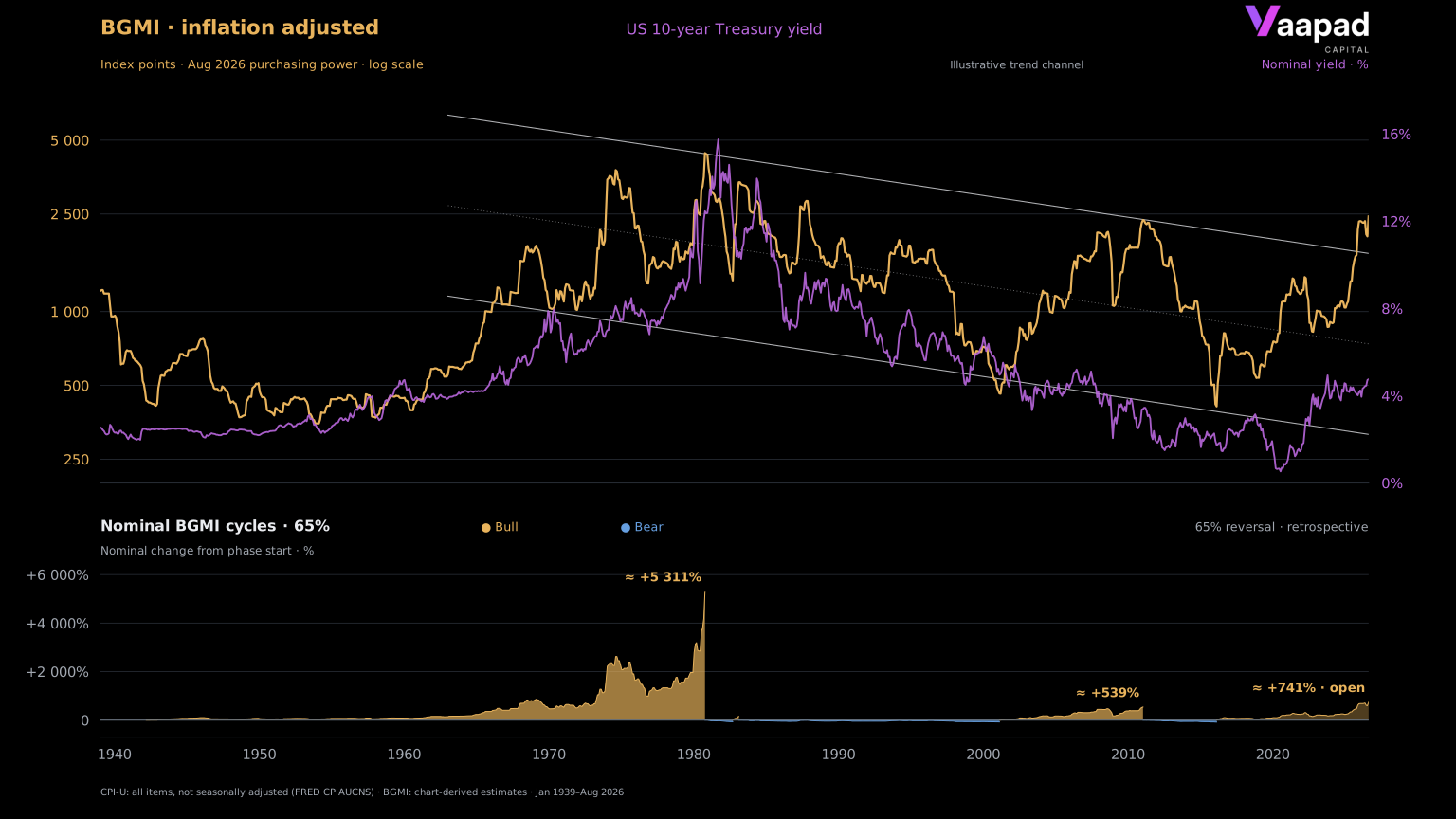
Open full-size figure (SVG) · Download PNG
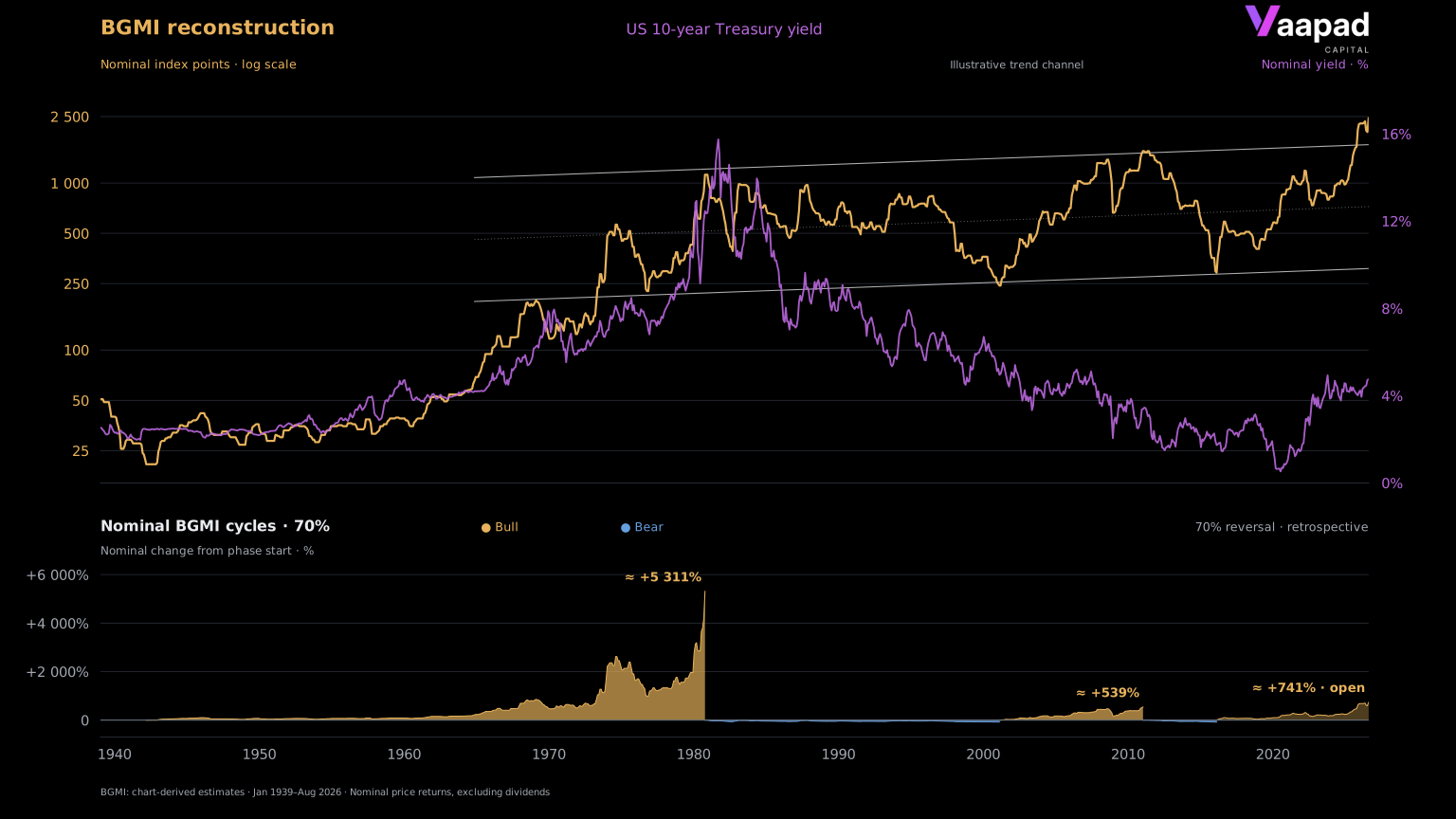
Open full-size figure (SVG) · Download PNG
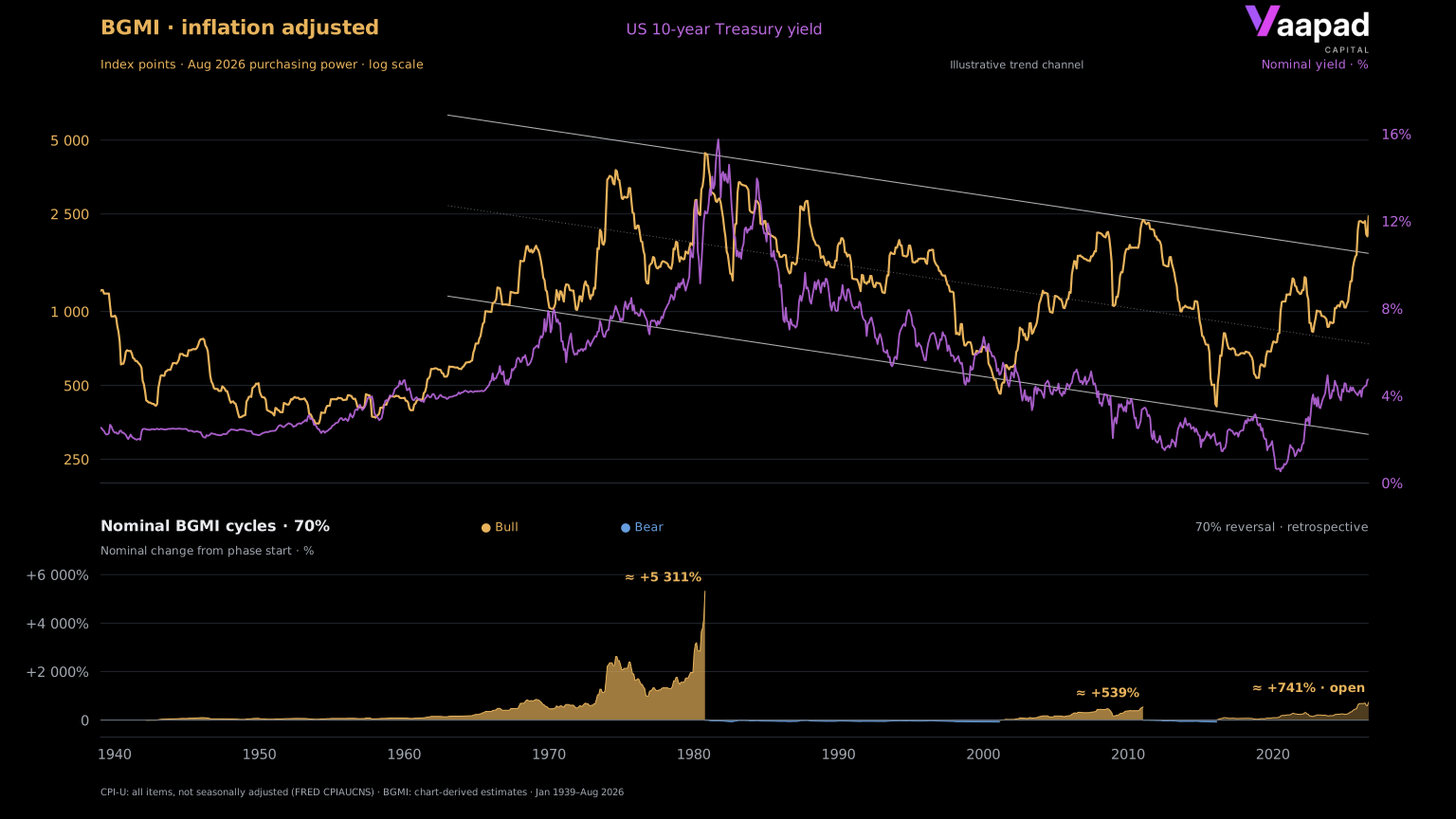
Open full-size figure (SVG) · Download PNG
Interpreting the extreme cases: Before March 1942, the lower panel remains unfilled at these three thresholds: the initial decline is approximately 59.20% in the reconstruction and reaches none of the three reversal thresholds. A turn is still confirmed after the retrospectively marked extreme. The 60% segmentation in October 1976 is particularly sensitive: the reconstructed decline from August 1974 is approximately 60.007%, only about 0.007 percentage points beyond the threshold. Rounding or digitisation differences can change this boundary. The previously stated limits of the BGMI reconstruction, CPI-U calculation and nominal treatment of yields and phase returns apply to all twelve cards.
The two upper curves use independent scales. Their intersections and vertical distances therefore have no common numerical meaning. Both panels share the timeline from January 1939 to August 2026. The BGMI series ends with an intramonth August snapshot; subsequent GDX proxy values are excluded. The yield series comes from the exported monthly closing-value column of TradingView symbol TVC:US10Y. All 1,052 months in the common period are present; no interpolation was used.
The advance from August 1948 to February 1969 reaches approximately +631% over 20.5 years; the phase from February 2001 to August 2008 approximately +468% over 7.5 years. These total returns compare different durations. The still-open phase from September 2022 to August 2026 stands at approximately +232%.
For equal durations, the reconstruction's retrospectively strongest 120-month windows starting in the 1960s and 2000s return approximately +869% from August 1964 to August 1974 and +537% from February 2001 to February 2011, respectively. The earlier window explicitly extends into the 1970s. These windows were selected with hindsight; they are not a selection rule available in advance.
A reversal of at least 30% confirms a turn. The phase boundary is assigned retrospectively to the preceding extreme; identical extremes use the first month. Each phase begins at zero: phase return = 100 × (current BGMI / BGMI at phase start − 1). The first interval may have begun before the available history, and the latest remains open. This is a retrospective description, not a contemporaneously available trading signal.
The BGMI values are approximate reconstructions from chart images and have not been validated against original historical data. Before July 1970, digitised BGMI/gold ratios were converted using gold prices; later observations come from a digitised BGMI curve. Of 1,051 monthly transitions, 438 are unchanged. The analysis is nominal, without dividends, inflation adjustment, HUI substitution or GDX extension. Daily and weekly extremes may differ.
A previous comparison found approximately +382% for 1970–1974 versus +596% in the reference graphic, and approximately +397% for 1976–1980 versus +554%. These differences remain unresolved. The numerical checks confirm the calculation from the supplied approximate series, not its historical accuracy or a reliable ranking of actual BGMI bull markets.
Sources and dates: existing BGMI reconstruction with 1,052 monthly observations, January 1939 to August 2026; provenance and calculation data are documented with this Field Note in the repository. Yield series: TradingView source layout with TVC:US10Y, exported on 24 September 2026. Phase calculations dated 23 September 2026. Both series are assigned to their calendar month; the timestamps do not guarantee an identical observation day.
This page does not constitute investment advice, an investment recommendation, an offer, or a solicitation to buy or sell any financial instrument. Trading financial instruments involves substantial risk, up to and including total loss of capital; individual results may differ materially. Vaapad Capital is not a licensed investment firm and does not provide portfolio management. Past performance is not a reliable indicator of future results. The operator may hold positions in instruments discussed, which can create conflicts of interest. An article establishes neither current holdings nor a contemporaneous trade rationale. Available broker holdings and their data timestamp are shown under Portfolio in the member terminal. .