19 Sept 26Updated: 20 Sept 26112 min read
Author: Tim Hack
Published by Vaapad Capital
Published: 19 Sept 26. Research does not establish contemporaneous trade rationale.
Author: Tim Hack
Published by Vaapad Capital
Published: 19 Sept 26. Research does not establish contemporaneous trade rationale.
An analysis of Namib Minerals (NASDAQ: NAMM), second survey: why the share price has fallen by a third since June while gold held and the pumps ran; why the stock rose sevenfold in January 2026 when gold rose by a quarter; why the owners' open bill and the gold price are not two risks but one; and what an investor sees when he reads the stock not as a company but as what it is in its cost structure — an option with an expiry nobody knows, and a gamma that hardly any other paper on a US exchange has.
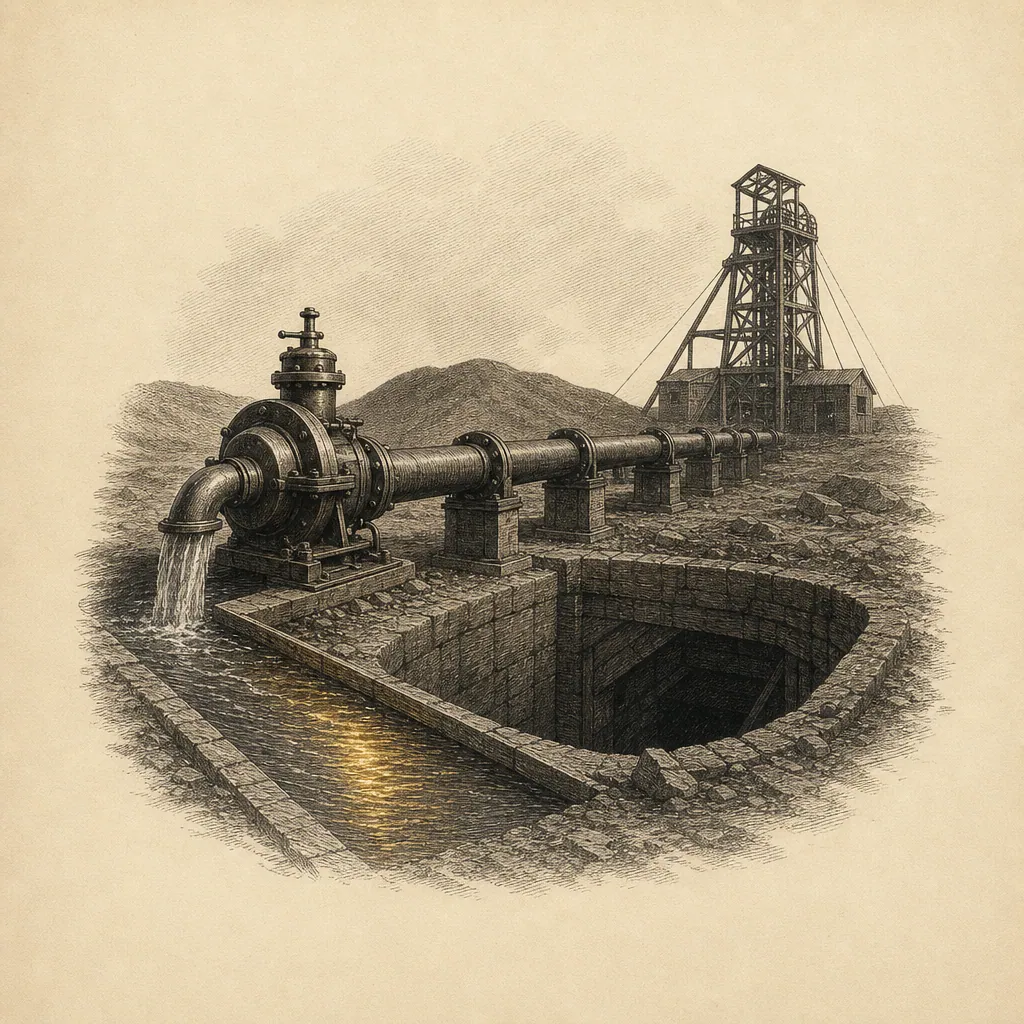
Since 29 January 2026 a pump has been running at a dormant gold mine in Zimbabwe's Manicaland province. In its first months it lifted more than half a million cubic metres of water out of the shafts, the water level is falling, and in July the company that owns the mine published, for the first time, a dated path for what happens once the water is gone. It is an unspectacular process — water, pipes, around 640 cubic metres an hour — and it is running to plan.
The share price of the company that owns it has fallen by a third in those same three months. The gold price has not moved. The EBITDA of the producing mine is growing, per guidance, by 70 to 110 percent. The pumps are running. And the stock is falling.
The first survey of this case, published in June under the title "Der Preis des Überlebens" ("The Price of Survival"), asked what a survivor is worth that trades like a corpse. The answer was a valuation gap, an operating lever, a catalyst and a historical pattern. It was not wrong. But it did not predict the share price of the last three months and cannot explain it, and a thesis that cannot explain its own underlying is incomplete.
This second survey therefore begins not with valuation but with mechanics. It claims that Namib Minerals does not behave like a gold stock because it is not one — it is an option on gold, out of the money, whose price at $1.30 is almost entirely time value and whose payoff above a strike of around $4,500 an ounce is not linear but convex. It shows that in January the stock did exactly what such an option does when gold briefly ran above the strike. It shows why the float is so small that the gamma of this option is among the highest on any American exchange. And it shows that the open bill hanging over the owners — a purchase price of £53.2 million for the mines, by the company's own account unpaid — is not a second risk alongside the gold price but the same one: below the strike it is a chronic overhang, above it it resolves itself.
Whoever holds an option must know three things: where the strike is, what the waiting costs, and when it expires. This text answers the first two. It cannot answer the third, and it says why.
Namib Minerals trades in September 2026 at around $1.30, 55.85 million shares, a market capitalisation of around $73 million. Against that stand three gold deposits in Zimbabwe — one producing, two being revived —, around 2.5 million ounces Measured & Indicated and 4.6 million ounces Inferred at grades that range from above average to world class in global underground gold mining, adjusted EBITDA of $29 million in fiscal 2025 and guidance of $50 to $62 million for 2026. That is a multiple of 1.2 to 1.5 on current EBITDA where the industry carries four to eight, and around $11 to $19 per resource ounce (depending on the count, Chapter 11) where African mid-tier producers carry $100 to $250.
The thesis of this work has four parts, and the first carries the other three.
First, the mechanics. NAMM is a call on gold with a strike around $4,500 an ounce. The strike is not in a model but in the cost structure: below it, How Mine is a profitable single operation that can neither carry a $300 to $400 million restart nor clean up the company's chain of ownership; above it, it carries both. At $1.30 what is priced in is: How alone, at 1.4 times EBITDA. That is the time value. Everything else — Redwing, Mazowe, a paid bill — is valued at zero, because the option is out of the money and the market prices it as if it would stay there.
Second, the gamma. Four to four and a half million shares are freely tradable; the rest is locked up, pledged, lent or does not yet exist as earnout. When gold ran 24 percent above the strike in January 2026, NAMM went from $1.00 to $7.36 — a beta of 26 on a move in the underlying. That was both things at once: the beginning of a re-rating — gold above the strike, a restart that had suddenly become calculable — and a bid for four million shares. The strike triggered the valuation chain, the float amplified it. The same tightness carries in the other direction, and it took the share price from $55 in June 2025 to $0.91 in January 2026.
Third, the open bill. The company holds its mines through a subsidiary it bought out of Metallon's insolvency estate in 2024 — for £53.2 million, payable not by the company but by its two controlling owners. By the company's own annual report that purchase price has not been paid; the contractual deadline of 5 June 2026 has passed, its outcome undisclosed. The guarantors hold around 34 million shares. At $1.30 that block is worth $44 million and the bill is unpayable without destroying it. At $7 it is worth around $240 million and the bill is a placement. The bill is a function of the gold price. That is why the stock has fallen since June, and why it does not have to stay there.
Fourth, the price of time. An option out of the money loses time value, and this one loses it visibly: 1.62 million shares to Cohen & Company at rock-bottom prices, an F-3 that frees four fifths of the share count for sale, a Nasdaq threshold that is arithmetically breached, a Redwing timeline that puts first production at 2029 in the base case. That is theta, and it is real. The question is not whether it costs, but whether the strike is reached before expiry — and this work can estimate the probability of that, but not the date.
This work sets out the thesis with analytical clarity and names the other side with the same sharpness. Zimbabwe is not a stable emerging market. The chain of ownership can snap before gold heals it. A corporate-rescue application — which surfaced in September as a fraudulent notice — could one day succeed. The company has so far not answered eighteen written questions in substance but referred to an investor call. This is not a sales brochure. It is the survey of an option: bounded loss, convex payoff, and an underlying that is right now edging toward the point at which both are decided.
A gold stock is a claim on a mine's cash flow. Its value rises with the gold price, and because the mine's costs are fixed it rises faster than the gold price: that is the operating leverage that anyone knows who has ever held a producer. A mine with $3,000 in costs per ounce earns a thousand at $4,000 and two thousand at $5,000 — the gold price rises by a quarter, the profit doubles. That is linearity with slope, not convexity. An ordinary gold stock is a leveraged gold exposure.
Namib Minerals is something else, and the difference lies not in the mine but in what surrounds it.
The underlying. How Mine produces, per 2026 guidance, around 30,000 ounces a year (2025: around 25,000), growing to 40,000 with the mill expansion. At $4,300 gold that delivers EBITDA of $50 to $62 million per guidance. After tax, interest and ongoing capital needs, perhaps $25 to $35 million of free cash flow remains. That is a solid business. It is also everything the company has at the moment: Redwing is flooded, Mazowe is flooded, and together they need $300 to $400 million to produce again.
The strike. A restart of that size cannot be paid out of $30 million of free cash flow, and at a market capitalisation of $73 million it cannot be paid with equity without wiping out the shareholders. It can only be paid with project debt — banks, development financiers, streaming partners —, and they provide it when two things are true: when the feasibility study shows, at their price deck, a return that carries the debt, and when the producing mine next door throws off enough cash to bridge the construction phase. Both depend on the gold price. And both tip in the same zone: around $4,500, the price the company itself puts under its guidance, and roughly the point at which a Redwing restart with the grades and costs of the historical mine pencils with debt. Below it Redwing is a project somebody could finance. Above it, it is one somebody will finance.
That is the strike. It is not a model assumption but a threshold in financeability — and for a company with $1.9 million in cash, financeability is the only variable that counts.
The time value. What does the market pay at $1.30? The arithmetic is short. $73 million of market capitalisation against $50 to $62 million of EBITDA is a multiple of 1.2 to 1.5. That is the price for How alone — for a single underground mine in Zimbabwe with limited reserves, in a controlled company with an open bill, without a discount for the country and without a premium for anything else. Redwing with 1.19 million ounces M&I: zero. Mazowe with inferred grades of 8.65 grams: zero. The clean-up of the chain of ownership: zero. That is what option traders call the intrinsic value of an out-of-the-money option — nothing —, and what remains is time value: the price for the possibility that the underlying might still move before expiry.
| What the price contains at $1.30 | Valued in the price | Valued once the strike is crossed |
|---|---|---|
| How Mine, producing | ~1.4× EBITDA | 4–6× EBITDA on higher EBITDA |
| Redwing, 1.19 Moz M&I, flooded | zero | financed restart, NPV of a 100-koz mine |
| Mazowe, 0.79 Moz Inferred @ 8.65 g/t | zero | next stage of the cascade |
| Chain of ownership (BMC purchase price) | discount | cleaned up (Chapter 3) |
| Float tightness | discount (illiquidity) | premium (squeeze) |
The payoff. If the strike is crossed and gold stays above it, not one thing happens but a chain. How's EBITDA rises disproportionately because costs are fixed. Redwing's feasibility study — technical part in early 2027, bankable by the end of 2027 — is run on a price deck that attracts debt. The financing that is impossible today becomes a negotiation. The share price that makes the financing affordable rises with the financing. The guarantors, whose block is then worth a multiple, pay their bill. The discount for the chain of ownership falls away. The warrants at $11.50, worthless today, become a source of capital of $214 million. And the next restart — Mazowe — is started by a company that by then looks like what Metallon once was, before it fell.
Each link in this chain is plausible on its own. Together they are the reason the payoff of this option is not linear. A gold stock doubles when its profit doubles. This one becomes a different company.
What that means for the holder. Whoever holds an option out of the money holds two things: a probability and an expiry date. The probability that gold rises from $4,300 to above $4,500 is no exotic assumption — it was at $5,600 in January. The expiry is the harder quantity, and Chapter 4 surveys it. But the structure is that of an asymmetric instrument: the loss is limited to the stake, because below the strike only the time value erodes and How keeps producing; the payoff above is convex, because it triggers a chain and not a multiplier. The market prices this option today as if it would stay out of the money. That is what makes it cheap — and it is also the most honest sentence one can say about it: it is cheap because it is out of the money, and it is more than time value only if it does not stay there.
An option proves its gamma not in theory but on the day the underlying moves. For Namib Minerals that day was January 2026, and the numbers are public.
Gold rose in January from around $4,500 to around $5,600 an ounce — plus 24 percent, the steepest month of the cycle. NAMM rose over the same period from around $1.00 to $7.36 — plus 636 percent. That is a beta of 26 to the move in the underlying. No senior producer did that; the big gold miners gained between 30 and 60 percent that month. No junior with a comparable resource did it. The stock did not behave like a leveraged gold exposure but like an option running from far out of the money into the money — and that is exactly what it was that month: gold was above the strike.
| January 2026 | from | to | change |
|---|---|---|---|
| Gold, USD/oz | ~4,500 | ~5,600 | +24% |
| NAMM, USD | ~1.00 | 7.36 | +636% |
| implied beta | ~26× | ||
| NAMM market capitalisation | ~$55 million | ~$400 million | +$345 million |
| traded float | ~4 million shares |
The last row explains the third — but not alone. A market capitalisation that rises by $345 million is, first of all, what it looks like: the beginning of a re-rating. Gold stood above the strike in January, and the market began to do what it has to do above the strike — to price in a financeable Redwing restart, a payable bill and a guidance that suddenly looked conservative. That is the valuation chain this text is about, and it started running in January. What turned the start into an explosion was the supply: buying interest that would be ordinary for a name of this size met a share count that does not exist for a name of this size. Namib Minerals' freely tradable stock is four to four and a half million shares — around eight percent of those outstanding. The rest sits in the Trust's control block, in lock-ups, in pledges, in share loans, or does not yet exist as earnout. Anyone who wanted to buy a million shares in January had to lift a quarter of the entire tradable stock out of the market. So both things are true, and they belong together: the strike triggered the re-rating, the float amplified it. The price of $7.36 was a valuation price with a clearance premium — and when gold fell back below the strike, the same mechanics ran in reverse.
Why the float is so small. The tightness is not an accident of trading but a consequence of the ownership structure and its obligations — and that is why it is structural, not cyclical. Chapter 7 dissects it in detail; here the overview suffices:
| Holding | Shares (approx.) | Why not tradable |
|---|---|---|
| Southern SelliBen Trust | ~31–34 million | control block; lock-up; 4.9% pledged to Metallon; 4.0 million lent to Khumalo |
| Insiders incl. Sikwila | ~8–9 million | lock-up with price thresholds $12.50 / $15.00 |
| Khumalo (borrowed) | 4.0 million | borrowed shares; sale possible but not reported |
| Institutions | ~4 million | held, rarely traded |
| Earnout | up to 28.77 million | does not exist until milestones are met |
| Warrants | 18.58 million | out of the money at $11.50 |
| Freely tradable | ~4–4.5 million | ~8% of shares outstanding |
A float of this size has three consequences one must know before touching the stock.
First: An institution that wants a position has to make the price itself. A fund that wanted to hold two percent of its assets in NAMM would, at a fund size of $500 million, have to invest ten million dollars — seven to eight million shares, almost twice the float. As long as gold stands below the strike nobody does that, because building the position would multiply the price before the position exists. Above the strike the logic reverses: whoever assumes gold stays up wants the position anyway — and then builds it, if need be at any price, up to the level at which the restart is priced in. That is exactly what happened in January. Below the strike the stock is therefore a retail and insider paper without institutional coverage; above the strike it is a paper institutions have to get into without being able to — and that is the second half of the gamma.
Second: The gamma works in both directions. The same tightness that multiplied the price sevenfold in January had previously taken it from the SPAC high of $55 in June 2025 to $0.91 in January — minus 98 percent in seven months. Whoever has to sell into a tight float finds no buyer at the valuation price, only at the clearance price on the way down. Khumalo's sale of 4.9 million shares between August 2025 and February 2026 — more than the entire float — is part of that path, and it explains why the stock stood at a fraction of its EBITDA at the low.
Third: The float has become smaller, not larger. The 4.9 million Khumalo shares sold did not stay with the public; part of them migrated into firm hands, part was recycled through the short position. The 4.0 million borrowed shares are a potential supply, not an existing one. And the 2.7 million pledged shares could one day become supply. Between the bid and the ask of this stock lies not just a spread but an ownership structure.
Beta as a measure of convexity. What January showed is the slope of the payoff curve above the strike — not its level. NAMM at $7.36 was a market capitalisation of around $400 million, 6.5 times the 2026 EBITDA guidance, still at the lower edge of what African mid-tier producers carry. So the stock was not expensive at the high; for one month it was normally valued. That it fell back to $1.30 afterwards was because gold ran back below the strike, the option went out of the money again and the float worked in the other direction. Whoever reads the stock as a company sees chaos. Whoever reads it as an option sees gamma.
To this work's knowledge there is no second producing gold company on a major US exchange whose stock reacts to a move in the underlying with 26 times. That is not a recommendation. It is the description of an instrument that one should only hold if one understands that it is one.
The first survey carried the Metallon legacy as a reputational and litigation risk. That was too weak, and it was also filed in the wrong place. The legacy is an ownership risk — and not one that stands beside the gold price but one that depends on it. This chapter shows the connection; Chapter 6 supplies the contract details.
The bill. Namib Minerals holds its three mines through Greenstone, a Cayman subsidiary that in June 2024 bought all shares of the Bulawayo Mining Company out of Metallon's insolvency estate. Purchase price: £53.2 million, around $67 million. Payable not by Greenstone, not by Namib — but by two guarantors: Mzilikazi Khumalo personally and the Southern SelliBen Trust, his family trust, which holds the majority of Namib's shares. The annual report for 2025 says in one sentence what became of it: "the Guarantors are responsible for payment of the Purchase Price, which to date has not been satisfied." As security the Trust pledged 4.9 percent of Namib's shares to the administrators, with a deadline of 5 June 2026. The deadline has passed. Its outcome is undisclosed.
Why the guarantors cannot pay. The question the market has been asking since June is: why do two owners who together hold the majority of a Nasdaq company not pay $67 million? The answer is in the share price. The Trust holds around 34 million shares. At $1.30 that is $44 million. The bill is larger than the entire control block. To pay it out of the block, the Trust would have to sell more shares than it has — into a float of four million shares, which would push the price to a fraction and devalue the rest of the block. Khumalo tried it: between August 2025 and February 2026 he sold his entire direct holding of 4.9 million shares, at an average of $3.46, for around $17 million. Whether that money went toward the bill is Question 5 of the catalogue. Even if it did: fifty million are missing, and the sale halved the share price.
That is the trap the owners sit in. They owe an amount they can only pay with their shares, and every sale of their shares lowers the value of what they pay with. At $1.30 the bill is unpayable without destroying the company — and that is why it hangs.
Why they can pay above the strike. Now the same arithmetic at $7, the January high. The block is worth around $240 million. $67 million is then around ten million shares — a quarter of the block, placeable with institutions that, at a market capitalisation of $400 million and a financed Redwing restart, can suddenly build a position. Or a convertible at Trust level. Or a settlement with the administrators, who negotiate quite differently when the pledge is worth $19 million instead of $3.5 million. The bill that is an existential problem at $1.30 becomes a transaction at $7.
| NAMM price | Value of the Trust block (~34 million shares) | Value of the pledge (2.7 million shares) | Shares needed for $67 million | Share of the block | Status of the bill |
|---|---|---|---|---|---|
| $1.30 | $44 million | $3.5 million | 52 million | >100% | unpayable |
| $2.50 | $85 million | $6.8 million | 27 million | 79% | destructive |
| $4.00 | $136 million | $11 million | 17 million | 49% | hard |
| $7.00 | $238 million | $19 million | 9.6 million | 28% | placement |
| $12.50 | $425 million | $34 million | 5.4 million | 16% | formality; lock-up threshold reached |
The link to the gold price. NAMM's share price depends — that is the content of the first two chapters — not linearly but convexly on the gold price. So the payability of the bill depends convexly on the gold price. Below the strike the stock remains an option out of the money, the block remains too small for the bill, and the bill remains open — a chronic overhang that weighs heavier every month, because the administrators will not wait forever. Above the strike the stock is re-rated, the block becomes a multiple of the bill, and the bill dissolves in a placement. The chain of ownership cleans itself up as soon as gold lets it.
That is the core of this second survey, and it deserves its own sentence: The open bill and the gold price are not two risks. They are one. Whoever holds NAMM is not betting that the owners are honourable or the administrators patient — but that gold runs above the strike before patience ends. Whoever avoids NAMM bets on the opposite. Both bets are rational. Neither is primarily a bet on Zimbabwe.
What that means for incentives. From this structure follows something that is in no governance chapter and yet is the most important thing one can know about the interests of the controlling owners: they need the share price. Not in the vague sense in which every shareholder needs it, but in the concrete sense that without a price above the strike they cannot pay their own bill and lose their pledge. A trust that has to service a $67 million bill with a $44 million block has no incentive to depress the price, dilute shareholders or strip the company — all of that would make the bill even less payable. It has a single incentive: that Redwing gets financed and the stock is re-rated. That is the same incentive as the minority shareholder's. It did not arise from honour but from necessity. But necessity is the more reliable incentive of the two.
That does not mean the structure is harmless. It means the danger is a different one than it looks. The danger is not primarily that the owners use the company against the minority — that risk exists, and Chapter 7 and criterion F9 name it. The greater danger is that time runs out before the strike is reached — that the administrators enforce, that a creditor challenges the sale, that the Nasdaq threshold falls —, and that the option expires worthless although the underlying was right. That is theta. It is the subject of the next chapter.
An out-of-the-money option has an enemy, and its name is time. Every day the underlying stays below the strike is a day on which time value decays — not as a metaphor but as measurable erosion. With an exchange-traded option the expiry is written on the contract. With Namib Minerals it is written nowhere, and that is exactly what makes the survey necessary: one has to know the channels through which time value drains, and estimate how long they can stay open before the option expires.
Since 19 June 2026 four such channels have become visible. None of them was in the first survey.
Channel 1 — Cohen. The company has a promissory note of $3.5 million to Cohen & Company Securities, amended and restated on 9 December 2025. The July Form F-3 reveals how it is being serviced: as of 27 July 2026 Namib had issued 1,620,302 shares to Cohen, and it registers up to 1,629,698 more. The company is thus paying its financial adviser in shares, at prices between $1.30 and $2 — the option's time value, converted into dilution. That is the most precise expression of theta there is: every month below the strike converts a piece of the company into fees.
Channel 2 — the F-3. The Form F-3 that became effective on 6 August makes 80.6 million shares available for resale; of those, around 45 million are already issued — 80.5 percent of today's share count —, the rest are earnout, sponsor warrants and the Cohen tranche. That creates no capital. It removes the sales restriction on four fifths of the shares as soon as lock-ups allow, and registers the entire future overhang at the same time: 55.57 million reserved shares against 55.85 million outstanding — an overhang of 99.5 percent before a dollar of restart capital has been raised. For an option that is the number of contracts the writer may write on top while one waits.
Channel 3 — the Nasdaq thresholds. In January 2026 the company received a letter from Nasdaq: the market value of publicly held shares was below $15 million, the threshold for the Nasdaq Global Market. On 18 February compliance was confirmed — the January squeeze had solved the problem. At $1.30 and a public share that by Nasdaq's definition — excluding officers, directors and ten-percent holders, lock-ups included — is around 14 percent, the arithmetic value is again ten to eleven million. No new letter has been reported; Nasdaq calculates by its own definitions. But the minimum-bid threshold of one dollar is only around 23 percent away, and a reverse split would be, for a thesis that bets on multiplication, no economic but a considerable psychological cut. The milder outcome — a move to the Nasdaq Capital Market with its threshold of one million — is a path many micro-caps take. Both are costs of waiting, not costs of failure.
Channel 4 — the timeline. On 20 July the company published, for the first time, a dated restart path for Redwing: dewatering by Q4 2026, DFS technical work in early Q1 2027, resource definition with 8,750 metres of drilling by Q4 2027 — then financing and construction. What matters is what is already paid for: the technical DFS programme is, by the company's own account, fully funded from internal cash flow, and the drilling runs as soon as the levels are dry — it hangs on no capital raise. What hangs on the gold price is the speed afterwards. Read the path at a gold price below the strike, and 2028 is the year of financing and construction start and 2029 the first year of production. Read it at a gold price that stays above $4,500 — and that is the scenario this work is betting on —, and resource definition and financing run in parallel, because a price deck above the strike brings every bank to the table before the last drill metre is reported; then construction happens in 2028, and Redwing produces in 2028/29. For the option that means: the underlying must not only cross the strike, it must stay there long enough for a feasibility study to be run, reviewed and financed on that price deck. A January spike is not enough for that. A year above $4,500 is — and it wins back exactly the year the base case loses.
| Channel | What drains | Measure | Status |
|---|---|---|---|
| Cohen note | shares in the company against fees | 1.62 million shares issued, up to 1.63 million more | running |
| F-3 / reserved shares | dilution overhang becomes tradable | 55.57 million reserved = +99.5% | registered |
| Nasdaq thresholds | listing quality, access to capital | MVPHS ~$10–11 million against $15 million; minimum bid $1.00 | arithmetically breached, no letter reported |
| Redwing timeline | years to payoff | production 2029 in the base case, 2028 with gold above the strike | time becomes a function of the gold price |
| The deadline | patience of the administrators | 5 June 2026 passed, outcome unknown | open |
How long the option runs. That is the question this work cannot answer, and it says why. The expiry of an ordinary option is a date. The expiry of this option is an event, and the events that could trigger it lie in other hands: an enforcement by the administrators, a challenge to the sale, a delisting, a successful corporate-rescue application, an equity round at rock-bottom prices. None of them is announced. Each of them is possible. What can be said is the order of probabilities: the Nasdaq thresholds are the nearest channel, because they are mechanical; the administrators the slowest, because an enforcement into a float of four million shares would be a clearance price for them too; the equity round the least likely, because it would make the guarantors' bill even less payable — Chapter 3.
The other side of theta. There is a reason time value does not only drain. While the option waits, the pumps run. The dewatering that began in January is due to be complete in the fourth quarter. The DFS, which cannot be run without the water gone, is due in its technical part in early 2027 and bankable at the end of 2027. The mill at How, which processes 40,500 tonnes today, is due to process 55,000 by year-end. Each of these steps lowers the strike a little, because it de-risks the project that the strike has to make financeable. A Redwing mine with a finished DFS and dry shafts needs a lower gold price to attract debt than a flooded one with a study from 2023. So the option loses time value by the calendar — and gains intrinsic value by progress. Whether the one outweighs the other is decided not in this text but in the four quarters it surveys.

Namib Minerals' valuation discount has a name, and it is Metallon.
Metallon Corporation was at times in the 2010s the largest gold producer in Zimbabwe: four mines — How, Redwing, Mazowe, Shamva —, around 100,000 ounces a year, an operation that had made an industrial gold company out of the country's old "Ancient Workings". Founded and led by Mzilikazi Khumalo, a South African entrepreneur who after 1994 was among the first black mining capitalists on the continent. Metallon was no accident but a build-up — and neither was its fall.
The decline did not begin in Zimbabwe but in the gold market. Metallon grew in the bull market up to 2011 and fell in the bear market afterwards: from 2013 to 2019 gold stood between $1,050 and $1,350, and a high-cost underground operation in a country with unreliable power earns nothing at those prices. That is the lever from Chapter 14 in its other direction — the same margin that explodes at $4,300 did not exist at $1,200. Onto that price then fell the pattern that is no isolated case in Zimbabwe: exchange controls that restricted access to dollar revenues; power cuts that made underground operations uneconomic; litigation with the Reserve Bank of Zimbabwe over withheld export proceeds; debts that could no longer be serviced in the crisis. In 2018 a flood shut Mazowe, in 2019 Redwing went into care and maintenance. Both mines fell into corporate-rescue proceedings, which the Supreme Court set aside in 2021 and 2022. In the meantime Redwing was run under a tribute agreement by Betterbrands Mining — the phase Chapter 9 treats as the mine's documented legacy. Metallon itself went into administration in England; the administrators are in office to this day, and that, as Chapter 6 shows, is no historical footnote. The sequence matters because it explains today's discount: the market prices Metallon's failure as if it had been a Zimbabwe failure. It was first a gold-price failure — and the gold price has more than tripled since.
What comes along from the Metallon era. The assets: three mines with over four million ounces of resource, one of them producing, all with proven metallurgy and historical production — How since 1941, Redwing with 650,000 historical ounces, Mazowe with grades that in the Inferred category stand at 8.65 grams. The liabilities: the reputation. Whoever hears "Metallon" hears debt, litigation, a scandal over more than a hundred dead in an unregulated artisanal phase and a founder whose name polarises in Zimbabwe and South Africa. The market prices both, and it prices the second more heavily than the first. That is the survivor-junior dynamic of the first survey: survivors still traded like corpses.
The SPAC path. The road to Nasdaq ran through a merger with Hennessy Capital Investment Corp. VI, completed in June 2025. The structure is typical of SPAC transactions of 2024 and 2025 and carries their burdens: an earnout of up to 28.77 million shares upon reaching milestones, 18.58 million warrants at $11.50, staggered lock-ups with price thresholds at $12.50 and $15.00, negative equity that stems largely from the fair-value accounting of these instruments. And it carries an achievement that is not small: Metallon was a private black box; Namib Minerals is an SEC registrant with a 20-F, material-weakness disclosure, an audit committee and a Nasdaq that enforces thresholds. The first survey carried the listing as a strategic asset. That still holds — with the addition that a listing is also a clock, as Chapter 4 has shown.
The person. Khumalo is settlor of the Southern SelliBen Trust, which holds the majority of the company, but formally without power of disposal over the Trust's shares. He is at the same time — and this is the point at which origins pass into mechanics — one of the two guarantors of the unpaid purchase price. Operational leadership has been with Tulani Sikwila since March 2026, an ACA-qualified finance man who was previously CFO and since July is also chairman. The first survey read this line-up as constructive: the founder figure remains as anchor, financial discipline moves to the top. This second survey holds to that — and adds that Sikwila also signs for the Trust, as the Deed of Assignment shows, and that this dual role deserves its own treatment in Chapter 7.
The ancient-gold perspective. A last thought on origins, which was set out more broadly in the first survey and remains here only as an anchor: the three mines sit on greenstone belts that have been mined since pre-colonial times — the "Ancient Workings" from which the gold of Great Zimbabwe and the Swahili coast came, long before European companies mapped them. That is not romance but a geological data point: deposits that were economic again and again over centuries are rarely exhausted. They are mostly only exhausted at the price that happened to prevail. At $4,300 a different one prevails.
Chapter 3 showed why the bill hangs on the gold price. This chapter shows the bill itself — contract by contract, date by date, from the company's and its owners' own filings. It is the chapter that was missing from the first survey, and it is deliberately dry.
The contract. On 17 June 2024, amended on 17 January 2025, Greenstone Corporation — the Cayman subsidiary through which Namib Minerals holds all its mines — bought all shares of the Bulawayo Mining Company (BMC) from Metallon Corporation Limited, in administration in England. BMC holds How, Redwing and Mazowe. The shares in BMC are, in the words of the 20-F, "substantially all of Greenstone's assets and, in turn, the Company's assets". The purchase price: around £53.2 million, about $67.3 million, payable by two guarantors — Khumalo personally and the Southern SelliBen Trust. Greenstone has "no obligation or liability" toward Metallon. The guarantors indemnify Metallon, the administrators and Greenstone against all claims for six years.
And then the sentence: "Under the BMC Purchase Agreement, the Guarantors are responsible for payment of the Purchase Price, which to date has not been satisfied."
Why that concerns the company although it owes nothing. Greenstone is the registered owner of BMC, regardless of payment. But Metallon's administration cannot be concluded before the purchase price is paid and all creditors satisfied. And the 20-F says what then threatens: "if the Purchase Price is not satisfied … there is a risk that a claim may be made to, among other things, rescind or unwind the BMC Sale or for Greenstone to pay all or a portion of the Purchase Price." The indemnity by the guarantors does not protect against "equitable remedies" — not against the unwinding itself. And if Greenstone cannot pay a monetary award, creditors can pursue "actions relating to Greenstone's assets, which may include the shares of BMC". The mines belong to Namib. The claim that they remain Namib's hangs on two private parties and $67 million.
The security and the deadline. On 25 July 2025 the Trust signed a Deed of Assignment with the administrators — published as an exhibit to the Trust's Schedule 13D, not in a filing by the company.
| Element | Provision (Deed of Assignment, 25 July 2025) |
|---|---|
| Secured liabilities | initial purchase price plus admitted creditor claims of the Metallon administration plus interest and costs |
| Security | 4.9% of Namib's shares from the Trust's holding, assigned to Metallon upon an enforcement event |
| Initial purchase price due | no later than 4 August 2025 |
| Event of default | (a) secured payment not made by 5 June 2026, or (b) administration not concluded by 5 June 2026 |
| Cure period | 30 days — uncured, the default becomes an enforcement event around 5 July 2026 |
| Enforcement | Metallon may hold or sell, at most 5% of the prior day's volume per day |
| Lock-up priority | the pledged shares are released first upon any early lock-up release |
| Signatories for the Trust | Three Rivers PTC Limited, represented by Alexandra Neal and Tulani Sikwila |
A clarification that limits the strength of the observation. The 5 June deadline is not in the annual report. The 20-F's risk factor on the BMC purchase names no date; the only "June 5, 2026" in the 20-F concerns the expiry of the lock-up agreement. Nor do the 4.9 percent appear in the 20-F. The two documents do not reference each other; this work places them side by side for the first time. Whether the parties have extended, cured or consensually handled the deadline is not publicly known. The company's EDGAR file contains no filing since 5 June that addresses the outcome — and none at all since 24 August.
What has been observable since 5 June.
| Date | Event | Source |
|---|---|---|
| 5 June 2026 | contractual deadline for payment and conclusion of the administration | Deed of Assignment |
| 29 June 2026 | Share Loan Agreement: the Trust lends Khumalo 4,000,000 shares; Khumalo pledges his earnout shares | Schedule 13D/A, 24 August |
| ~5 July 2026 | end of the cure period | Deed of Assignment |
| 7 July 2026 | board reshuffle: Sikwila chairman and CEO; Wendy Luhabe lead independent director; Sphesihle Mchunu CFO | 6-K |
| 20 July 2026 | Redwing timeline; Ecobank facility of $5 million for BMC | 6-K |
| 28 July / 6 August 2026 | Form F-3: 80.6 million shares for resale; 1.62 million shares already issued to Cohen | F-3, EFFECT |
| 24 August 2026 | Schedule 13D/A Khumalo: 4,886,996 shares sold at ~$3.46; holding 4,000,000 borrowed shares (7.1%) | 13D/A |
| 9 September 2026 | IR to the author: points to be addressed in the investor call "later in the month" | Correspondence |
| 14 September 2026 | Corporate-rescue notice in Redwing's name; company rejects it as fraudulent | Mining Zimbabwe |
This chronology can be read innocently: a founder creates liquidity; a trust receives its voting position; a board settles; a bank finances a mine. It can also be read differently: a guarantor who owes 67 million sells his entire direct holding for 17 million and, three weeks after the payment deadline, receives four million shares on loan from the control block — saleable material, without the trust giving up its reported stake. This work does not decide between the readings. It records that the company could, and so far has not — and that Chapter 3 offers a third reading that contains both: the owners are doing what one can do with a block of 44 million and a bill of 67 million, namely buying time.
What the company itself says about going concern. The notes to the annual report contain no reference to a material uncertainty about going concern. The liabilities of the mothballed mines are, by the company's own account, ring-fenced — Redwing 9.2 million, Mazowe 6.7 million USD — and no entity in the group has provided security for them. The group is in compliance with all covenants. The ownership question is therefore not a liquidity question of the operating entities. It is a question at the shareholder level — less urgent than an insolvency and harder to cure, because the company cannot resolve it without doing exactly the kind of support for the guarantors that question 16 of the catalogue seeks to rule out. Unless the share price resolves it. That is Chapter 3.
Namib Minerals is a "controlled company" in the Nasdaq sense. The majority sits with the Southern SelliBen Trust, a New Zealand foreign trust for the benefit of the Khumalo family, established on 24 July 2024, trustee Three Rivers PTC Limited. Khumalo is settlor without formal power of disposition. The trust is at the same time guarantor of the unpaid purchase price, and 4.9 percent of the shares from its holding are pledged for it. That is the frame; the table is the content.
| Owner / group | Stake (approx.) | Shares (approx.) | Changed since June |
|---|---|---|---|
| Southern SelliBen Trust | ~56–60 % | ~31–34 m | 4.0 m lent to Khumalo (29 June); 4.9 % pledged to Metallon |
| Mzilikazi Khumalo (direct) | 7.1 % | 4.0 m — borrowed | own holding of 4.9 m shares sold in full between Aug. 2025 and Feb. 2026 at ~3.46 USD (~16.9 m USD) |
| Tulani Sikwila | ~8–9 % | ~4.8 m | Chairman and CEO in one person since 7 July; director of the trustee company |
| Other insiders | ~5–8 % | ~3–4 m | — |
| Institutions | ~7 % | ~4 m | — |
| General public | ~6–8 % | ~3.5–4.5 m | Metallon's pledge (2.7 m) would land here on enforcement |
| Total outstanding | 100 % | 55.85 m (27 July 2026) | June: 54.5 m |
Khumalo. In June he stood at around 9 percent as the second-largest individual shareholder next to the trust. Today he holds not a single share of his own. The Schedule 13D/A of 24 August shows 4,886,996 shares sold, "broker assisted, open market transactions", at an average of 3.46 dollars — during the phase in which the stock fell from its summer high to its January low, and into a float that was smaller than the parcel sold. And he holds 4.0 million shares that the trust lent him on 29 June, against a pledge of his future earnout shares. The loan keeps his reported position at 7.1 percent although his capital is out of the stock, and gives him saleable material from the control block without the trust changing its stake. Whether the borrowed shares have been or will be sold is not disclosed — question 15. Chapter 3 showed why this is not a question of honour but of arithmetic: a guarantor with a bill larger than his assets sells what he can and borrows what he may not sell.
The board of 7 July. Three changes, two of them in different directions.
| Position | June 2026 | September 2026 |
|---|---|---|
| Chairman | not disclosed | Tulani Sikwila |
| CEO | Sikwila (since March) | Sikwila |
| CFO | vacant | Sphesihle Mchunu (previously General Counsel) |
| COO | vacant | not reported |
| Lead Independent Director | — | Wendy Luhabe (new) |
| Independent directors | 2 | 3 |
| Link board ↔ trust | Sikwila | Sikwila — director of the trustee company, signatory of the Deed of Assignment |
The CFO vacancy has been filled internally, not with a mining CFO from the market. Wendy Luhabe — in South Africa a prominent entrepreneur and non-executive director, co-founder of WIPHOLD and former chair of the Industrial Development Corporation, South Africa's state development bank — lifts the independent bench to three and creates the role that, in a controlled company, is meant to scrutinise related-party questions. Her appointment has a second reading, which this work considers the more likely one: Luhabe knows the continent's development financiers — IDC, DBSA, Afreximbank, the DFI windows of the World Bank Group — from the inside, and the company's stated financing preference is explicitly project debt and DFIs before equity (Chapter 12). A lead independent director who opens those doors is, for a company with 1.9 million in cash and a 300-million restart, not governance ornament but the financing path in person. If that is confirmed, it is the single most positive personnel event since the listing. That is the constructive change. The other is the dual role: Sikwila is chairman and CEO, and he signs for the trust as a director of Three Rivers PTC. He thus runs the company that owes Metallon nothing, chairs the board that would have to decide whether it helps the guarantors, and represents the guarantor who owes 67 million.
No conflict of interest is misconduct per se. This one has a property that distinguishes it from the usual kind and that Chapter 3 explains: above the strike, it is no conflict at all. If the share price rises, the trust has no interest in the company helping it, because it can help itself. The conflict exists only below the strike, and there it is acute: a company with 1.9 million in cash can help the guarantors only with its own substance — a buyback, a placement, a guarantee, a loan — and each of these transactions would be a transfer of minority wealth to the controlling owners. Question 16 of the catalogue asks whether the board rules them out. That Luhabe as lead independent director is there for exactly this makes her role the most important appointment of the year.
The float and what is coming toward it. Chapter 2 showed the float as the source of the gamma. Here is the supply side: first, 4.0 million borrowed Khumalo shares, if they are sold — almost today's entire float once more. Second, the pledge: 2.7 million shares that Metallon could realise on an enforcement event, capped at 5 percent of the previous day's volume — a realisation that at today's turnover would stretch over many months and cap the share price for as long. Third, the F-3 registration, which frees 80.5 percent of the existing holdings for resale as soon as lock-ups allow. None of this is new capital for the company. All of it is supply against a float of four and a half million shares.
And that is the ambiguity one has to bear: the same float that generates a gamma of 26 above the strike is, below the strike, a funnel into which three potential sources of supply drain. The structure is not neutral. It amplifies what the underlying does.
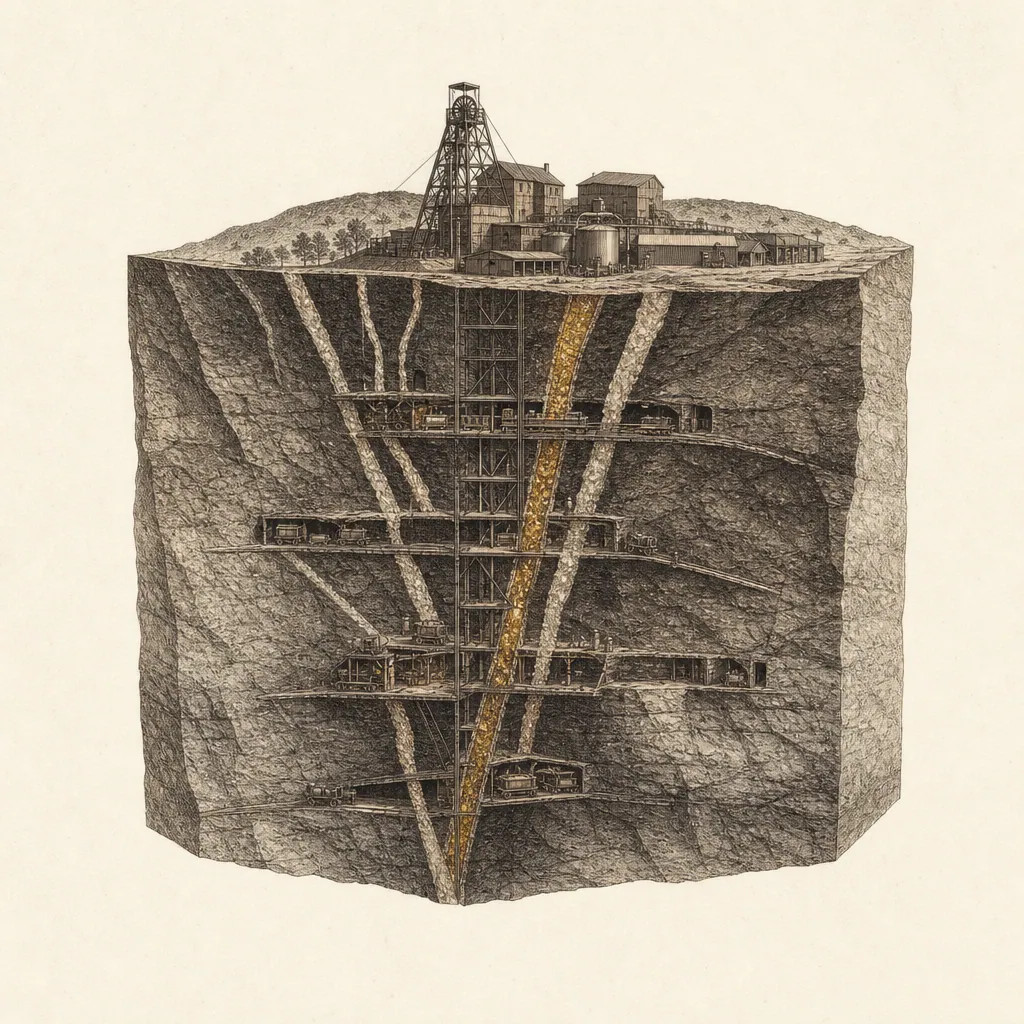
How Mine is the underlying of the option. Everything said in the first four chapters about strike, time value and gamma rests on the cash flow of this one mine — which is why it pays to know it precisely.
Located in Matabeleland South under Mining Lease ML 28, How is an underground gold mine with one of the longest continuous production histories in Zimbabwe: since 1941, around 1.82 to 1.84 million ounces. Through the Second World War, independence in 1980, the hyperinflation of the 2000s and the Metallon collapse, it has produced. That is not an exploration promise. It is a proof that no study can deliver: the deposit works geologically, metallurgically and politically. In 2025 How produced around 25,000 ounces — practically the company's entire production.
| How Mine | |
|---|---|
| Location / licence | Matabeleland South · ML 28 |
| Type | Underground, narrow-vein, open stoping |
| Production 2025 | ~25,000 oz |
| Guidance 2026 | 28,000–31,500 oz · EBITDA 50–62 m USD |
| Processing | own CIP plant, ISO-certified |
| Capacity | 40,500 t/month → 55,000 t/month (target H2 2026) |
| Reserves | 103,000 oz @ 1.29 g/t (as at 31 Dec 2025) |
| Historical production | ~1.82–1.84 Moz since 1941 |
The expansion — status September 2026. The concrete operational catalyst is the mill expansion from 40,500 to 55,000 tonnes per month, plus 36 percent throughput, planned for the second half of 2026. The operational update of 2 June confirms an "advanced stage" with major components on site; the website reports the installation of the last major component. What has not been reported as of 19 September: mechanical completion and start of commissioning. With a target of "H2 2026", a good three months remain for that. That is not a delay — but it is the point at which the next verifiable operational proof falls due, question 6 of the catalogue and falsification criterion F3. The Ecobank facility of 20 July — 5 million USD, 36 months, borrower BMC — is expressly designated for capital works at How.
Why the growth in 2026/27 comes from How — and what Redwing can contribute before then. The guidance of 28,000 to 31,500 ounces is How plus the ramping expansion; Redwing is not in it, nor is Mazowe. The solid, near-term visible story is How, and it is solid enough to carry the option's time value on its own. But Redwing is not a new discovery; it is a mine with shafts, drives, a grid connection and a plant that ran until 2019. Once the upper levels are dry, a refurbished legacy plant with limited throughput — ore from already developed levels, processed in existing or mobile capacity — is not a restart in the sense of the DFS but a forerunner that the company can carry from its own cash flow and the Ecobank facility. That would be possible in 2027/28, it would generate cash flow before the bank financing, and it would feed the DFS with operating data. It appears in no announcement, and this work carries it as a scenario, not as a plan. Whoever rests the thesis on a fast doubling through Redwing overstretches the base case's timeline — whoever rules out the forerunner underestimates what a brownfield mine can do above the strike.
The narrow-vein geology. Narrow, steeply dipping gold veins are mined by open stoping: stopes along the vein, selective extraction, low dilution. The advantage is selectivity; the disadvantage is that the production rate is limited by the geometry. That is exactly why the mill expansion is the decisive lever: it raises throughput within the geological limits. And the deep drilling down to Level 40, which continues to intersect mineralisation, means that the stated 88,000 ounces of reserve are a floor — an embedded, free extension option on the cash flow.
How as a source of financing — and as the definition of the strike. A producing mine with positive free cash flow can carry part of the revival of its sister projects and soften the externally financed requirement. The EBITDA guidance of 50 to 62 million is this internal source. It does not cover 300 to 400 million — but it is what a project financier examines as debt-service capacity during the construction phase. And here lies the precise meaning of the strike from Chapter 1: at 4,300 dollars, How's cash flow is an argument. At 4,500 and above, with 55,000 tonnes of throughput and 40,000 ounces, it is collateral. The difference between argument and collateral is the difference between an option out of the money and one in the money.
How is the proof that Namib Minerals is not a pure hope stock. A valuation of NAMM on How alone — as a single-asset producer with 30,000 ounces growing to 40,000 — yields, at industry multiples, a value well above today's share price. Redwing and Mazowe are what turns this solid single-asset case into an option.
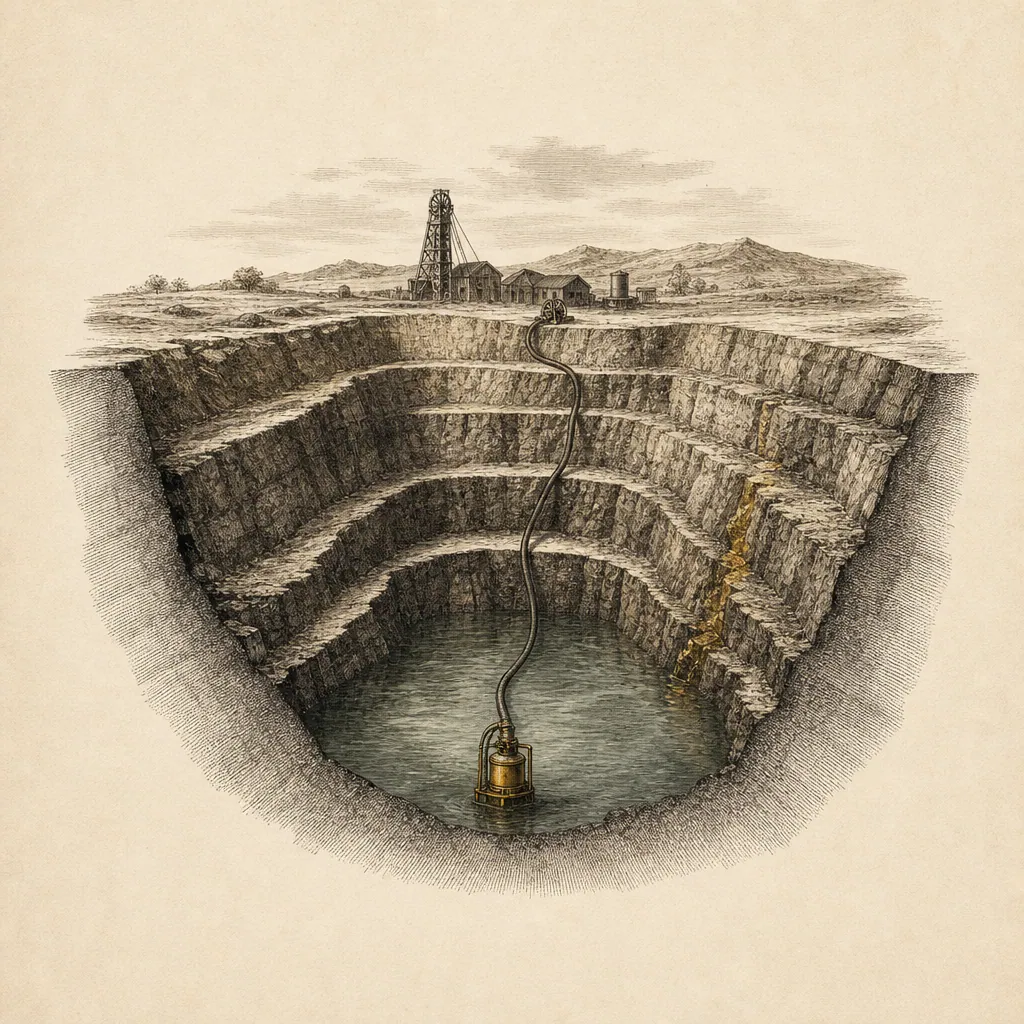
Redwing is the place where the option runs into the money — or does not. The brownfield mine in Manicaland under ML 34, at Penhalonga near Mutare, has historically produced around 650,000 ounces before it fell into care and maintenance under Metallon in April 2019. Its resource base is the company's largest: 1.18 to 1.19 million ounces Measured & Indicated at 3.83 grams, plus 1.33 million ounces Inferred at 2.61 grams.
The dewatering — and the path that is dated for the first time. The pump has been running since 29 January 2026; over the first months more than 544,000 cubic metres, water level at around minus 22 metres, around 640 cubic metres an hour. The first survey could cite these figures but not what comes after them. Now it can: on 20 July the company published, via 6-K, a five-stage restart path in which each stage releases the next.
| Stage | Content | Date | Financing | Status |
|---|---|---|---|---|
| 1 | Dewatering | completion Q4 2026 | internal | running, "on track" |
| 2 | DFS, technical programme (WSP, S-K 1300) | completion early Q1 2027 | internal, freed up by Ecobank | running |
| 3 | Resource definition and bankability: 8,750 m of surface drilling, geotechnics, metallurgy, FEED, costs, environment | completion Q4 2027 | not reported | to follow |
| 4 | Financing decision and project debt | after stage 3 | 300–400 m USD for Redwing and Mazowe together, staggered | open |
| 5 | Underground access, plant, TSF, production | after stage 4 | — | 2029 in the base case; 2028 with gold above the strike |
The decisive sentence is in stage 3: the resource definition, without which no bank finances, is completed at the end of 2027. The first survey had carried "2028 or later". By the company's own path, 2028 in the base case is the year of financing and construction start and 2029 the first year of production — and this work records that this path comes from an announcement that dates it for the first time at all; a dated path is worth more than an undated hope. But the path was written at 4,300 dollars gold. If gold breaks out upward — above 4,500 and all the more above 5,000 — then stage 3 is no longer a precondition that banks wait for but a formality that runs in parallel to the financing: a price deck 1,000 dollars above the study's makes any conservative resource bankable, and stage 4 begins in 2028 instead of 2029. For the option this means: the strike must not only be reached, it must be held — and every quarter it is held claws back a quarter of the timetable.
The full funding — read precisely. The announcement bears the title "Fully Funded Through to Completion", and that is true for stage 2. But the mechanism: the DFS has so far been paid out of running cash flow, "which governed the pace at which the work could progress" — it is fully funded because the Ecobank facility takes over the How capital works and frees up internal cash flow. Orderly capital allocation, no sleight of hand, but: the self-financing of the study hangs on a loan, not on surplus liquidity. Stages 3 to 5 are not financed.
Why brownfield beats greenfield. A mine that has already produced brings a head start in de-risking that no discovery can deliver: known geology, proven metallurgy, partly existing infrastructure, an established permitting history. Redwing was not shut down because it was exhausted but because Metallon ran out of capital. That shifts the risk from incalculable exploration to calculable execution and financing risk — and financing risk is, as the first book showed, a function of the gold price.
The legacy — unvarnished. This work would fail its own standard if it concealed the scandal. In March 2025, Inhlase and GroundUp documented, under the title "Deaths, cover-ups and bribes at Zimbabwe's lawless Redwing Mine", the state of the mine in the phase before NAMM: after the corporate-rescue proceedings around 2020, Redwing was de facto controlled by Betterbrands Mining, an actor with ties to the ZANU-PF politician Scott Sakupwanya. More than 3,000 open pits, more than 100 documented deaths from gas poisoning and collapses without official records, reports of corruption, police and army members with their own pits. That is the reality from which the water is receding. Formalisation through NAMM — a regulated, capitalised, supervised dewatering — is the resolution of this scandal, not its continuation. But the reputational legacy remains a risk that must be managed, and it is the ground on which the next episode grows.
The corporate-rescue notice of September. In mid-September a corporate-rescue notice was published in the name of Redwing Mining Company, issued by Raynos Gumbo of Gumbo & Associates. The company reacted on 14 September in unusually sharp form: it had "categorically" not placed itself under corporate rescue and had authorised no one; the notice was false, defamatory and part of "fraudulent attempts to unlawfully interfere in the affairs of the company"; it would pursue civil and criminal action, lodge a complaint with the Law Society of Zimbabwe and file a police report.
The history falls predominantly in the company's favour. The corporate-rescue orders of the Metallon era were lifted in 2021 (Mazowe) and 2022 (Redwing). In early 2024, Redwing employees failed before the High Court on formal defects under section 124 of the Insolvency Act, on non-disclosure and on time-barred claims. An application for Mazowe from February 2024 is, according to the 20-F, still pending, the hearing postponed — with the company pointing to "the recent withdrawal of the principal petitioner's application" and recording that both mines had "successfully defended several legal applications that were filed in 2024". Such applications are a recurring tool of former participants at these mines, and so far they have failed without exception.
This work assesses the notice by what is verifiable: the company did not authorise it and is taking legal action against it. What is not verifiable is whether an application was filed with the High Court and by whom — question 13, and the company has published no 6-K. For the option: a fraudulent notice is a stress signal for the environment, not an expiry event. An admitted proceeding would be one — criterion F8.
The dewatering arithmetic. At around 640 cubic metres an hour, around 15,000 cubic metres a day and around 460,000 a month are pumped; the reported 544,000 cubic metres correspond to a good five weeks of pumping, and the cumulative volume since January is arithmetically a multiple of that but is not reported on a running basis. Whether dewatering is completed by Q4 2026 depends on the total depth of the flooded zone and on the inflow, which are not fully quantified publicly. The regularly reported, internally consistent figures are what one expects from a seriously run project, and not what one would see from a PR vehicle.
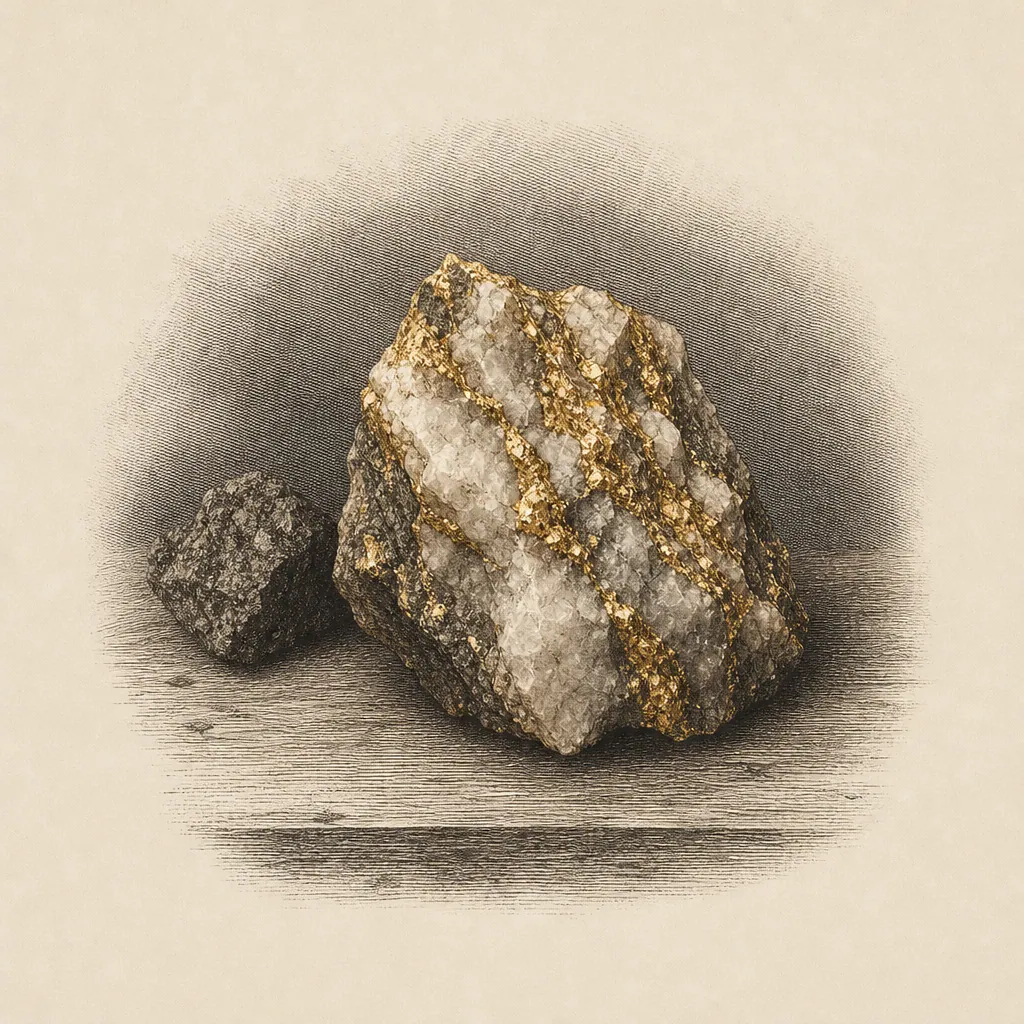
Mazowe is the second stage of the cascade and the least priced. The mine lies in Mashonaland Central, north of Harare, and was historically the highest-grade of the Metallon portfolio. Its resource is smaller than Redwing's, but its grade is the highest in the company and, in the Inferred category, among the highest in African underground mining: around 790,000 ounces Inferred at 8.65 grams per tonne. For comparison: the global average of producing underground gold mines lies between three and five grams.
Why the grade changes everything. An ounce at 8.65 grams needs half as much rock as one at 4 grams — half as much drilling, blasting, hoisting, milling. The cost structure of a high-grade mine is structurally lower, its operating leverage to the gold price structurally higher. And in the option logic of this text: its strike lies lower. A Mazowe restart would pay at a gold price at which a Redwing restart still needs arguments. That is why Mazowe is potentially not the third but the second stage of the cascade — once Redwing has proven that the company can finance and execute a restart.
| Mazowe | |
|---|---|
| Location | Mashonaland Central |
| Resource | ~0.79 Moz Inferred @ 8.65 g/t |
| Status | Care & maintenance since the Metallon collapse; flooded |
| Corporate rescue | 2021 order lifted; Feb. 2024 application pending, hearing postponed, principal petitioner withdrawn |
| Study | WSP feasibility announced; no date (question 9) |
| Value in the share price | zero |
The flooding question. Mazowe, like Redwing, is flooded, and unlike at Redwing there is no ongoing dewatering and no dated path. The announcement of 20 July names Mazowe as a "planned restart" without a timeframe. That is honest, and it means: Mazowe is an option on an option — it becomes part of the cascade only once Redwing is financed. Its value in the share price is zero, and for a flooded mine without a timetable that is appropriate. Its value in the cascade is substantial, because it would be the proof that the company does not merely pull off one revival but has a business model.
The depth. Mazowe was historically mined down to the 18th level. What lies beneath is untested — and untested means not rich but unknown. The resource is Inferred, the lowest confidence category; a feasibility study could confirm, expand or reduce it. This work therefore includes Mazowe nowhere in a valuation. It carries it as what it is: the second stage of a cascade whose first has not yet ignited, with a grade that — if confirmed — would change the cost structure of the entire company.
The resource base has changed since the first survey in one place that the first survey overlooked: the 20-F of April 2026 carries for How a new estimate as at 31 December 2025, calculated with a gold price of 3,600 dollars for the cut-off — and this re-estimate has multiplied How's Measured & Indicated sevenfold, from around 147,000 to 1,046,000 ounces, at a grade that fell from 2.21 to 1.36 grams. Redwing and Mazowe remain at the status of 31 December 2023, calculated at 2,340 dollars. The next estimate comes with the Redwing resource definition at the end of 2027. The table follows the 20-F.
| Asset | Date / cut-off price | M&I | Grade M&I | Inferred | Grade Inferred | Reserves |
|---|---|---|---|---|---|---|
| How, underground | 31 Dec 2025 · 3,600 USD | 1,046 koz | 1.36 g/t | 2,176 koz | 2.18 g/t | 103 koz @ 1.29 g/t |
| How, tailings | 31 Dec 2025 | — | 220 koz | 0.59 g/t | — | |
| Redwing | 31 Dec 2023 · 2,340 USD | 1,188 koz | 3.83 g/t | 1,328 koz | 2.61 g/t | none (DFS pending) |
| Mazowe | 31 Dec 2023 · 2,340 USD | 291 koz | 7.77 g/t | 915 koz | 8.65 g/t | none (study pending) |
| Total | 2,525 koz | 2.26 g/t | 4,639 koz | 103 koz |
Note on the count: the first survey worked with around 4 Moz (1.6 Moz M&I, 2.4 Moz Inferred) on the old How basis. This work keeps the 4 Moz as the conservative basis for all ratios — it corresponds roughly to the inventory without How's re-estimate at 3,600 dollars and without tailings — and cites the 7.2 Moz of the 20-F as the upper bound. On the conservative basis, 73 million of market capitalisation is around 19 dollars per ounce; on the full basis around 11.
What the table tells. First: the gold price is a strike for the resource as well. How's re-estimate shows what a higher cut-off price does to a deposit — seven times more M&I ounces at a lower grade, because material that was waste at 2,340 dollars is ore at 3,600. Redwing and Mazowe have not yet been recalculated; the DFS will do it, with a price deck closer to 4,000 than to 2,340. Second: the weighted M&I grade of 2.26 grams is depressed by How's re-estimate; Redwing at 3.83 and Mazowe at 7.77 grams lie above the average of producing underground mines, Mazowe far above. Third: the only reserve — that is, the only ounce with demonstrated economics — is 103,000 ounces at How. Everything else is resource, and resource is a statement about presence, not about mineability. Fourth: around 4 million ounces of the conservative basis against 73 million of market capitalisation is around 19 dollars per ounce, the full 7.2 million around 11 — where African mid-tier producers carry 100 to 250 dollars.
The value staircase. An ounce moves from Inferred via Indicated and Measured to Reserve, and each step raises its value because it removes uncertainty. Redwing's 1.19 Moz M&I are the candidates for the next step, and the 8,750 drill metres of the 2027 resource definition are the way there. The counter-calculation belongs with it: that Redwing and Mazowe have no reserves means that their economic mineability is formally not demonstrated. A feasibility study can conclude that parts of the resource are not profitable at realistic costs — in particular Redwing's Inferred at 2.61 grams. The staircase does not lead upward by guarantee.
The option reading. In the language of the first book, the resource base is the notional of the option: what it is written on. 4 million ounces are, at 4,300 dollars, an in-situ value of 17 billion; the 7.2 million of the 20-F would be 31 billion. Nobody gets in-situ values; they are an upper bound, not a valuation. But they say how large the thing is on which 73 million of market capitalisation is a claim — and why the payoff above the strike cannot be linear.
The operating figures for 2025. Around 25,000 ounces, an adjusted EBITDA of 29 million USD, an operating cash flow of 13.8 million. And a net profit of 101.2 million — which misleads. It stems predominantly from non-cash revaluations of the SPAC instruments: when the share price falls, the fair value of earnout and warrants falls, and the difference is booked as profit. A trailing P/E near 1 is therefore not a valuation metric but an accounting artefact. The anchor of truth is operating cash flow, and for a single-asset mine with 25,000 ounces it is respectable.
The 2026 guidance. 28,000 to 31,500 ounces; EBITDA 50 to 62 million USD. That is the leverage in numbers: a production increase of around 20 percent and a gold price that is higher on the annual average yield EBITDA growth of 70 to 110 percent. Multiplicative, not additive — Chapter 14.
The balance sheet — two worlds. At year-end 2025: 1.9 million USD cash, working capital minus 37.4 million, total liabilities around 102 million, equity minus 39 million. That looks alarming and falls apart into two completely different worlds. The real, cash-repayable financial debt is around 5 million — a term loan at ABC Zimbabwe and operating lines, due 2028, well covered. The remaining roughly 97 million are SPAC fair-value positions: earnout and warrants, which are settled in shares, not in money. They are dilution, not insolvency risk. The notes confirm: no going-concern qualification, liabilities of the mothballed mines ring-fenced, all covenants complied with.
| Item | Amount (USD) | Character |
|---|---|---|
| Total liabilities | ~102 m | optically alarming |
| of which real financial debt | ~5 m | cash, secured, due 2028 |
| of which SPAC fair value | ~97 m | earnout + warrants → shares |
| Cash (31 Dec 2025) | 1.9 m | H1 2026 figures not published to date |
| Ecobank facility (July 2026) | +5.0 m | 36 months, borrower BMC, for How |
| Equity | −39 m | over 90 % SPAC artefact |
The channels of theta — in numbers. Chapter 4 named them; here they stand with their source.
| Channel | First survey | Status September 2026 | Source |
|---|---|---|---|
| Cohen promissory note | ~3.5 m USD, convertible into 1.75 m shares | 3.5 m USD, restated 9 Dec 2025; 1,620,302 shares already issued; up to 1,629,698 more registered | F-3 |
| Shares outstanding | 54.5 m | 55,852,406 (27 July 2026) | F-3 |
| Reserved shares | — | 55,574,152 for incentive plan, warrants, earnout, Cohen | F-3 |
| Warrants | 18.576 m @ 11.50 USD | unchanged | F-3 |
| F-3 resale | — | 80.6 m shares registered; ~45 m of them already issued = 80.5 % of the outstanding | F-3 |
| Nasdaq MVPHS | — | deficiency Jan. 2026, cured 18 Feb.; arithmetically below 15 m again at ~1.30 USD | 20-F |
The "reserved shares" line is the one to remember: the company has reserved almost as many shares as it has outstanding. The dilution overhang of the first survey, around 92 percent, is no longer an estimate but a registration figure — an overhang of 99.5 percent, before a single dollar of restart capital has been raised. And the Cohen line shows how a company with 1.9 million in cash pays its bills: in shares, at prices that fell over the course of the year from 2 to 1.30 dollars.
The financing routes. Equity is the most dilutive route — at 300 to 400 million and 1.30 dollars that would be 230 to 300 million new shares, a five- to sixfold increase. Debt does not dilute but burdens the balance sheet — the Metallon trap. Streaming sells future production for upfront capital. Joint ventures share risk and upside at the asset level. In April 2026 management explicitly prioritised non- and low-dilutive routes, with DFIs in discussion; the Ecobank facility is the first signed step on this route — small, but in the right category. And Chapter 3 showed why the equity round is the least likely route: it would make the guarantors' bill even less payable.
The sales side. Namib sells to Fidelity Gold Refinery, the state refinery. 75 percent in USD, 25 percent in ZiG, less 3 to 5 percent royalty. The ZiG component is a real currency factor and part of the Zimbabwe risk in the sixth book.

The valuation gap has widened since June, and it has widened for a different reason than the first survey assumed.
| Metric | June 2026 | September 2026 | Industry |
|---|---|---|---|
| Share price | 1.90–2.01 USD | ~1.30 USD | |
| Shares | 54.5 m | 55.85 m | |
| Market capitalisation | ~107 m USD | ~73 m USD | |
| Enterprise value | ~112 m USD | ~77 m USD | |
| EV / EBITDA (2026 guidance, midpoint 56 m) | ~2.0× | ~1.4× | 4–8× |
| EV / resource ounce (~4 Moz) | ~27 USD | ~19 USD | African mid-tier: 100–250 USD |
| Gold price | ~4,300 USD | ~4,300 USD |
The last row is the finding: gold has not moved, EBITDA is growing, the pumps are running — and the valuation has fallen by a third. A market that looks at gold and operations does not do that. A market that looks at the ownership chain and the float does. Chapters 3 and 7 explained why.
The honest list — why the discount exists. Zimbabwe: frontier jurisdiction, exchange controls, ZiG share, political concentration. The float: four million shares, below the strike no institution can build a position, no analyst coverage with institutional reach. The ownership chain: an unpaid purchase price, a lapsed deadline, a guarantor who has sold. The dilution overhang: 55.6 million reserved shares, 80.6 million registered for resale. The governance: controlled company, dual role, three independent directors. The legacy: Metallon, Redwing, the scandal. The internal controls: disclosed material weaknesses. Each of these points justifies a discount on its own. Together they justify a substantial one. The question is not whether NAMM should trade cheaper than a producer in Nevada. The question is whether 1.4 times EBITDA — a multiple at which the company buys itself back in under two years — is the right price for this list.
The peers. African mid-tier producers — Perseus, West African Resources, Caledonia (also Zimbabwe) — trade between 4 and 8 times EBITDA and between 100 and 250 dollars per resource ounce. Caledonia, the closest comparison because of the same jurisdiction, carries a multiple of NAMM's valuation with a single mine, Blanket, which is smaller than How plus Redwing. The Zimbabwe discount alone therefore does not explain the gap; Caledonia carries it too. What distinguishes NAMM from Caledonia is not the country. It is the list above — and that stands almost entirely under the control of the company and its owners, not of the state.
The option reading of the valuation. In the language of the first book: 1.4 times EBITDA is the time value. The market pays for How alone, with a discount for everything on the list, and with zero for everything that would come above the strike. The peer multiples say what the payoff would be if the option runs into the money and the list cleans itself up: at 5 times EBITDA on 56 million that is 280 million — around 5 dollars per share on today's basis, around 2.50 dollars fully diluted — and that without Redwing. With a financed Redwing and 100,000 ounces in 2030 the industry calculates differently: 100,000 ounces at 4,500 dollars and 1,900 dollars AISC are 260 million EBITDA, at 5 times 1.3 billion, on 111 million fully diluted shares around 12 dollars. That is not a forecast. It is the payoff that the market values at zero today.
The analyst consensus. In June, seven analysts carried a consensus price target around 9.60 dollars. This work cites the figure as an external data point and does not adopt it as its own forecast; arithmetically it sits at seven times today's share price and is an indication of where a valuation lands that does not read the list as permanent.
The triangulation. Three routes to a value, without Redwing and without the strike: the peers' EBITDA multiple (4–6× on 56 m) gives 225 to 340 million. A resource multiple with a 50 percent discount to the lower peer edge (50 USD per ounce on 4 Moz) gives 200 million. A single-asset DCF of How (30,000 ounces growing to 40,000, ten years, 8 percent) gives 150 to 250 million. All three land at two to four and a half times today's market capitalisation — for How alone, at 4,300 dollars, without the option running into the money. That is the intrinsic value on which the market imposes a discount of 50 to 80 percent because the list weighs on it. It is also the operating floor as long as the contract holds: what happens if the strike is never reached and the list nevertheless slowly cleans itself up.

A mine with high fixed costs translates every gold-price move disproportionately into cash flow. That is the simplest and most important calculation in this text, and it is the reason the option has a gamma at all.
How produces at all-in sustaining costs that the company guides for 2026 at 2,400 to 2,700 dollars per ounce and that stood at 2,546 dollars in 2025; this work assumes — in the upper half of the range — around 2,600 dollars. At 4,300 dollars gold, every ounce earns 1,700 dollars. At 5,600 dollars, the January high, it earns 3,000. The gold price rose 30 percent; the margin per ounce rose 76 percent. That is the first lever, and it is purely arithmetical.
The second lever is volume. The mill expansion lifts production from 30,000 to 40,000 ounces — plus 33 percent. Both levers multiply: 30,000 ounces at a 1,700-dollar margin are 51 million; 40,000 ounces at a 3,000-dollar margin are 120 million. The gold price rose 30 percent, production 33 — and EBITDA 135.
| Gold, USD/oz | Margin per oz (AISC 2,600) | EBITDA at 30,000 oz | EBITDA at 40,000 oz |
|---|---|---|---|
| 4,000 | 1,400 | 42 m | 56 m |
| 4,300 (today) | 1,700 | 51 m | 68 m |
| 4,500 (strike) | 1,900 | 57 m | 76 m |
| 5,000 | 2,400 | 72 m | 96 m |
| 5,600 (January high) | 3,000 | 90 m | 120 m |
| 6,500 | 3,900 | 117 m | 156 m |
For comparison: the 2026 guidance (50–62 m at 28,000–31,500 oz) sits in the 4,300–4,500 row — the table is calibrated to reality.
The third lever — the reserves. A higher gold price lowers the cut-off grade above which rock is economic, and turns resource into reserve without a metre being drilled. At How, where mineralisation continues to Level 40, that extends the mine life. At Redwing, where 1.33 million ounces Inferred sit at 2.61 grams, the cut-off decides whether half the resource is mineable or not. This lever is invisible until a study reports it — and the Redwing DFS will calculate with a price deck that the 2023 study did not have available.
Why AISC is the decisive number. Everything in this chapter hangs on the cost assumption. The company reports AISC — 2,546 dollars for 2025, 2,400 to 2,700 in the 2026 guidance; this work assumes 2,600 and considers the figure conservative. Were it 2,200, every row of the table would be 12 to 16 million higher. Were it 3,000, lower by as much. Whoever wants to test the thesis should test this number first — the 2026 guidance is the best public anchor, and it confirms the order of magnitude.
The decomposition. Gold times costs times volume. The market sees only the first factor and trades gold equities as leveraged gold. At NAMM all three act simultaneously, and then there is the fourth, which appears in no mine calculation: the float. If 40,000 ounces at 5,600 dollars deliver 120 million EBITDA and the market pays 5 times for it, that is 600 million of market capitalisation — and whoever wants to buy this re-rating into four million free shares does not pay 600 million. He pays the clearing price. That is the bridge from Chapter 14 to Chapter 2.
The tables in this chapter are maps, not forecasts. They show what the stock would be worth if certain things occur — and they show it deliberately on two share bases: today's 55.85 million and the fully diluted roughly 111 million that arise when earnout, warrants, Cohen note and the other reserved shares are fully converted. The second column is the more honest one. The first shows why insiders accepted lock-up thresholds at 12.50 and 15 dollars.
Table A — How alone, multiple 5× EBITDA. This is the case in which the strike is never reached, Redwing is never financed, and the list from Chapter 13 cleans up only far enough for NAMM to get a normal peer multiple.
| Gold, USD/oz | 30,000 oz — basic / diluted | 40,000 oz — basic / diluted |
|---|---|---|
| 4,000 | 3.80 / 1.90 | 5.00 / 2.50 |
| 4,500 | 5.10 / 2.60 | 6.80 / 3.40 |
| 5,000 | 6.40 / 3.20 | 8.60 / 4.30 |
| 5,600 | 8.10 / 4.00 | 10.70 / 5.40 |
| 6,500 | 10.50 / 5.30 | 14.00 / 7.00 |
Even the top-left cell — gold falls to 4,000, the expansion fails, full dilution — sits at 1.90 dollars, above today's share price. That is the floor of this map — the operating floor, which holds as long as the contract holds; what suspends it is in Chapter 19 — and it is the reason the option has, even out of the money, a time value that is not zero.
Table B — the cascade, 2030, fully diluted. This is the case above the strike: Redwing financed and in production (100,000 ounces), later Mazowe (another 100,000), blended AISC 1,900 dollars because of the higher grades, multiple 5×, 111 million shares. The restart financing is assumed to be debt; were it equity, the share count would have to be raised accordingly — Chapter 3 gave the reasons why that is the less likely route.
| Gold, USD/oz | How + Redwing (140,000 oz) — EBITDA / price | How + Redwing + Mazowe (240,000 oz) — EBITDA / price |
|---|---|---|
| 4,000 | 294 m / 13.20 | 504 m / 22.60 |
| 4,500 | 364 m / 16.30 | 624 m / 28.00 |
| 5,000 | 434 m / 19.50 | 744 m / 33.40 |
| 5,600 | 518 m / 23.20 | 888 m / 39.90 |
| 6,500 | 644 m / 28.90 | 1,104 m / 49.60 |
What the two tables say together. Table A is the time value: what NAMM is worth if it remains what it is today. Table B is the payoff: what it is worth if the option runs into the money and the cascade ignites. The distance between the two — at 4,500 dollars from 2.60 to 16.30 dollars, sixfold — is the convexity asserted in the first book. And the 4,500 row is no fantasy: it is the company's guidance price.
Dilution as a deliberate simplification. Both tables calculate without the equity component of a restart financing. Whoever considers it likely should raise the share count in Table B by the number of new shares he expects — at 100 million USD of equity at 5 dollars that would be 20 million, and every cell falls by 15 percent. The map remains legible. The EBITDA column of Table B is more robust than the price column because it is independent of the share count; the market capitalisation at 5× is five times it.
The time component. Table B is a picture of 2030. At 8 percent discount, a dollar in 2030 is worth 74 cents today, and the probability that the path there is traversed without delay, dilution or expiry is well below one. Whoever wants to translate the tables into an expectation should multiply them by his probability for the strike and discount. This work does not do that for him. It notes that at any probability above about 15 percent and any discount below 15 percent, an expected value well above 1.30 dollars remains — and that exactly this calculation is the reason the instrument can be valued as an option and not as a share.
This work is not technical analysis, and it will not become any. But a chart can show something tables cannot: the shape in which a market pushes a decision ahead of itself. NAMM's daily chart since the listing has such a shape, and it fits the mechanics of this text so precisely that it deserves mention — as illustration, not as proof.
The shape. On a logarithmic scale the chart draws, since the SPAC high in June 2025, two rounded forms, one inside the other. The large one: from the high, through the collapse of the second half of 2025, into the floor at 0.94 dollars in January 2026 and from there, in the January spike, up to 6.50 to 7.36 dollars — a cup whose right rim sits lower than the left, because the spike bounced off the falling line from the SPAC high. The small one: from the January high, through the summer months, into the floor between 1.20 and 1.40 dollars where the share price has sat since August — the handle of the large cup, itself shaped as a rounding. Both roundings contain the same detail: a falling wedge of two converging lines. The first, drawn from the June high, converged in the January 2026 floor and resolved with the spike, a sevenfold in four weeks. The second, drawn from the January high, is converging now; by the geometry its apex lies in the fourth quarter of 2026, at 1.20 to 1.30 dollars. The structure repeats one level lower, with the same sequence — rounding, wedge, resolution — and in September 2026 the share price stands at the point where it tipped the first time.
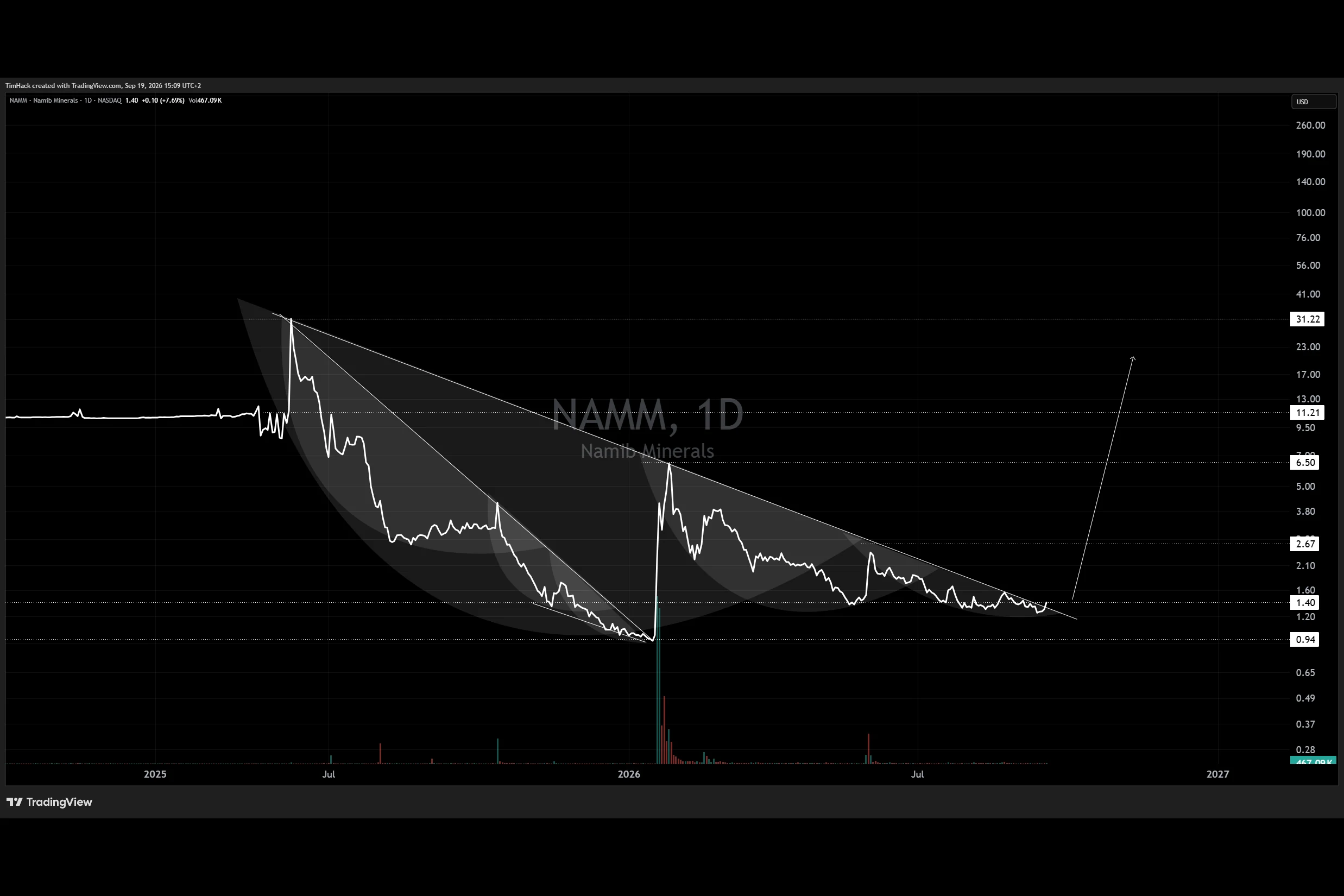
| Level | Price | What sits there |
|---|---|---|
| 0.91–0.94 | January low | floor of the large cup; Nasdaq minimum bid of 1.00 USD just above |
| 1.20–1.40 | floor of the handle | apex of the second wedge; 1.30 today |
| 2.00–2.67 | June level / spring resistance | first survey; first level above the handle |
| 6.50–7.36 | January high | right rim of the large cup; what a handle classically runs at; Table A (30,000 oz, basic) between 5,000 and 5,600 USD gold |
| 11.21–11.50 | warrant strike | warrants become a source of capital; the handle's cup depth projected from the rim |
| 12.50 / 15.00 | lock-up thresholds | insider shares become free |
| 20–31 | range of Table B; left rim of the large cup | cascade in the money |
What the shape means in the language of the option. A cup is a market that answers a collapse not with a V but with a rounding: the supply that drove the price down is absorbed over months until the floor flattens — accumulation, not panic. At NAMM this is to be taken literally: four million free shares change between hands that wait for the strike and hands that consider the list from Chapter 13 permanent, and the wedge in the handle is the compression of that exchange — buyers and sellers willing at similar prices in similar quantities, neither side tipping the balance. The gold price stands at 4,300 — close enough to the strike that nobody sells, far enough below it that nobody buys. The handle is, in the language of the first book, theta in picture form: time passing while nothing is decided in the underlying.
What the shape does not say. It does not say that history repeats. A handle that falls too deep — below half the cup's rim, and this one is far below it — already counts, in the textbook reading, as a break of the pattern; and the floor of the handle lies a few dozen cents above the Nasdaq threshold of one dollar. Whoever reads the chart as a bullish signal reads it wrongly. Whoever reads it as a timing statement — the wedge forces the decision into the next one to two quarters — reads it correctly. And the decision is not made in the chart. It is made in the gold price, in the investor call, in the deadline and in the DFS — that is, in the things this text surveys. The chart is only the picture of the market considering them near as well.
The breakout arithmetic, for completeness. The classic target projection of a cup with handle is the rim, then the cup's depth projected upward from the rim. For the handle that means: rim at 6.50 to 7.36, depth around five dollars, target around 11 to 12 — where, without the chart knowing it, the warrant strike of 11.50 and the first lock-up threshold of 12.50 sit. For the large cup it means a rim at 20 to 31, the range of Table B; on a logarithmic scale that is no longer a target but an order of magnitude. A downward breakout has a target that does not exist, because below one dollar the Nasdaq mechanics take over. That is the asymmetry of the chart, and it is the same as the asymmetry of the option: bounded below by a floor that is institutional, open above to the next threshold.
The first survey treated this chapter at length; here it stands in the form that fits the mechanics.
The Barron's Gold Mining Index rose from the end of 1969 to October 1980 by around 1,247 percent, while the S&P 500 delivered about 43 percent. Within this cycle the major producers delivered ten to twenty times. The juniors — small producers, revivals, explorers with one mine — delivered fifty to a hundred times in 1979 and 1980, some more. The difference lay not in the quality of the deposits. It lay in three properties the winners shared: a low starting valuation, high operating leverage through grade and cost structure, and a tight market for the stock in which a re-rating occurred not linearly but in jumps.
One recognises the three properties. They are time value, leverage and float — Chapters 1, 14 and 2 of this work.
| Property of the 1979 winners | NAMM 2026 |
|---|---|
| Low starting valuation | 1.4× EBITDA; 19 USD per resource ounce |
| High leverage through grade and costs | 3.9 g/t weighted; Mazowe 8.65 g/t; fixed-cost mine |
| Tight market, jumpy re-rating | float ~4 m shares; January 2026: 26× beta |
| Growth path through production increase | How expansion +36 %; Redwing restart; Mazowe |
The anatomy of a junior cycle. It does not begin with the juniors. It begins with the metal, passes through the seniors, then the mid-tiers, and reaches the juniors last — but then with the greatest amplitude, because by then the capital that wants into the sector finds no more seniors at defensible prices and crowds into the tight names. Gold has more than doubled since 2024. The seniors have been re-rated. The mid-tiers too. The juniors — and NAMM is among the producing juniors on a US exchange one of the cheapest — have not yet been, and January showed what happens when they are for a month.
What history proves and what it does not. It does not prove that NAMM makes a hundredfold. It proves that stocks with exactly this profile in exactly this market environment have made a hundredfold in the past — and that afterwards, 1981 to 1985, they lost most of it again. The historical precedent is an argument for the existence of the right tail of the distribution, not a guarantee of its repetition, and it is equally an argument that a position in such an instrument needs an exit plan. Today's conditions differ: stricter regulation, more efficient markets, a float that arises from obligations and not from a scarcity of free holders. But the mechanics are the same, and the mechanics are what this work grounds its observation on.
The option has an underlying, and the underlying lies in Zimbabwe. The first survey devoted four chapters to the country — macro, politics, climate, expropriation. This second one combines them into one, not because the country has become less important, but because in three months little has changed about Zimbabwe and much about the company. What remains is the finding: Zimbabwe is the reason the option is so cheap, and Zimbabwe is, alongside the ownership chain, the one factor that can render the option worthless without anything happening to the gold price.
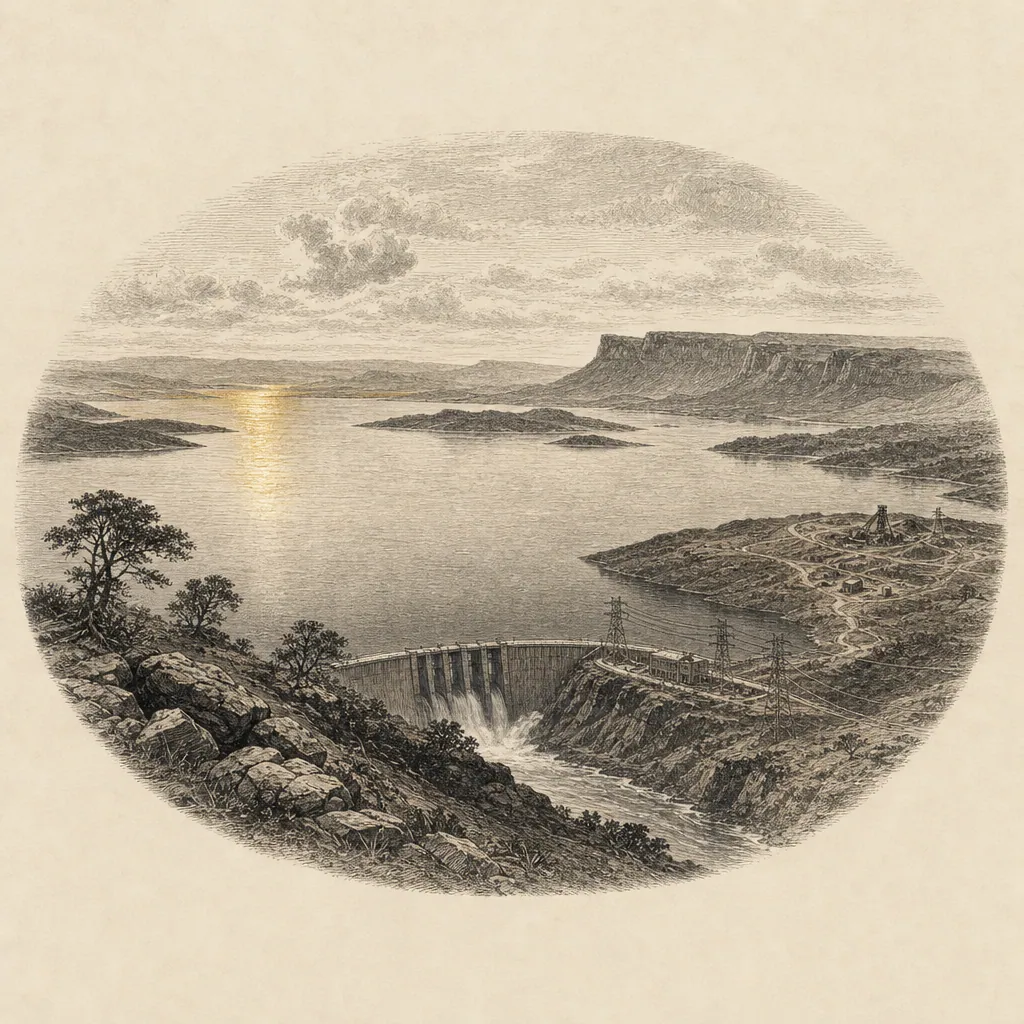
Macro — the dual nature. The country in which NAMM produces is no longer the country of hyperinflation to which the discount implicitly refers. GDP grew by around 6.6 percent in 2025, forecasts for 2026 lie between 5 and 8.5 percent, inflation was in single digits in January 2026 at around 4.1 percent for the first time in decades, and an IMF staff-monitored programme accompanies the stabilisation. Mining and agriculture carry the growth. At the same time the fragility is real: low scores for democracy and the rule of law in the Bertelsmann Transformation Index, widespread poverty, a power supply that depends on the level of the Kariba dam and produces load-shedding in drought years — those power cuts that paralysed Metallon's energy-intensive underground operations and became a contributing cause of its failure. Zimbabwe is not Botswana. It is a high-risk environment, and exactly this fragility is a legitimate part of the discount.
| Factor | Finding | Direction for NAMM |
|---|---|---|
| Growth | ~6.6 % (2025), 5–8.5 % (2026e) | positive |
| Inflation | ~4.1 % (Jan. 2026), single digits for the first time | positive, reversible |
| Currency | ZiG, gold-backed; 25 % of revenues | double-edged |
| Power | Kariba-dependent; load-shedding in drought years | negative, operational |
| Rule of law | low BTI scores; Constitutional Amendment No. 3 | negative, structural |
| Treasury | gold as strategic source of foreign exchange | protective |
The currency. NAMM sells its gold to the state-owned Fidelity Gold Refinery and receives 75 percent in US dollars and 25 percent in ZiG, less a royalty of 3 to 5 percent. A quarter of revenue in a soft currency is a devaluation and a convertibility risk, and both push the effective margin below the nominal value. There is a symmetry that softens the risk without removing it: the ZiG is nominally gold-backed, and a gold producer paid partly in a gold-backed currency is partially hedged against the devaluation of this specific currency — insofar as the backing holds, which depends on the discipline of Zimbabwean monetary policy. For the option this means: the ZiG component is a discount on the time value, not a factor that moves the strike.
Politics. Emmerson Mnangagwa has governed since 2017, ZANU-PF since 1980. Constitutional Amendment No. 3 — term of office from five to seven years, possible postponement of elections to 2030, switch from direct to parliamentary election of the president — is highly controversial in democratic terms, and the protests against it (students, opposition, diaspora) are suppressed by police. For a mining company with multi-year capital deployment, the same amendment means extended predictability. Both are true, and this work records both. The underestimated risk is a different one: Mnangagwa is around 83 years old, and transitions in authoritarian-leaning systems are unpredictable — the one from Mugabe to Mnangagwa in 2017 ran in an orderly fashion within the party, but that is a data point, not a law. The term extension can be read as consolidation of power or as postponement of a succession question whose unregulated resolution would be the greater risk.
Climate — risk, not tailwind. The temptation to declare the climate an ally of the thesis is great; the data do not support it. The IPCC (AR6) and the regional models project for Zimbabwe and southern Africa rather a decrease in mean annual precipitation — in the order of 5 to 20 percent by the end of the century — more frequent, often El Niño-driven droughts and at the same time more intense individual heavy-rain events. In 2024 a national drought disaster was declared. For NAMM this is a double risk: drought lowers the Kariba level and with it the power supply and threatens the process water; heavy rain threatens tailings, workings and infrastructure — it was a flood that shut down Mazowe in 2018. The one real water advantage comes not from the climate but from the operation: the Redwing dewatering pumps large volumes of groundwater that can be used as process water, provided quality (acid mine drainage, heavy metals) and inflow are controlled — details that only the DFS and the environmental review will deliver. Manicaland is moreover relatively richer in water than other parts of the country. That softens the drought side. Against flood and power scarcity it does not help.
Expropriation — examined. The provocative thesis that NAMM is so cheap because it will ultimately be nationalised — raise capital on Nasdaq, develop Redwing, then expropriation — deserves examination rather than reflex. It does not hold, for four reasons. First, the company's strategy is inconsistent with a planned loss of the asset: whoever builds platform, dewatering and DFS plans for decades. Second, Zimbabwe has softened its indigenisation legislation since about 2020; for large mines 100 percent foreign ownership is possible, and the government courts capital, visibly in the lithium boom. Third, the ZIDA Act offers an investor-protection framework. Fourth, a bait-and-switch against a Nasdaq-listed company would be self-harming for the state: bilateral investment treaties, arbitration, the end of the laboriously built access to capital. The game theory is unambiguous — the one-off gain of an expropriation is limited, the repetition costs are permanent, and a state that needs foreign exchange and regards gold as one of its few reliable sources of it has a naked fiscal interest in gold mines producing. It is not trust in abstract rule of law that protects the NAMM shareholder, but the state's self-interest in taxes, royalties and foreign exchange from running production. That is not a proof — states do not always act rationally — but it shifts the probability markedly downward. Expropriation belongs in the matrix as a tail risk, not as a base expectation.
What the terrain means for the option. Zimbabwe explains why the option is available at one dollar of time value and not at three. It does not explain why it rose to 7.36 in January and has fallen to 1.30 since — in these eight months nothing about Zimbabwe has changed that would justify this path. The country is the constant discount in the price. The variable is the company. And that is why this second survey treats the terrain in one chapter and the ownership chain in three.
Here the work tests itself. It ranks every risk by severity and by what it hits in the option — the underlying, the time or the contract itself — defines in advance which observable events would refute the thesis, sets the eighteen questions to the company beside the public state of facts, and then draws the conclusion.
The matrix. The first survey carried "Metallon legacy" as a reputational and litigation risk. That was too weak. The ownership chain belongs at the top, because it is the only risk that concerns not the value of the assets but their ownership — in the language of the option: it hits not the underlying but the contract. The fourth column assigns each risk to the part of the option it damages.
| Risk | Severity | Description | Hits | Chapter |
|---|---|---|---|---|
| Ownership chain / BMC purchase price | high — new | 53.2 m GBP "not satisfied" per 20-F; deadline 5 June 2026 lapsed, outcome not disclosed; 4.9 % of shares pledged; risk of "rescind or unwind" | the contract | 6, 7 |
| Conflict of interest trust ↔ board | high — new | CEO and chairman in one person is director of the guarantor's trustee company and signatory of the Deed of Assignment | the contract | 7 |
| Capital requirement and dilution | high | 300–400 m USD against ~73 m USD market capitalisation; 55.6 m reserved shares (+99.5 %); F-3 puts 80.5 % of issued shares up for resale | time | 3, 12 |
| Execution / restart delay | high | Redwing production 2029 in the base case (2028 with gold above the strike); resource definition Q4 2027; Mazowe without a date | time | 4, 9, 10 |
| Gold price | high | the underlying; below 4,500 USD the option is out of the money, below 3,000 less than 400 USD of margin per ounce remains, at 2,600 break-even | underlying | 1, 14, 15 |
| Liquidity / float | high | effective float ~4–4.5 m shares against 4.0 m borrowed and 2.7 m pledged shares; amplifies in both directions | time (gamma) | 2, 7 |
| Corporate-rescue applications | high — re-weighted | notice in Redwing's name September 2026 (rejected by the company as fraudulent); Mazowe application of February 2024 pending per 20-F | the contract | 9, 10 |
| Zimbabwe political/economic | high | Constitutional Amendment No. 3, succession question, power, ZiG share, rule of law | time (constant discount) | 18 |
| Governance / controlled company | high | trust majority; three independent directors; minority without blocking minority | the contract | 7 |
| Internal controls | high | disclosed material weaknesses | the contract (data basis) | 5, 13 |
| Artisanal legacy Redwing | high | more than 100 deaths in the Betterbrands phase before NAMM; ESG, reputation | time | 9 |
| Nasdaq listing | medium — new | MVPHS deficiency January 2026 cured; at 1.30 USD arithmetically below 15 m USD again; minimum bid of 1.00 USD around 23 percent away | the contract | 4, 16 |
| Climate and water | medium | drought → power and process water; heavy rain → tailings and flood (Mazowe 2018) | underlying, operational | 18 |
| Expropriation / nationalisation | medium (tail) | real, but not the primary scenario; the state's fiscal interest works against it | the contract | 18 |
How to read the "Hits" column. A risk that hits the underlying is the ordinary case: gold falls, the option loses value, but it continues to exist, and when gold comes back, it comes back with it. A risk that hits the time shifts the point at which the strike takes effect — a restart in 2029 instead of 2028 costs time value, not the contract. A risk that hits the contract is the other category: if the ownership chain breaks, a court admits a rescue proceeding or the state intervenes, then it is irrelevant where gold stands. The option expires although it would be in the money. Three of the contract risks are new or re-weighted since June. That is the real finding of this matrix.
Falsification — F1 to F9. A thesis that does not say what would make it fail is not a thesis. The six criteria of the first survey remain valid; F1 receives a new date, three are added.
| No. | Assumption | Falsification | Consequence |
|---|---|---|---|
| F1 | Dewatering and DFS proceed on schedule | dewatering not completed by Q4 2026; DFS technical work not by early Q1 2027 | catalyst lapses; strike moves out in time |
| F2 | Restart financing without ruinous dilution | equity issue that more than doubles the share count at a price below 5 USD | cascade to be corrected downward; Table B becomes Table A |
| F3 | How expansion succeeds in H2 2026 | commissioning slips beyond 2027 or falls clearly short of capacity | time value falls; 2027 growth lapses |
| F4 | Gold price holds ≥ 4,000 USD/oz | sustained relapse below 4,000 USD/oz; below 3,000 the margin shrinks to a fraction | option stays out of the money; time value collapses |
| F5 | Zimbabwe respects property rights | state intervention, licence withdrawal, forced participation | contract expires |
| F6 | Material weaknesses remain controllable | restatement, audit qualification or delisting threat | data basis compromised |
| F7 | The ownership chain holds | Metallon or the administrators realise the pledged shares, announce a default or pursue the unwinding of the BMC sale — or the company confirms that the purchase price remains outstanding without extension or agreement | thesis hit in its foundation — not "not yet played out" but refuted |
| F8 | Corporate-rescue applications remain unsuccessful | a court admits a corporate-rescue proceeding for Redwing or Mazowe | control over the asset lost; restart plan void |
| F9 | Listing and board oversight remain intact | delisting from Nasdaq without transfer to the Capital Market; or a transaction by Namib, Greenstone or BMC that supports the guarantors in their purchase-price obligation | access to the capital market or minority protection lost |
F7 and F9 are the criteria that distinguish this second survey from the first. Both are decided not in years but in weeks — by an announcement the company can make as soon as it wants to. And both have a property the other seven lack: their opposite is equally datable. If the purchase price is reported as paid or the deadline as extended, and the board rules out supporting the guarantors, then not only have F7 and F9 not occurred — then the largest single reason for the discount since June has fallen away, without anything having changed about mines, gold or guidance. That is the asymmetry this work observes: the criteria that could refute the thesis fastest are the same that could confirm it fastest.
A thesis that dates its falsification criteria must also date its questions. The following eighteen were put to the company in writing on 28 August, 3 September and 18 September 2026. IR committed on 9 September to addressing "a number of the points" in the investor call later in September and to following up directly afterwards, "within the limits of what we can share publicly". None of the questions is rhetorical. Each has an answer the company knows and could give without disclosing material non-public information, because each refers to matters already named as risks in its own SEC filings. The "State of facts" column reproduces what is known from public documents as of 19 September 2026; the "Weight" column ranks what an answer means for the option. Whoever listens to the call can lay these tables beside it and tick them off.
Block A — BMC and Metallon: the ownership chain
| No. | Question | State of facts (public) | Weight |
|---|---|---|---|
| 1 | How much of the 53.2 m GBP purchase price has been paid, how much is outstanding? | 20-F FY2025: "to date has not been satisfied". No announcement since. | decisive — F7 |
| 2 | Is the outstanding amount solely the guarantors' obligation, with no payment obligation for Namib, Greenstone or BMC? | Yes per the contract ("Greenstone … has no obligation or liability to Metallon"). But: an indemnity does not protect against unwinding. | high |
| 3 | Is there a default notice, enforcement, lawsuit or intention of the administrators to unwind the BMC sale? | Deadline 5 June 2026 plus 30 days lapsed; nothing reported. The author's enquiry to the administrators (S&W Group) unanswered. | decisive — F7 |
| 4 | Can enforcement against the guarantors or their security affect Greenstone's ownership of BMC or BMC's operation of the mines? | 20-F: on non-payment, risk of "rescind or unwind" and recourse to "the shares of BMC". Security: 4.9 % of Namib shares. | high |
| 5 | Were proceeds from Khumalo's sale of ~4.9 m shares paid toward the purchase price? | 13D/A: 4,886,996 shares sold at ~3.46 USD (~16.9 m USD). Use not disclosed. | high |
Block B — How Mine: the time value
| No. | Question | State of facts (public) | Weight |
|---|---|---|---|
| 6 | Has mechanical completion of the mill expansion been reached; when does the commissioning update come? | 6-K 2 June: "advanced stage, key components on-site, H2 2026". Website: last major component installed. No commissioning reported. | medium — F3 |
| 7 | Is there new production and cost guidance once 55,000 t/month is reached? | Guidance 2026: 28,000–31,500 oz, EBITDA 50–62 m USD. No 2027 guidance. | medium |
Block C — Redwing and Mazowe: the strike
| No. | Question | State of facts (public) | Weight |
|---|---|---|---|
| 8 | Is the DFS technical programme on plan for early Q1 2027? | 6-K 20 July: stage 2 (DFS technical) early Q1 2027; stage 3 (8,750 m of drilling, bankability) Q4 2027. | high — F1 |
| 9 | Is WSP's Mazowe study running in parallel; what timetable? | Mazowe mentioned only as "planned restart"; no date. Corporate-rescue application of February 2024 still pending per 20-F, hearing postponed. | medium |
| 10 | Are staged restart variants with smaller initial capital being examined? | Staged path yes; capital figures for an initial stage no. | high |
| 11 | Do the 300–400 m USD apply to Redwing and Mazowe together and staggered? | Call 2 April: yes, over several years. No new figure since July. | high |
| 12 | Does the preference remain: How cash flow, project debt, DFIs before equity? | 6-K 20 July: DFS from internal cash flow; Ecobank 5 m USD, 36 months, non-dilutive. No DFI agreement reported. | high — F2 |
Block D — Addenda of 18 September
| No. | Question | State of facts (public) | Weight |
|---|---|---|---|
| 13 | Corporate-rescue notice Redwing: has an application been filed with the High Court, by whom? Is a 6-K coming? | Notice in Redwing's name by Raynos Gumbo (Gumbo & Associates); company: not authorised, fraudulent, police report announced. No 6-K — no SEC filing at all since 24 August 2026. | high — F8 |
| 14 | Cash as at 30 June 2026 and liquidity through to the end of dewatering and DFS? | 31 Dec 2025: 1.9 m USD cash, working capital −37.4 m USD; going concern without qualification. H1 2026 figures not published to date. | high |
| 15 | Share loan of 29 June 2026 (trust to Khumalo, 4.0 m shares): did independent directors and administrators know of it; further sales? | 13D/A: loan confirmed, secured with Khumalo's earnout shares. Third-party knowledge not disclosed. | high |
| 16 | Does the board rule out any transaction that directly or indirectly supports the guarantors in the purchase-price obligation? | Not addressed. CEO/chairman is director of the trustee company (Deed of Assignment). | decisive — F9 |
| 17 | Nasdaq: plan for the 1.00 USD minimum bid and 15 m USD MVPHS? | MVPHS deficiency Jan. 2026, cured 18 Feb. 2026. At 1.30 USD and a small public share, the arithmetical MVPHS is below 15 m USD; no new letter reported. | high |
| 18 | Cohen note: shares issued so far and drawdown schedule? | Partly answered — from the F-3, not from an announcement: 1,620,302 shares already issued (27 July 2026); up to 1,629,698 more registered. Drawdown schedule open. | medium |
How to read the tables after the call. Three questions decide: 1, 3 and 16. If the company says the purchase price has been paid or the deadline extended by agreement, and the board rules out supporting the guarantors, then the largest reason for the discount since June has fallen away, and the rest of the table is operational routine — the option stays out of the money, but the contract stands. If it evades these three questions — and "within the limits of what we can share publicly" is, for matters that stand as risks in its own 20-F, no tenable reason — then the evasion itself is the answer. This work commits in advance: it will add the outcome of the call to exactly these tables, question by question, and it will assess questions 3, 13 and 16 by what was said and what was left out.
What the first survey saw and what it overlooked. In June this work described Namib Minerals as a survivor junior: a company that has survived the collapse of its owner, rescued its assets through the crisis and accepted a Nasdaq listing as a disciplining framework — but whose share price prices the trauma it has overcome as if it were a continuing condition. This description has not become wrong. It has become incomplete. The survivor has survived the fire, but the bill for the rescue has not been paid, and the market has reflected that in the share price before the company did so in an announcement. Three months after the first survey the share price has fallen by a third while gold stood still, EBITDA grew, the pumps ran and the company for the first time presented a dated restart path. Whoever looks only at gold and operations cannot explain this price path. Whoever looks at the ownership chain can.
What the second survey adds. It adds the mechanics. NAMM at 1.30 dollars is not a gold stock in the ordinary sense — a claim on cash flow that grows linearly with the gold price. It is a call option on gold with a strike around 4,500 dollars that comes not from a formula but from three facts that converge there: the company's own guidance assumption, the price from which a restart of 300 to 400 million dollars becomes calculable with project debt, and the price from which the trust block is large enough to pay the bill that weighs on it. Below the strike one pays a dollar of time value for a producing mine at 1.4 times EBITDA. Above it the market buys a cascade: How finances the DFS, the DFS makes Redwing bankable, Redwing lifts the share price, the share price makes the guarantors solvent, the paid bill cleans the ownership chain, the clean chain opens Mazowe. January 2026 showed what this cascade looks like when the market believes it for four weeks: gold plus 24 percent, NAMM times 7.4, on a float of four million shares that arises not from a scarcity of free holders but from obligations — pledged, lent, locked up, bound in the earnout. That is the gamma. And it has a reverse side that the path from 7.36 back to 1.30 demonstrates just as well.
The survivor-junior dynamic, made precise. The class this work describes combines two properties that otherwise occur separately: the real substance of an established operation and the deep discount of an unloved stock. The second survey adds a third that distinguishes NAMM from other survivor juniors: the discount is tied to a single, datable event that the company can resolve. Most cheap juniors are cheap for diffuse reasons — jurisdiction, size, liquidity, history — and diffuse reasons disappear slowly. NAMM's largest single reason is an open bill whose status can be clarified with a single press release. That does not make the option safer. It makes it faster: the criteria that could refute it are the same that could confirm it, and both are decided in weeks, not years.
The five observation points. A thesis without verifiable waypoints is a matter of faith. The first survey named three; the second names five, and the order has changed.
| # | Observation point | What to check | When |
|---|---|---|---|
| 1 | The purchase price | Has the BMC purchase price been paid, the deadline extended or the administration ended? Is there a default or an enforcement? | investor call September 2026, then ongoing |
| 2 | The conflict of interest | Does the board rule out any support for the guarantors? Does the lead independent director take a public position on it? | investor call, then annual report |
| 3 | The How expansion | Mechanical completion and commissioning by year-end; production and cost guidance for 2027 | Q4 2026 |
| 4 | Dewatering and DFS | Completion Q4 2026; DFS technical work early Q1 2027; then drilling programme over 8,750 m | Q4 2026 – Q1 2027 |
| 5 | The financing route | Does the Ecobank facility get followed by a DFI or streaming agreement — or by an equity round? | from Q4 2027, after stage 3 |
The first two points deliberately precede the operational ones. Points 3 to 5 decide how much the company is worth. Points 1 and 2 decide whom it belongs to. The second question comes before the first, and the first survey did not ask it. Added to this is what is not a waypoint but the underlying: the gold price. At 4,300 dollars it stands close enough to the strike that the option does not expire, and far enough below it that it does not ignite. The handle in the chart is the shape of this waiting.
The bear case, in its strongest form. It is not "Zimbabwe", and it is not "dilution". It is: the ownership chain breaks before gold reaches the strike. The administrators realise the pledged shares into a market that has four million shares of float; the share price falls below one dollar; the Nasdaq clock runs; the reverse split comes; and the cascade that defines the strike runs backwards — not because the mines have become worse, but because the contract that connects them to the shareholder is contested. In this scenario the option is worthless although How continues to produce gold. That is the difference between an underlying risk and a contract risk, and this work considers it the most important sentence of the text.
The position, not the recommendation. This work gives no investment recommendation, and it does not say how large a position should be. It says what the instrument is: an option with a double-digit probability of total loss and a right tail of the distribution that the tables of the fifth book survey and that the history of 1979 to 1980 documents for this class. Such an instrument is not held like a share. It is sized like an option — large enough that the success case moves a portfolio, small enough that expiry is bearable — and it needs an exit plan, because every junior cycle is followed by the collapse, as in 1981 to 1985. Whether this leverage is worth the risk is a question this work does not answer — it is the judgement every reader has to make for themselves, with their own capital, their own time horizon and their own tolerance for total loss. This work supplies the survey for that judgement, not the verdict.
Out of the money. The title of this second survey is a description of a state, not a judgement. An option out of the money is not worthless; it is the cheapest form of holding a right whose value depends on a single event. At NAMM there are two: that gold crosses the strike and that the contract holds until then. The first the company cannot influence. The second — clarity about the contract — it can establish in a single afternoon, and the fact that it has not done so as of 19 September 2026 is the one observation this work cannot explain and the only one it does not need to explain in order to know what it is observing. The market is no longer pricing a mine. It is pricing an open bill. And it prices it at a dollar of time value, while the mine that carries the time value continues to produce gold.
Methodology. This work deliberately uses a scenario sensitivity instead of a DCF with a point valuation. A DCF produces a seemingly precise single number that, for a company with so many open variables — restart success, gold price, dilution, ownership chain — suggests an accuracy that does not exist. The tables of the fifth book lay the range open instead of hiding it. The assumptions are: AISC 2,600 USD/oz as the midpoint of the guidance range (1,900 USD/oz for the cascade scenarios with Redwing and Mazowe, in line with the company's cost assumptions for higher-grade underground production); an EBITDA multiple of 5× as the conservative middle of the junior-producer band; 55.85 million shares basic and 111.4 million fully diluted (warrants, earnout, Cohen note, reserves). The option terminology — strike, time value, gamma, theta — is an analogy, not a valuation formula. There is no Black-Scholes for NAMM. What the analogy achieves is the separation of three kinds of risk that a linear view blends: risks to the underlying (gold), risks to the time (restart, financing, float, Zimbabwe discount) and risks to the contract (ownership chain, rescue, listing, data basis). The strike of around 4,500 USD is not a calculated quantity but the convergence of three independent thresholds derived in the first book. January's 26-fold beta is an observation, not an estimate; it describes four weeks and not the instrument.
Limitations. Seven deserve to stand explicitly. First: the gap described in Chapter 6 between the 20-F and the Deed of Assignment — deadline and pledge appear only in the second document, the two do not refer to each other, and this work places them side by side for the first time; that is its contribution and at the same time its caveat. Second: there are no H1 2026 figures. Cash, working capital and going-concern status are as at 31 December 2025. Third: the float estimate of 4 to 4.5 million shares is a derivation from lock-ups, pledge, loan and earnout, not a reported figure; the actually tradable stock may differ from it. Fourth: the cascade tables assume the success of a financing whose structure is unknown; whoever reads them via the EBITDA column bypasses the dilution assumption, whoever reads them via the price per share must take the fully diluted number. Fifth: the resource figures date to 31 December 2023 and will only be updated with the DFS. Sixth: enquiries to the Metallon administrators (S&W Group) and to WSP remained unanswered as of 19 September 2026; the company's answers to the eighteen questions are outstanding. Seventh, and most honestly: this work tests a constructive working hypothesis and has gathered the evidence for it with particular thoroughness. The only serious answer to this bias is not the assertion of neutrality but the structural inclusion of the counter-argument — the matrix, the nine criteria, the bear case in the conclusion. Whoever reads the thesis should read the cross-check with it.
What has changed since the first edition. The first edition of 10 June 2026 had 25 chapters in six books and ran the risk axis through Zimbabwe, dilution and time. This second one has 21 chapters in seven books, runs the risk axis through the ownership chain and adds the option mechanics as the spine. Four Zimbabwe chapters have been condensed into one; three chapters on the ownership chain, one on the chart and one on the eighteen questions are new; the sensitivities have been recalculated on 55.85 million shares and the guidance AISC; the mania multiples of the first edition (50×/100×/200×) have been replaced by the 1979/80 precedent, which documents the same thing without asserting it as a table.
Sources — Level 1: SEC filings and contracts (read in full)
| Document | Date | What comes from it |
|---|---|---|
| Form 20-F FY2025, risk factors and note F-7 | 2 April 2026 | purchase price 53.2 m GBP / 67.3 m USD, "to date has not been satisfied"; unwinding risk; corporate-rescue history; MVPHS letter January 2026 and cure 18 February 2026; cash 1.9 m USD, working capital −37.4 m USD; ring-fencing Redwing/Mazowe; material weaknesses; resources as at 31 Dec 2023 |
| Deed of Assignment, Exhibit 99.7 to the Schedule 13D/A of the Southern SelliBen Trust | 25 July 2025 | security over 4.9 % of the shares; event of default as at 5 June 2026; 30-day cure period; realisation cap of 5 % of the previous day's volume; signatories Alexandra Neal and Tulani Sikwila for Three Rivers PTC |
| Schedule 13D/A, Mzilikazi Godfrey Khumalo | 24 August 2026 | 4,886,996 shares sold (Aug. 2025 – Feb. 2026) at ~3.46 USD; Share Loan Agreement of 29 June 2026 over 4,000,000 shares; secured with earnout shares; holding 7.1 % |
| Form F-3, effective 6 August 2026 | 28 July 2026 | 55,852,406 shares outstanding (27 July 2026); 55,574,152 reserved shares; 80,646,036 shares for resale, of which ~44.96 m already issued (80.5 %); Cohen note 3.5 m USD (A&R 9 December 2025), 1,620,302 issued, up to 1,629,698 more; 18,576,677 warrants @ 11.50 USD; closing price 1.43 USD on 27 July |
| Form 6-K — Redwing milestones | 20 July 2026 | five-stage restart path; dewatering Q4 2026; DFS technical work early Q1 2027; 8,750 m of drilling and bankability Q4 2027; Ecobank Zimbabwe facility 5.0 m USD over 36 months (borrower BMC); DFS "fully funded" from internal cash flow |
| Form 6-K — Board and management | 7 July 2026 | Sikwila as chairman and CEO; Wendy Luhabe as lead independent director; Sphesihle Mchunu as CFO |
| Form 6-K — Operational update | 2 June 2026 | How mill expansion at an advanced stage; commissioning still targeted for H2 2026 |
| Form 6-K — FY2025 results and earnings call | 2 April 2026 | guidance 2026: 28,000–31,500 oz, AISC range, EBITDA 50–62 m USD; 300–400 m USD for Redwing and Mazowe staggered; financing preference |
| EDGAR filing index, CIK 0002026514 | ongoing | completeness check: no announcement on the outcome of the 5 June 2026 deadline, no 6-K on the corporate-rescue notice, no H1 2026 figures as of 19 September 2026 |
Sources — Level 1: Correspondence
| Item | Date | Content |
|---|---|---|
| Questions 1–12 to Namib IR | 28 August and 3 September 2026 | BMC purchase price, guarantors, default, Khumalo sales; How commissioning and guidance; Redwing DFS, Mazowe, staged restarts, 300–400 m USD, financing preference |
| Reply from Namib IR | 9 September 2026 | "We will be addressing a number of the points you raise during our investor call later this month"; commitment to direct feedback afterwards "within the limits of what we can share publicly" |
| Questions 13–18 to Namib IR | 18 September 2026 | corporate rescue and 6-K; cash as at 30 June 2026; Share Loan Agreement; exclusion of support for the guarantors; Nasdaq thresholds; Cohen note |
| Enquiries to third parties | 28 August 2026 | Metallon administrators (S&W Group) and WSP (DFS) — without reply as of 19 September 2026 |
Sources — Level 2: Press and third parties
| Source | Date | What comes from it |
|---|---|---|
| Mining Zimbabwe — Redwing rejects corporate-rescue notice | 14 September 2026 | notice by Raynos Gumbo (Gumbo & Associates); rejection as false, defamatory and fraudulent; announced civil, criminal and professional-conduct steps |
| Mining Zimbabwe — Redwing seeks corporate rescue | September 2026 | wording of the notice as it was circulated |
| New Zimbabwe — employees' corporate-rescue application fails | January 2024 | precedent: High Court dismisses application by three employees — formal defects under s. 124 Insolvency Act, non-disclosure, limitation |
| Mining Weekly — Redwing timetable | 21 July 2026 | independent account of the staged plan |
| Namib Minerals — press releases | ongoing | installation of the mill's last major component; Redwing press release of 20 July |
| Price and market data (Nasdaq, StockAnalysis) | as of 19 September 2026 | price 1.30 USD; market capitalisation ~73 m USD; January range 0.91–7.36 USD; gold price ~4,300 USD/oz |
Sources — Level 3: Macro, climate, history
IMF (staff-monitored programme Zimbabwe), Bertelsmann Transformation Index, ZimStat (inflation January 2026), IPCC AR6 (regional projections southern Africa), reports on Constitutional Amendment No. 3 and on the ZIDA legislation; for the 1979/80 precedent the documented price histories of North American junior gold producers in the 1976–1980 cycle and their collapse in 1981–1985.
Note on reliability. All statements on the ownership chain come exclusively from Level 1 — from SEC filings of the company and its major shareholders and from a contract published as an exhibit. Nothing is asserted about the intentions of those involved. Where this work sets two readings of a chronology side by side, it does so expressly, without deciding between them. What is not public — the outcome of the deadline, the use of the sale proceeds, the independent directors' knowledge of the share loan — stands as an open question in the catalogue and has not been replaced by conjecture. This work is not investment advice. The author holds a position in NAMM.
First edition: 10 June 2026 ("Der Preis des Überlebens"). Second edition: 19 September 2026. An addendum after the investor call follows in Chapter 20.
This page does not constitute investment advice, an investment recommendation, an offer, or a solicitation to buy or sell any financial instrument. Trading financial instruments involves substantial risk, up to and including total loss of capital; individual results may differ materially. Vaapad Capital is not a licensed investment firm and does not provide portfolio management. Past performance is not a reliable indicator of future results. The operator may hold positions in instruments discussed, which can create conflicts of interest. An article establishes neither current holdings nor a contemporaneous trade rationale. Available broker holdings and their data timestamp are shown under Portfolio in the member terminal. .